

A Practical Guide to Filing Workers’ Comp Claims
How to Start a Workers’ Comp Claim After an Injury
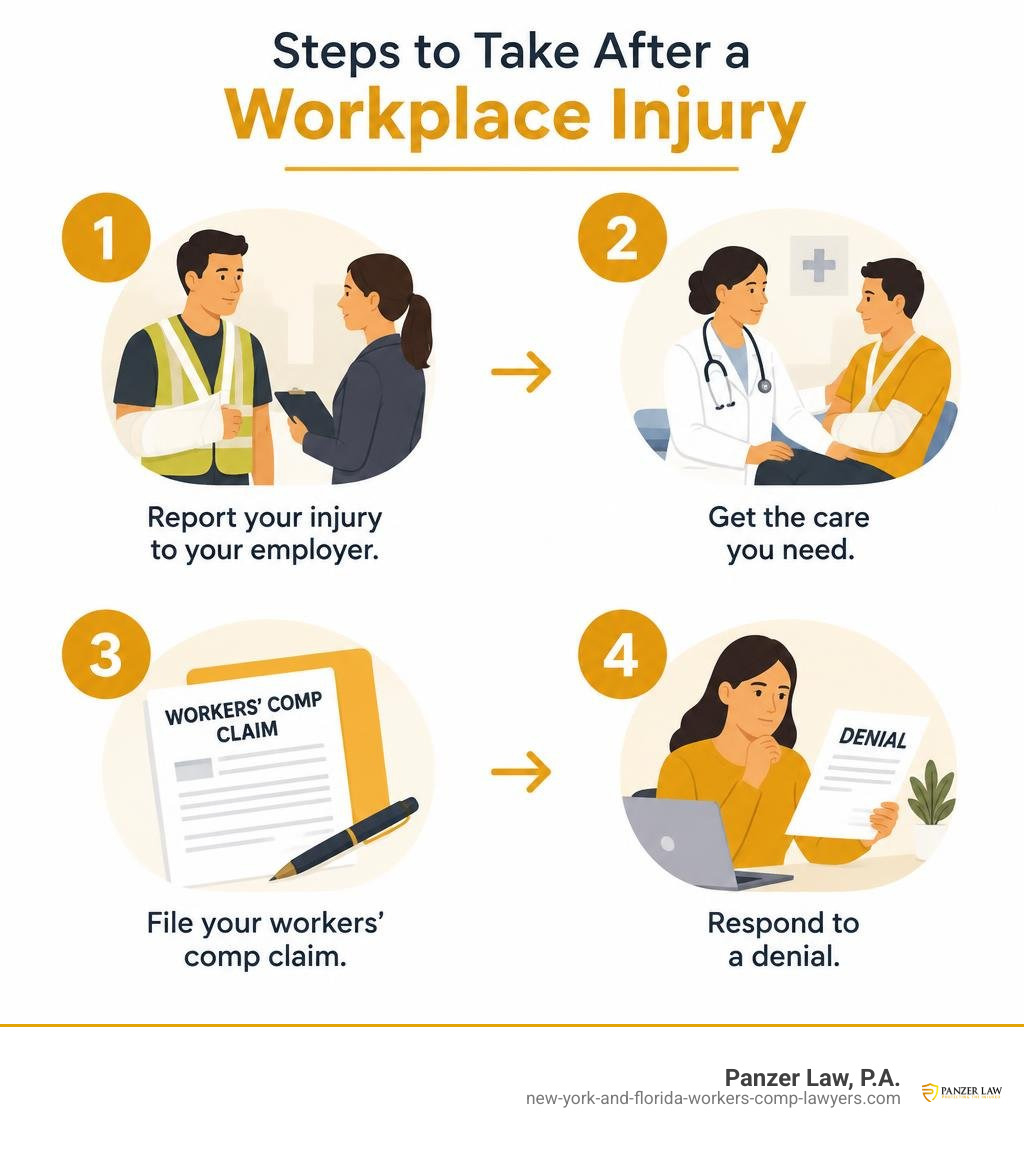
Report your injury to your employer as soon as you can. Ask how to start a workers’ compensation claim and which doctor is authorized to treat you. In New York, you have the additional right to select your doctor without asking which doctor is authorized to treat you. Get emergency care if you need it. Keep copies of your injury report, medical records, and missed-work dates. If your claim is delayed or denied, ask for the reason in writing and get help before a deadline passes.
Navigating workmans comp claims can feel overwhelming, but workers’ comp may cover medical care and part of your lost wages after a work-related injury or illness. The rules and filing deadlines depend on your state, so reporting the injury is only the first step.
I’m Gil Panzer, owner and attorney at Panzer Law, P.A. For more than 30 years, I’ve helped injured workers with workers’ comp claims, medical care, and settlements.
Understanding Eligibility and Types of Benefits Available
Workers’ compensation is a state-mandated no-fault insurance system designed to provide medical care and wage replacement to employees injured on the job. Because it is a no-fault system, you do not have to prove that your employer was negligent to receive benefits. As long as your injury or occupational illness arose out of and occurred within the scope of your employment, you are generally covered.
Most full-time, part-time, and seasonal employees are entitled to statutory coverage. However, most independent contractors, volunteers, and certain business owners are excluded. Employers sometimes intentionally misclassify workers as independent contractors to avoid paying insurance premiums, but your actual job duties determine your legal status, not merely what your employer calls you.
When an injury occurs, workers’ compensation provides several categories of benefits:
- Medical Treatment: Full coverage for all authorized doctor visits, hospital stays, physical therapy, diagnostic tests, prescriptions, and assistive medical devices.
- Out-of-Pocket and Mileage Reimbursement: Travel expenses to and from authorized medical appointments, as well as necessary out-of-pocket costs related to treatment.
- Wage Loss Benefits: Ongoing replacement of a portion of your income while you are unable to perform your regular job duties.
- Death Benefits: In tragic cases where a workplace accident results in a fatality, dependent spouses and children can recover statutory funeral expenses and ongoing financial compensation.
Temporary vs Permanent Disability Categories
Disability benefits are categorized based on whether your limitation is temporary or permanent, and whether it prevents you from working partially or entirely.
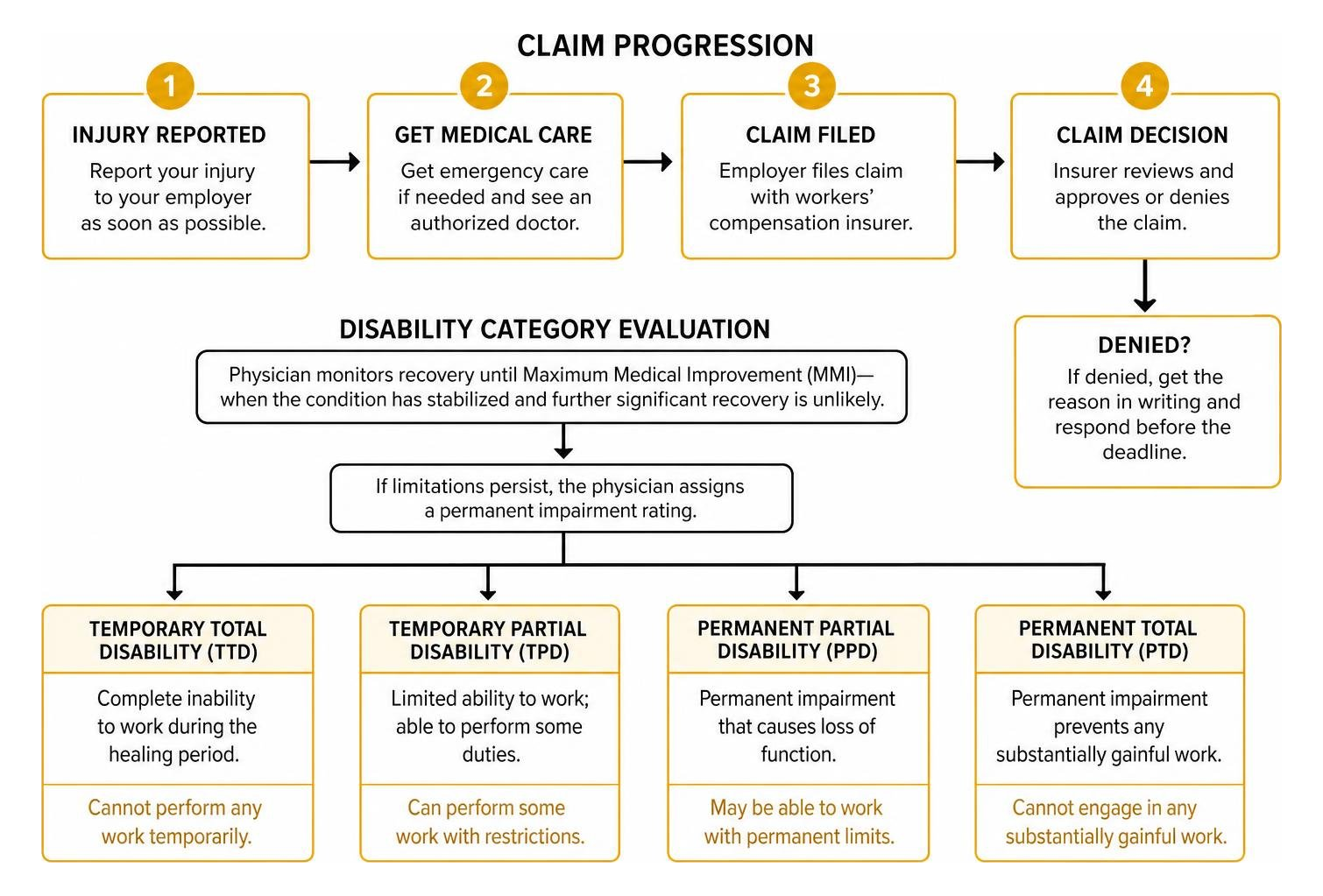
When treating your injury, your physician monitors your recovery until you reach Maximum Medical Improvement (MMI)—the point where your condition has stabilized and further significant recovery is unlikely. If limitations persist, your doctor assigns a permanent impairment rating.
| Disability Category | Description | Work Capability |
|---|---|---|
| Temporary Total Disability (TTD) | Complete inability to work during the healing period. | Cannot perform any work temporarily. |
| Temporary Partial Disability (TPD) | Ability to work restricted hours or modified duties during recovery. | Capable of light duty or limited hours. |
| Permanent Partial Disability (PPD) | Permanent functional impairment, but retaining some working capacity. | Can work with permanent physical restrictions. |
| Permanent Total Disability (PTD) | Catastrophic, lifelong injury preventing any gainful employment. | Unable to return to any form of employment. |
Wage Replacement Calculations and Waiting Periods
Wage replacement benefits are calculated using your Average Weekly Wage (AWW), which is based on your gross earnings before taxes over the period leading up to the accident. Indemnity payments typically equal up to two-thirds (66 2/3%) of your gross average weekly pay, subject to statutory minimum and maximum caps set by state law.
These income benefits are generally tax-free. Most jurisdictions enforce a short waiting period—frequently three to seven days—before wage replacement checks begin. If your disability extends past a statutory threshold (such as 14 or 21 consecutive days), benefits are paid retroactively for those initial waiting days.
Step-by-Step Process for Filing Workmans Comp Claims
Filing a claim requires specific procedural steps to ensure your benefits are authorized quickly and without insurance delays:
- Report the Accident Immediately: Inform your supervisor or employer in writing right away. Verbal reports can easily be disputed later.
- Obtain Official Documentation: Request an incident report and a copy of the state claim form.
- Seek Authorized Medical Evaluation: Attend an examination with an employer-approved physician, clearly explaining that your injury happened at work. In New York, the physician need not be employer-approved.
- Follow Up on Insurance Submission: Ensure your employer submits the First Report of Injury (FROI) to their insurance carrier within statutory reporting windows.
Critical Deadlines and Timelines for Workmans Comp Claims
Missing a statutory deadline is one of the most common reasons legitimate claims get denied. You must report your injury to your employer as soon as possible—typically within 30 days of the incident. Failing to provide timely notice can permanently bar your claim.
Formal petitions for benefits must also be filed within the applicable statute of limitations, usually within one to two years from the injury date or the date of last authorized medical treatment. If you encounter resistance or have questions about filing deadlines, consulting an experienced Florida workers’ compensation lawyer or New York workers’ compensation lawyer can often help protect your rights and ensure all documents are submitted properly.
Special Considerations for Occupational Illness and Repetitive Stress
Not all work injuries happen in a sudden accident. Occupational diseases—such as respiratory conditions from chemical exposure—and repetitive strain injuries like carpal tunnel syndrome develop gradually over months or years.
In repetitive motion and toxic exposure cases, state laws apply the “discovery rule.” Under this standard, the legal date of injury is determined by when you first experienced symptoms and knew (or reasonably should have known) that your medical condition was work-related. Documenting your work environment, physical duties, and medical evaluations is essential for establishing this causal link.
Medical Care, Physician Choice, and Returning to Work

Under workers’ comp laws, your employer’s insurance carrier generally selects the authorized treating physician, except in New York. In emergency situations, you have the right to seek immediate medical treatment at the nearest emergency room or urgent care center.
If you are dissatisfied with your treating doctor, you are often entitled to request a one-time change of physician within the insurer’s network. In New York, there normally exists no limit and you can usually select the physician of your choice.
Return-to-Work Rights, Restrictions, and Anti-Retaliation Protections
Once your authorized doctor determines you can return to work, they will issue specific physical restrictions (such as lifting limits or reduced standing). If your employer provides a valid light-duty or modified job offer that fits these restrictions, you must accept it; refusing suitable modified work can result in the suspension of your wage loss benefits.
If modified work pays less than your pre-injury wage, you may qualify for temporary partial disability benefits to bridge the difference. It is also illegal for an employer to fire, demote, or harass you simply because you filed a claim.
Managing Disputed Claims and Appeals
Insurance adjusters regularly deny claims using arguments like pre-existing conditions, late reporting, or lack of objective medical evidence. If your claim is disputed, the insurer will issue a formal Notice of Denial or Notice of Controversy.
When a dispute arises:
- Independent Medical Examinations (IMEs): The carrier may request an examination by their own medical expert to evaluate your treatment or work readiness.
- Alternative Dispute Resolution: Many state systems require non-binding mediation before scheduling a trial, giving both sides an opportunity to resolve differences.
- Formal Evidentiary Hearings: If mediation fails, your case proceeds to an administrative hearing before a workers’ compensation judge. If your injury occurred in New York, a dedicated New York workers’ compensation lawyer can represent your interests through every phase of the litigation process.
How Insurance Carriers Review and Investigate Workmans Comp Claims

Insurance adjusters work to limit the carrier’s financial exposure. Within 30 days of receiving notice, the claims administrator must generally notify you whether your claim is accepted, denied, or undergoing further investigation. If an insurer fails to timely deny a claim within statutory windows (such as 120 days in some jurisdictions), the injury may be presumed covered.
During investigations, adjusters often review past medical history, request recorded statements, and sometimes deploy private investigators to conduct video surveillance. If an outside party caused your injury (such as a negligent driver in a delivery accident), the insurer may also pursue subrogation against that third party.
Frequently Asked Questions About Workers’ Comp Claims
Can I be fired for reporting a work-related injury or filing a claim?
No. State labor and workers’ compensation statutes strictly prohibit retaliatory discharge. An employer cannot terminate, demote, or discipline an employee for reporting an on-the-job injury or exercising their legal rights under workers’ compensation laws. If you experience retaliation, you may be entitled to separate legal remedies, including lost wage damages and job reinstatement.
What should I do if my employer refuses to report my injury to their insurer?
If your employer refuses to report your injury or provide a claim form, you can file a direct petition for benefits with the state workers’ compensation board. Employers who fail to report documented injuries face administrative fines and penalties. For clear guidance on these procedures, review our frequently asked questions to understand your next steps.
Can I pursue compensation from a third party in addition to my claim?
Yes. While workers’ comp prevents you from suing your direct employer for negligence, you can pursue a third-party personal injury lawsuit if someone else contributed to your injury. Common examples include:
- A motor vehicle accident caused by a negligent driver while running a work errand.
- Defective industrial equipment manufactured by an outside company.
- Unsafe conditions caused by a subcontractor on a shared job site.
Third-party lawsuits allow you to recover damages not covered by workers’ comp, such as compensation for pain and suffering.
Conclusion: Protecting Your Rights and Securing Full Benefits
Filing a workers’ compensation claim involves strict reporting windows, authorized medical networks, and complex insurance negotiations. When insurance adjusters minimize your injuries or delay your wage replacement checks, you do not have to handle the process alone.
At Panzer Law, P.A., we protect injured workers’ rights across Florida and New York, handling claim filings, medical care disputes, and settlement negotiations. We operate on a contingency basis with no upfront costs—meaning you pay no attorney fees unless we recover benefits for you. Contact us today for a free case evaluation.
