

Find a Florida Workers’ Comp Lawyer for Your Claim
Understanding Florida Workers’ Compensation Rights and Benefits
If you were hurt on the job, a Florida workers compensation lawyer can help you secure medical care and wage replacement benefits while you focus on recovery. An attorney handles reporting deadlines, disputes with the insurance carrier, and settlement negotiations so you do not have to manage the claim alone.
Under Chapter 440 of the Florida Statutes, workers’ compensation operates as a no-fault system. This structure is designed to provide prompt medical treatment and wage replacement benefits to injured employees without requiring them to prove fault against their employer. In exchange for these guaranteed statutory benefits, employers receive immunity from standard personal injury lawsuits—a concept known as the exclusive remedy rule.
Coverage mandates apply broadly across the state. In Florida, non-construction employers with four or more employees must carry workers’ compensation coverage, while construction businesses must secure coverage if they employ one or more workers.
When you suffer a work-related injury, your benefits primarily fall into two categories:
- Medical Benefits: The insurance carrier must pay for all reasonable and necessary medical care related to the injury. This includes emergency treatment, doctor visits, diagnostic imaging, physical therapy, prescription medications, medical devices, and travel reimbursement for medical appointments.
- Indemnity (Lost Wage) Benefits: If your injury prevents you from working or limits your earning capacity, you are entitled to wage replacement payments. These payments are calculated based on your Average Weekly Wage (AWW), which generally reflects your gross earnings over the 13 weeks preceding the accident. Typically, disability payments equal 66 2/3% of your AWW, subject to statutory maximums set by state law.
| Disability Benefit Category | Eligibility Criteria | Benefit Rate & Duration | Primary Purpose |
|---|---|---|---|
| Temporary Total Disability (TTD) | The authorized doctor certifies you are completely unable to work during recovery. | 66 2/3% of your AWW (up to 80% for specific severe injuries) for up to 104 weeks. | Replaces lost income while you are completely sidelined from all employment. |
| Temporary Partial Disability (TPD) | You are released to light duty with restrictions, but earn less than 80% of your pre-injury wage. | Up to 64% of the difference between your pre-injury AWW and your current earnings (up to 104 weeks combined). | Bridges the wage gap when you return to restricted, lower-paying work. |
| Permanent Impairment Benefits (IB) | You reach Maximum Medical Improvement (MMI) but have lasting physical limitations. | Paid weekly based on your assigned impairment percentage and your AWW calculation. | Compensates you for permanent anatomical loss or functional impairment. |
| Permanent Total Disability (PTD) | You suffer catastrophic injuries or cannot perform even sedentary work within a 50-mile radius. | 66 2/3% of your AWW paid until age 75 (or for life in certain catastrophic cases). | Provides long-term financial security when you are permanently disabled from the workforce. |
Eligibility and Covered Workplace Injuries
Every year, employers report roughly 2.5 million nonfatal workplace injuries across various industries. To qualify for benefits, an individual must hold recognized employee status and suffer an accidental injury arising out of and in the course of employment. Covered scenarios encompass:
- Acute Traumatic Accidents: Slipped disks, bone fractures, torn ligaments, and concussions caused by falls, equipment mishaps, or motor vehicle crashes while performing job duties.
- Repetitive Trauma Injuries: Progressive physical damage resulting from continuous physical stress, such as carpal tunnel syndrome, tendonitis, or chronic spinal wear.
- Occupational Illnesses: Diseases or respiratory ailments triggered by exposure to toxic substances, dust, mold, or hazardous chemicals in the work environment.
- Construction and Industrial Hazards: Severe injuries sustained from scaffolding collapses, heavy machinery malfunctions, falling debris, or electrical burns.
Disability Classifications and Impairment Ratings
Once your medical recovery plateaus, your authorized physician will determine that you have reached Maximum Medical Improvement (MMI). Reaching MMI means your condition is not expected to improve significantly with further treatment.
At MMI, the physician evaluates your physical restrictions and assigns a Permanent Impairment Rating (PIR) using the Florida Uniform Permanent Impairment Rating Schedule or the relevant AMA Guides. This percentage reflects your lasting anatomical loss. A difference of even a few percentage points—such as an 8% versus a 12% rating—can alter the total financial payout you receive in impairment benefits. If your injuries are so severe that you can never return to any form of employment, you may qualify for permanent total disability benefits.
Crucial Deadlines and Medical Protocols in Florida Claims
Navigating a Florida workers’ compensation claim requires strict adherence to statutory deadlines and medical procedures. Missing a reporting window can result in an immediate forfeiture of your right to benefits.
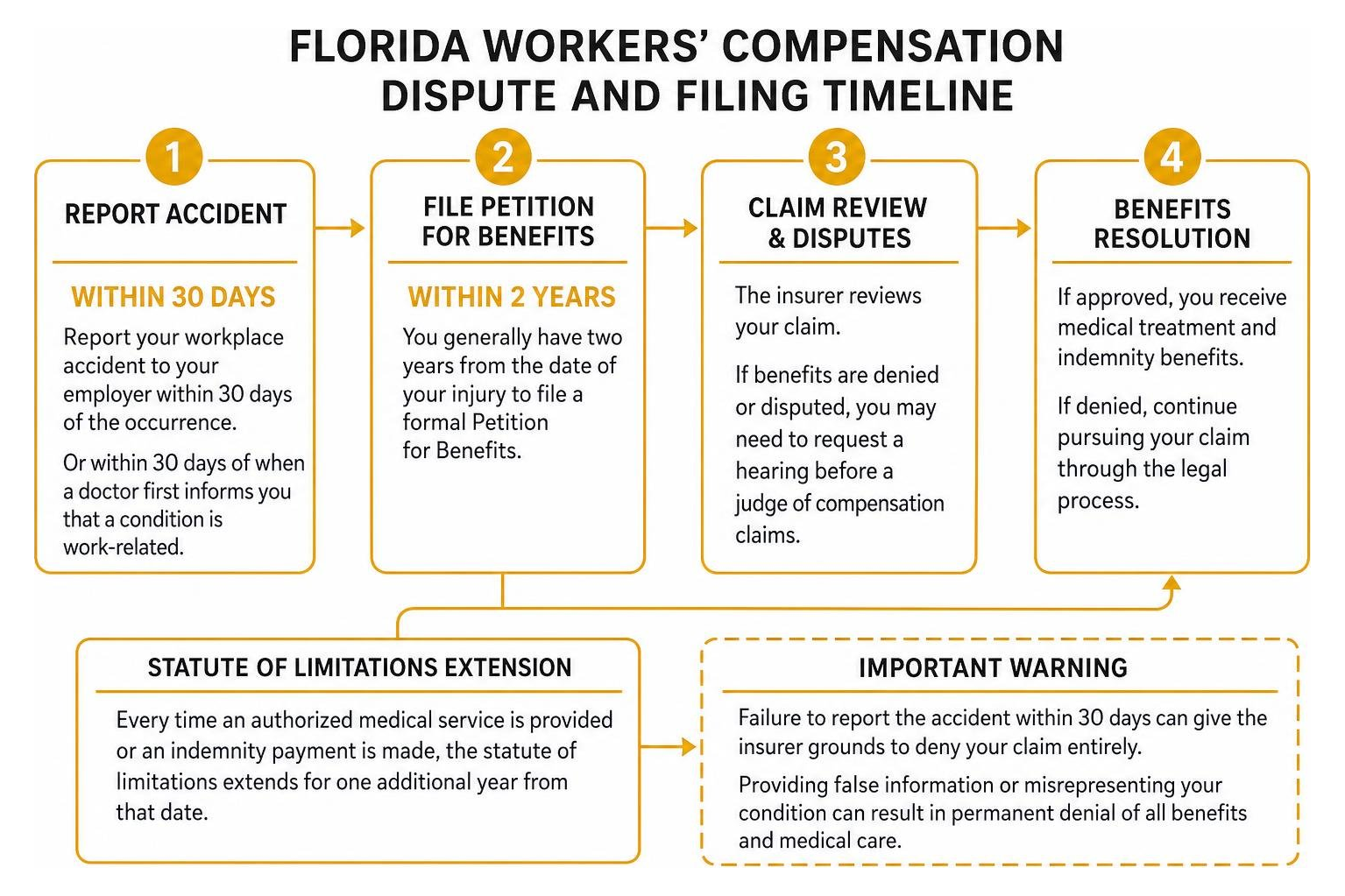
Under Florida law, you must report your workplace accident to your employer within 30 days of its occurrence (or within 30 days of when a doctor first informs you that a condition is work-related). Failure to provide timely notice gives the insurer grounds to deny your claim entirely.
Furthermore, you generally have two years from the date of your injury to file a formal Petition for Benefits. However, every time an authorized medical service is provided or an indemnity payment is made, the statute of limitations extends for one additional year from that date.
Accuracy and honesty throughout this process are critical. Florida courts strictly enforce fraud provisions: if an injured worker knowingly misrepresents symptoms or physical capacities to secure benefits, all compensation and medical care can be permanently terminated.
Navigating the Authorized Treating Physician System
Florida allows the employer’s insurance carrier to select the Authorized Treating Physician (ATP) who manages your care. Because the insurer chooses the doctor, workers often face conservative treatment plans or early releases back to full-duty work.
However, under Florida Statute Section 440.13, you hold a one-time right to request a change of physician during your claim. When you make this written request:
- The insurance carrier must authorize a new physician within 14 calendar days.
- If the carrier fails to provide an authorized replacement doctor within that 14-day window, you gain the legal right to select your own physician, and the insurer must cover the cost.
If major disputes arise regarding your physical capacity or recommended surgical procedures, an Independent Medical Examination (IME) may be requested to establish an objective evaluation before a judge.
What to Do Immediately Following a Job Site Injury
To protect your legal rights and personal health after an accident, follow these essential steps:
- Obtain Immediate Medical Attention: In an emergency, seek urgent medical treatment immediately. Inform the emergency room staff that your injury occurred on the job.
- Notify Your Employer in Writing: Report the exact details of the incident to your supervisor within 30 days, and keep a signed, dated copy of your incident report.
- Obtain Authorized Physician Details: Ask your employer or their carrier for the contact information of their approved medical network.
- Follow Doctor’s Orders Faithfully: Attend all therapy sessions and medical consultations, and strictly obey work restrictions.
- Collect Crucial Records: Preserve copies of your pay stubs, written doctor notes, work status slips, mileage logs to appointments, and all correspondence with insurance adjusters.
Why You Need a Workers Compensation Lawyer in Florida
Insurance carriers are for-profit corporations focused on minimizing claim payouts. Adjusters frequently dispute wage calculations, delay specialist authorizations, or claim an injury is linked to a pre-existing condition rather than your job duties. Working with a qualified lawyer ensures your interests are protected by someone who understands the intricacies of Chapter 440.
Having experienced counsel is vital in major business centers like Miami, where commercial and industrial work environments create complex claims. If you are injured in South Florida, partnering with a Miami workers compensation lawyer ensures your claim is handled by advocates familiar with local administrative judges and medical provider networks.
Handling Claim Denials and Petitions for Benefits
When an insurance carrier denies care or cuts off wage replacement, your attorney initiates formal dispute proceedings by filing a Petition for Benefits with the Office of the Judges of Compensation Claims (OJCC).
Once the petition is filed, the process moves forward through defined administrative steps:
- Carrier Response: The carrier must either provide the requested benefits or file a formal response within 14 days detailing its legal defense.
- State Mediation: A state-mandated mediation conference is scheduled. A neutral mediator attempts to help both sides resolve the disputed issues without trial.
- Pretrial and Final Hearing: If mediation does not resolve the issue, a Judge of Compensation Claims conducts a final hearing, reviews medical depositions and payroll evidence, and issues a binding legal ruling.
Evaluating Third-Party Lawsuits vs. Exclusive Remedy
While the exclusive remedy doctrine prevents you from suing your direct employer for standard negligence, it does not bar claims against negligent third parties. A third-party personal injury lawsuit can run parallel to your workers’ compensation case if an outside entity contributed to your injury.
Common third-party liability scenarios include:
- A motor vehicle accident caused by a negligent driver while you were driving for work.
- Defective industrial equipment or toxic chemicals produced by an outside manufacturer.
- Negligence by a general contractor or separate subcontractor on a multi-employer construction job site.
Third-party lawsuits allow you to pursue compensation not available through workers’ comp alone, including damages for pain, suffering, and full future wage loss. However, these recoveries are subject to Florida comparative fault rules and statutory workers’ compensation liens, making coordinated legal representation critical.
Hiring and Working with an Attorney for Your Claim
Securing experienced legal counsel allows you to focus on physical recovery while your legal team manages deadlines, medical disputes, and carrier negotiations. Whether you need a Boca Raton workers compensation lawyer or a West Palm Beach workers compensation lawyer, selecting an attorney with focused Florida experience makes a direct difference in the outcome of your claim.
When to Hire a Workers Compensation Lawyer in Florida
You should consult legal counsel immediately if you encounter any of the following obstacles:
- The insurance carrier denies your claim or alleges your injury was caused by a pre-existing condition.
- The adjuster miscalculates your Average Weekly Wage, resulting in underpaid checks.
- Recommended surgeries, diagnostic MRIs, or specialist appointments are stalled or refused.
- You face employer retaliation, threats of termination, or harassment after reporting your injury.
- Your injuries are catastrophic, involving spinal trauma, severe burns, or traumatic brain injuries.
Understanding Contingency Fees and No-Recovery Guarantees
Injured workers are often concerned about the cost of hiring legal representation. At Panzer Law, P.A., we operate entirely on a contingency fee schedule governed by Florida Statute Section 440.34.
This means:
- You pay zero upfront retainers or hourly fees.
- Attorney fees are contingent upon securing a financial recovery or winning contested benefits.
- If we do not recover money or secure benefits on your behalf, you owe us nothing.
- Any legal fees deducted from a settlement must be reviewed and approved by a Judge of Compensation Claims to ensure fairness and statutory compliance.
How a Workers Compensation Lawyer in Florida Maximizes Case Settlements
Workers’ compensation claims often conclude with a lump-sum settlement, frequently referred to as a “washout” or “full and final settlement.” In exchange for a one-time payment, you release the insurer from future wage and medical obligations.
Settling is an important strategic decision with clear trade-offs:
- Pros of Settling: You receive an immediate lump sum of cash, gain total control over your medical choices without insurance adjuster interference, and close out open litigation.
- Cons of Settling: You permanently forfeit the right to demand additional medical treatments or indemnity payments from the insurer if your medical condition worsens down the road.
An experienced attorney accurately values your future medical costs, evaluates past wage loss deficits, and negotiates directly with insurance defense teams to pursue maximum settlement value.
Frequently Asked Questions
Our team regularly addresses important inquiries regarding workplace injuries and administrative claims. For additional topics, browse our comprehensive frequently asked questions page.
Can I be fired for filing a workers’ compensation claim in Florida?
No. Florida Statute Section 440.205 explicitly prohibits employers from discharging, threatening to discharge, or intimidating any employee for claiming or attempting to claim workers’ compensation benefits. If an employer fires you in retaliation for asserting your statutory rights, you may file a separate wrongful termination and retaliation lawsuit to pursue compensatory and civil damages.
What mistakes can jeopardize my Florida workers’ compensation claim?
The most common mistakes that harm an otherwise valid claim include:
- Failing to notify your employer within the 30-day reporting window.
- Seeking unauthorized medical treatment from your personal physician without prior carrier approval.
- Exaggerating symptoms or giving inconsistent accounts of how the accident happened.
- Posting physical activities or vacation photos on social media, which insurance investigators routinely monitor.
- Missing scheduled therapy appointments or failing to follow medical restrictions.
What should I bring to my initial workers’ comp legal consultation?
To help us evaluate your claim quickly, bring all relevant records you have gathered, including:
- Copies of the written accident or incident report provided to your employer.
- Pay stubs, W-2 forms, or payroll printouts from the 13 weeks preceding your accident.
- Medical notes, diagnostic reports, and discharge paperwork from all doctors you have seen.
- Work status slips documenting physical restrictions or light-duty orders.
- Letters, denial notices, or email correspondence received from the insurance carrier.
Conclusion
A sudden workplace injury can upend your physical well-being, your career, and your financial stability. You do not have to confront insurance defense adjusters and complex administrative statutes alone.
At Panzer Law, P.A., we represent injured workers throughout Palm Beach County, Miami-Dade County, and across South Florida. We handle communication with insurance companies, dispute benefit denials, and pursue the full medical care and financial compensation you are entitled to under Florida law.
Contact us today to schedule your free, confidential consultation with a trusted Florida workers compensation lawyer. Under our no-recovery, no-fee guarantee, you pay nothing unless we recover compensation for your claim.
