

Florida Workers’ Comp Lawyer: Claim Representation Guide
Florida Workers’ Compensation System: Coverage and Employer Mandates
A Florida workers’ compensation lawyer helps injured workers secure medical care, wage replacement, and overcome claim disputes under Florida law. Florida operates under Chapter 440 of the Florida Statutes, which establishes a no-fault administrative system for workplace injuries. Under this doctrine, injured employees do not have to prove that employer negligence caused their injury to receive benefits. In exchange for this guaranteed access to medical treatment and wage replacement, workers surrender their common-law right to sue their employers for negligence.
While the no-fault concept sounds straightforward, navigating statutory thresholds, insurance carrier requirements, and managed care networks is rarely simple. Whether you live in bustling urban centers across Florida or work in suburban industrial corridors, understanding how state law governs workplace injury coverage is crucial when asserting your rights under workers’ compensation in Florida.
Employer Insurance Requirements Across Florida Industries
Coverage thresholds under Florida law depend heavily on the industry and the size of the employer:
- Construction Industry: Because of heightened hazards on job sites, employers with one or more employees (including the business owner or corporate officers) must carry workers’ compensation coverage.
- Non-Construction Businesses: Commercial operations outside construction must maintain insurance if they employ four or more individuals.
- Agricultural Sector: Agricultural employers must carry coverage if they employ six or more regular employees, or twelve or more seasonal workers who work at least 30 days during a season.
Corporate officers in non-construction businesses may elect to exempt themselves from coverage by filing an exemption with the state. In construction, exemptions are strictly limited to up to three corporate officers per entity, each owning at least 10% of the business.
When businesses fail to secure mandatory coverage, the Florida Division of Workers’ Compensation issues Stop-Work Orders, forcing operations to halt until the employer complies and pays substantial statutory penalties—often calculated at two times the amount the employer would have paid in premium over the prior two years.
Covered Workplace Accidents and Occupational Conditions
Florida’s system covers a wide range of job-related conditions occurring during the course and scope of employment:
- Slip, Trip, and Fall Accidents: Falls from ladders, scaffolding, wet floors in hospitality settings, or uneven surfaces.
- Overexertion and Heavy Lifting: Acute muscle tears, disc herniations, and spinal trauma caused by lifting heavy materials or machinery.
- Machinery and Crushing Incidents: Entanglement injuries, fractures, and severe lacerations from industrial equipment.
- Repetitive Trauma: Carpal tunnel syndrome, joint wear, and spinal degeneration developed over extended periods of repetitive job duties.
- Toxic and Chemical Exposures: Occupational illnesses arising from inhalation of toxic fumes, dust, or skin contact with dangerous chemicals.
Mental or nervous injuries without an accompanying physical injury requiring medical attention are generally not compensable under Florida law, unless specific statutory criteria are met (such as certain first responder PTSD claims).
Steps to File a Claim and Key Florida Statutory Deadlines

Securing your statutory benefits requires immediate action, strict adherence to notice rules, and thorough documentation. The path from initial accident to receiving full benefits involves precise deadlines that can make or break your case.
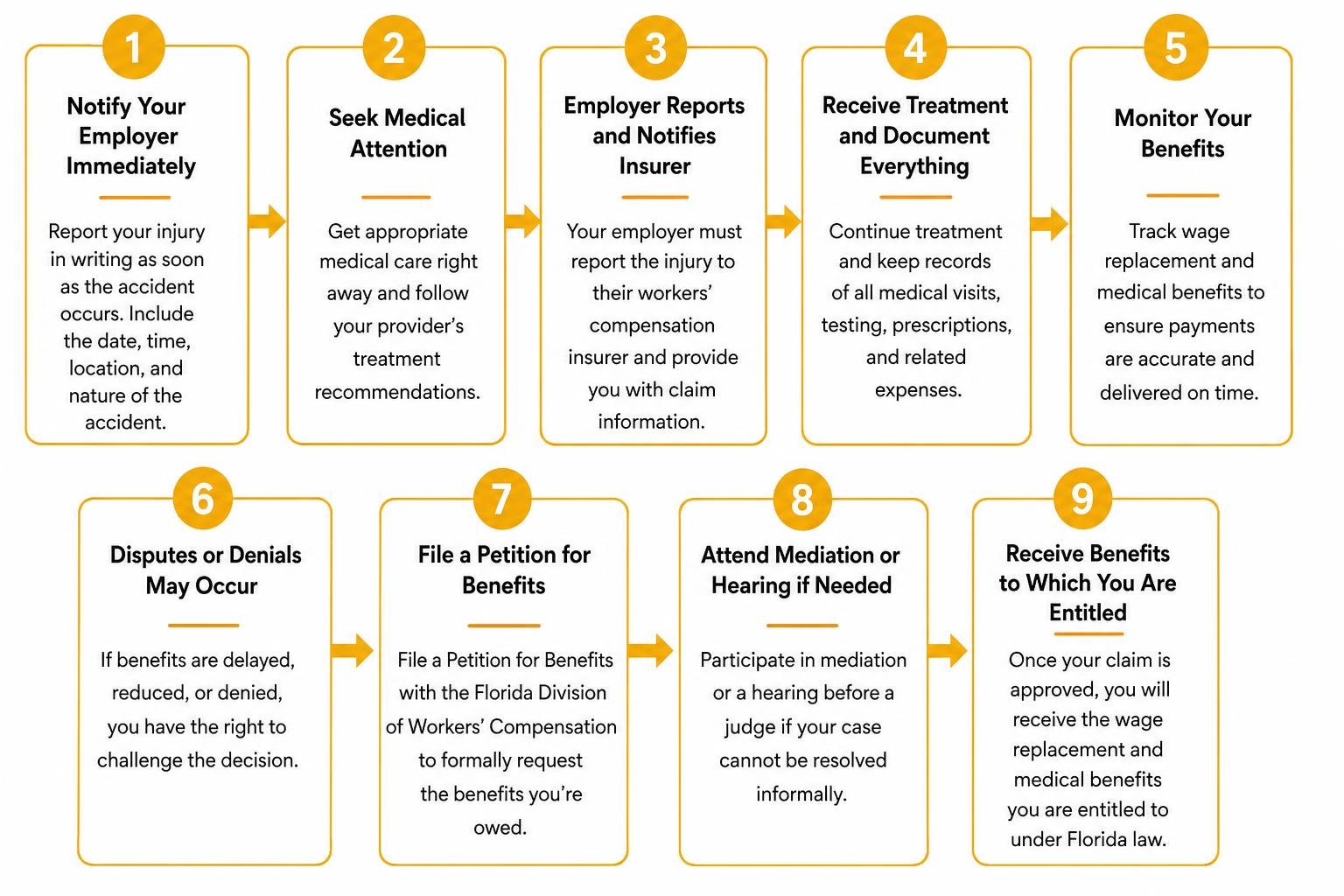
If you encounter delays or pushback after reporting an injury in Miami-Dade County, consulting an experienced Miami workers’ compensation lawyer early on ensures your documentation is preserved and deadlines are met.
Immediate Actions Following a Work-Related Accident
- Notify Your Employer Immediately: Report your injury to your supervisor or HR department in writing as soon as the accident occurs. Clearly state the date, time, location, and nature of the accident.
- Seek Emergency Medical Attention If Necessary: In life-threatening emergencies, visit the nearest emergency room. Inform hospital staff that the accident occurred while performing your job duties.
- Request Authorized Care: For non-emergency care, request that your employer or their carrier designate an authorized treating physician. Seeking unauthorized care outside true emergencies can leave you responsible for medical bills.
- Preserve Documentation: Retain copies of your First Report of Injury (Form DFS-F2-DWC-1), all medical discharge notes, work status slips (DWC-25), prescriptions, and recent pay stubs.
Critical Timelines Under Florida Workers’ Comp Law
- The 30-Day Notice Rule: Under Section 440.185, Florida Statutes, you must report your workplace injury to your employer within 30 days of the date of the accident or within 30 days of when a medical professional diagnoses you with a job-related occupational disease or repetitive trauma condition.
- Carrier Response Period: Once reported, the employer must submit the claim to their carrier within seven days. The insurance carrier then has 14 days to provide you with an informational brochure and initiate payments or issue a Notice of Denial.
- The Two-Year Statute of Limitations: You generally have two years from the date of the injury to file a formal Petition for Benefits (PFB) with the Office of the Judges of Compensation Claims (OJCC).
- Tolling Provisions: After the initial two-year period, the statute of limitations is extended (tolled) for one year each time the carrier provides authorized medical care or indemnity payments.
Florida Workers’ Comp Benefits: Wage Replacement and Disability Ratings
Florida workers’ compensation provides two main forms of relief: medical care and indemnity (wage replacement) benefits. Indemnity benefits are calculated using your Average Weekly Wage (AWW) and Compensation Rate (CR).
| Benefit Type | Qualifying Criteria | Compensation Rate | Maximum Statutory Duration |
|---|---|---|---|
| Temporary Total Disability (TTD) | Authorized doctor states you cannot work at all while recovering | 66.67% of AWW (up to 80% for specific severe trauma) | 104 weeks |
| Temporary Partial Disability (TPD) | Released to light duty with restrictions, earning less than 80% of pre-injury AWW | 80% of difference between 80% of pre-injury AWW and current earnings | 104 weeks (combined with TTD) |
| Permanent Impairment Benefits (IB) | Assigned an impairment rating upon reaching Maximum Medical Improvement (MMI) | 75% of average weekly compensation rate | Number of weeks scales with assigned rating percentage |
| Permanent Total Disability (PTD) | Catastrophic physical or neurological condition permanently preventing sedentary work | 66.67% of pre-injury AWW | Payable up to age 75 (or lifetime for severe catastrophic injuries) |
If you are dealing with complex disability rating disputes in Palm Beach County, partnering with a West Palm Beach workers’ compensation lawyer helps protect your right to accurate wage replacement calculations.
Medical Coverage and Authorized Physician Rules
Your employer’s workers’ compensation insurance carrier covers all reasonable, medically necessary treatment related to your work injury, including diagnostic imaging (MRIs, X-rays), surgical procedures, physical therapy, assistive devices, and prescription drugs.
However, you must be treated by insurance-authorized medical providers. Under Florida law, you are entitled to a one-time change of physician during your claim. If you make this written request, the carrier must authorize a new doctor within 14 calendar days. If they fail to provide an alternate doctor within that 14-day window, you acquire the legal right to select your own physician, and the carrier must pay for the care.
Calculating Wage Replacement and Permanent Disability Ratings
Your Average Weekly Wage (AWW) is established by averaging your gross earnings over the 13 consecutive weeks preceding your injury date. The standard compensation rate is 66.67% of this average, capped by Florida’s annual statutory maximum compensation rate.
Once your healing plateaus, your treating physician declares that you have reached Maximum Medical Improvement (MMI). At this stage:
- The physician assigns a Permanent Impairment Rating (PIR) using the Florida Uniform Permanent Impairment Rating Schedule.
- Each percentage point of impairment translates into a specific number of weeks of Impairment Benefits payable to you.
- Even after reaching MMI, you remain entitled to ongoing palliative medical care for your injury, provided you visit an authorized physician at least once every 12 months to keep your claim open.
Why You Need a Florida Workers’ Compensation Lawyer for Your Claim
Insurance companies are profit-driven corporations represented by skilled adjusters and defense lawyers who work to limit claim costs. A licensed lawyer specializing in workers’ compensation balances the scales, protecting your financial and medical recovery.
If you are facing claim pushback in southern Palm Beach County, working alongside a Boca Raton workers’ compensation lawyer ensures you do not accept inadequate settlements or premature benefit cutoffs.
How a Florida Workers’ Compensation Lawyer Overcomes Claim Denials
Insurance carriers frequently deny valid claims using various defenses:
- Major Contributing Cause (MCC): Carriers argue that a pre-existing degenerative condition, rather than the workplace accident, is more than 50% responsible for your current symptoms.
- Late Reporting: Alleging that you failed to report the accident within the mandatory 30-day window.
- Deviation from Employment: Claiming that you were engaged in horseplay or personal activities when injured.
- Intoxication Defense: Claiming drug or alcohol involvement without proving that the substance caused the accident.
We counter these denials by gathering objective diagnostic findings, deposing authorized medical providers, securing independent medical examinations (IMEs), and demonstrating clear workplace causation under Chapter 440.
Resolving Disputes with the OJCC and Division of Workers’ Compensation
When informal discussions with the insurance carrier fail, we file a formal Petition for Benefits with the Office of the Judges of Compensation Claims (OJCC). This triggers a formal dispute resolution framework:
- Carrier Response: The carrier must either provide the requested benefits or file a detailed response within 14 days.
- State Mediation: The OJCC schedules a mandatory mediation conference where both parties, accompanied by a state mediator, attempt to settle the disputed benefits.
- Pre-Trial and Final Merit Hearing: If mediation does not resolve the issue, the case proceeds before a Judge of Compensation Claims (JCC), who hears witness testimony, reviews medical evidence, and issues a binding final order.
Understanding Attorney Fees with a Florida Workers’ Compensation Lawyer
Injured workers often worry about the cost of legal representation. At Panzer Law, P.A., we operate entirely on a contingency fee basis. Under this model:
- You pay zero upfront costs or retainers.
- We charge no attorney fees unless we successfully recover indemnity benefits, overturn denials, or negotiate a settlement for you.
- Following the Florida Supreme Court’s landmark ruling in Castellanos v. Next Door Co., when an insurance carrier wrongfully denies benefits and we force them to provide those benefits through litigation, the carrier may be ordered by the judge to pay our attorney fees directly.
Frequently Asked Questions About Florida Workers’ Comp Claims
For answers to common procedural and benefit questions, explore our detailed frequently asked questions page or review key topics below.
What is the 30-day injury reporting deadline in Florida?
Under Florida Statute § 440.185, you must notify your employer within 30 days of the injury date. Failure to report within this timeframe can result in complete forfeiture of your right to workers’ comp benefits, unless the employer had actual knowledge of the incident or exceptional circumstances prevented timely notice.
Can an injured employee select their own treating physician?
In non-emergency circumstances, the workers’ compensation insurance carrier holds the initial right to select and authorize your medical providers. However, you can invoke your statutory right to a one-time change of physician in writing. If the insurer fails to provide an alternate doctor within 14 days of your written request, you gain the right to choose your own physician.
How is the Average Weekly Wage (AWW) calculated in Florida?
Your AWW is calculated by adding all gross wages earned during the 13 weeks immediately before your accident and dividing that total by 13. This calculation includes overtime, bonuses, and concurrent earnings from a second job if you were working multiple positions at the time of injury.
Conclusion
A serious workplace injury disrupts your physical health, everyday routine, and financial stability. You do not have to confront complex insurance guidelines, aggressive adjusters, and dense administrative statutes alone.
At Panzer Law, P.A., our team brings more than 30 years of focused workers’ compensation experience to every case we handle. We take pride in protecting injured workers across Miami-Dade County and Palm Beach County, helping you recover authorized medical care and the wage benefits you are owed.
Contact our dedicated team today to schedule your free, no-obligation consultation with an experienced Florida workers’ compensation lawyer. We work on a strict no-recovery, no-fee model—you pay nothing unless we recover compensation for you.
