

Key Criteria for Selecting the Best Workers Comp Lawyer
Finding the right advocate after a workplace injury requires cutting through standard advertising and examining real credentials. An injury on the job disrupts your physical well-being, your income, and your family’s financial stability. To protect your future, you need representation that understands the detailed procedural rules of state workers’ compensation systems.
When you look to find a Florida workers comp lawyer for your claim, you should evaluate four fundamental pillars: specialized legal knowledge, extensive administrative trial experience, clean professional standing, and verified peer recognition.
Board Certification and Trial Experience
Workers’ compensation is not general personal injury law. It is governed by separate statutory frameworks, administrative hearing offices, and specialized judges. Board certification represents the highest independent evaluation of an attorney’s competence.
State bar programs evaluate attorneys based on substantial case involvement, formal peer review by judges and opposing counsel, and rigorous written testing. In many states, fewer than five percent of all licensed practitioners ever achieve board certification in workers’ compensation.
Beyond formal credentials, real courtroom and administrative hearing experience matters. While most claims settle, insurance adjusters know which attorneys regularly take disputed claims to final hearings and which ones accept minimal offers to avoid a trial.
Whether your case involves administrative hearings before state compensation commissions or appeals to district courts of appeal, your attorney must possess the trial acumen needed to litigate complex medical causation issues effectively. Understanding safety regulations, such as municipal standards like the City of Raton municipal safety standards or federal workplace rules, helps build an airtight foundation when establishing occupational injuries.
Specialist vs. Generalist: Why You Need the Best Workers Comp Lawyer
Hiring a general practice lawyer for a disputed workers’ compensation claim can be compared to seeing a family doctor for complex open-heart surgery. A general practitioner might handle divorces on Monday, traffic violations on Tuesday, and personal injury on Wednesday.
In contrast, dedicated workers’ compensation attorneys spend their careers navigating:
- Exact average weekly wage calculations and benefit adjustments
- The nuances of authorized treating physicians versus independent medical examiners
- Rebutting claims of pre-existing medical conditions
- Establishing causation for repetitive trauma or catastrophic injuries
Attorneys who have a background in insurance defense provide an added advantage. Knowing how insurance adjusters, claims managers, and defense attorneys evaluate risk enables your legal team to anticipate their strategies. When you search to find local workmans comp lawyers near you, prioritize law firms that devote their daily legal energy entirely to workers’ advocacy.
Peer Recognitions, Avvo Ratings, and Client Reviews
Objective professional indicators provide clear insight into an attorney’s reputation within the legal community. Look for:
- Avvo Ratings: An Avvo 10.0 “Superb” rating indicates an exemplary track record, recognized ethical standards, and significant legal experience.
- Super Lawyers & Leading Lawyers: These independent, peer-influenced rating systems highlight practitioners who have earned the esteem of both their colleagues and opposing counsel.
- Verified Client Reviews: Reading accounts reveals how responsive an attorney is, how clearly they explain complex medical-legal steps, and how fiercely they fight for fair settlement values.
Comparing Dedicated Representation Against Self-Filing and General Practice
Navigating a claim alone or relying on non-specialized counsel often leads to forfeited benefits. Insurance companies employ adjusters and legal defense teams whose primary role is to minimize claim payouts.
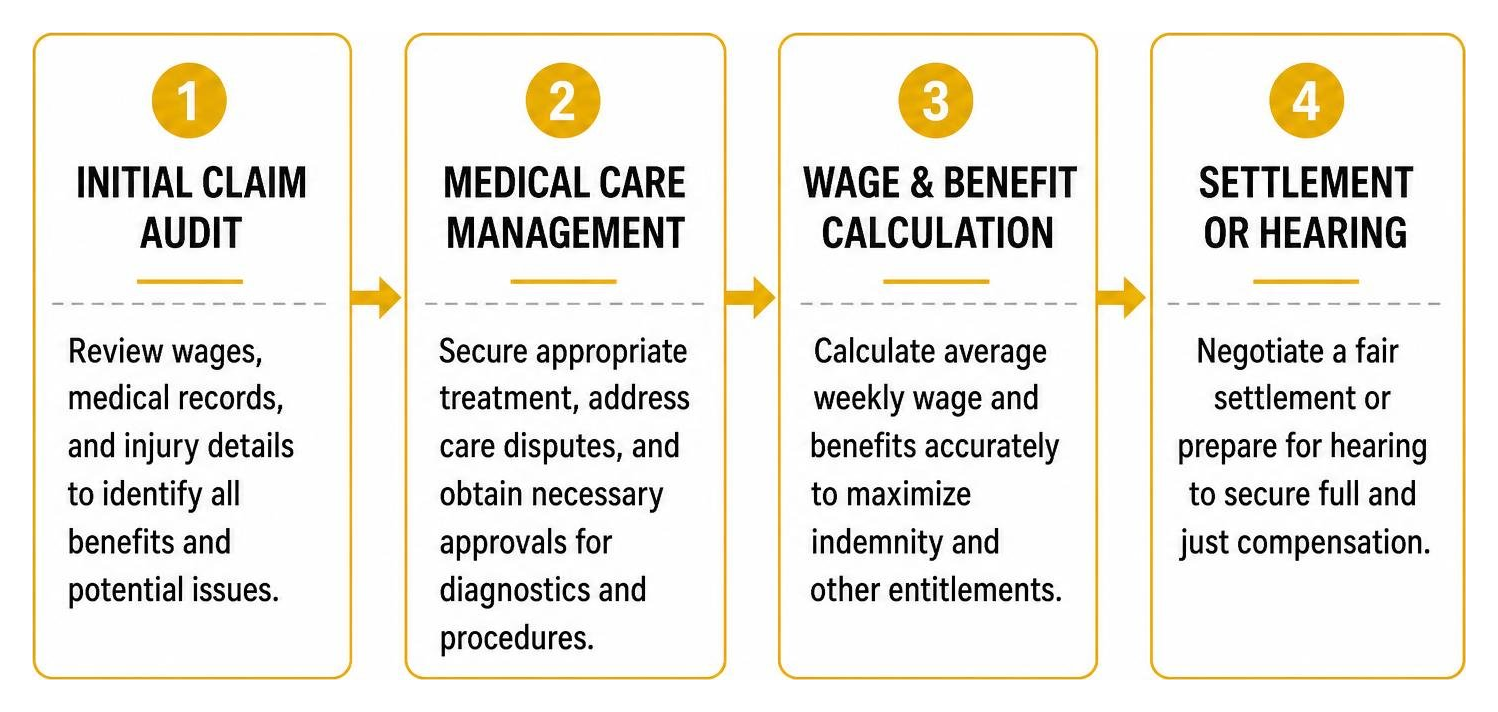
The following breakdown illustrates why dedicated legal representation makes a substantial difference across every stage of a claim:
| Feature / Benefit Stage | Self-Representation | General Practice Attorney | Dedicated Workers’ Comp Specialist |
|---|---|---|---|
| Initial Claim Audit | Unlikely; missed wage calculations and overlooked injury listings | Basic overview; may overlook secondary conditions | Comprehensive analysis of wages, medical needs, and potential penalties |
| Medical Care Disputes | Limited ability to challenge insurer-directed doctor opinions | May request hearings without specialized medical discovery | Deposes medical experts, challenges denials, and forces diagnostic approvals |
| Wage Calculation (AWW) | Accepts carrier numbers without verifying overtime or perks | Checks base pay, frequently misses statutory fringe adjustments | Audits 13-week pre-injury wages to ensure maximum statutory checks |
| Settlement Valuation | High risk of accepting lowball settlements that close medical rights | Standard settlement based on current bills only | Analyzes future medical exposure, indemnity caps, and Medicare requirements |
| Hearing & Trial Readiness | Easily overwhelmed by formal administrative procedures | Infrequent appearances before workers’ compensation judges | Regular appearances before judges; deep familiarity with defense tactics |
Contingency Fee Structures and the No Win, No Fee Model
The financial strain of an injury should never prevent you from obtaining top legal representation. Reputable workers’ compensation lawyers work on a contingency fee arrangement, commonly known as a “no win, no fee” model.
Under this structure:
- Zero Upfront Costs: You do not pay hourly retainers, upfront consultation fees, or out-of-pocket charges to start your case.
- Statutory Fee Alignment: Legal fees are calculated strictly as a state-regulated percentage of the financial benefits or settlement secured on your behalf.
- No Recovery, No Fee: If your legal team does not successfully obtain compensation or secure past-due benefits for you, you do not owe attorney fees.
This model aligns your attorney’s incentives directly with your success, ensuring every dollar of your statutory benefit package is pursued.
How the Best Workers Comp Lawyer Maximizes Benefit Types
A specialist does not merely ensure checks arrive; they work to optimize the full spectrum of statutory benefits available under the law. Our comprehensive Florida workers comp lawyer claim representation guide outlines how these key recovery categories are established and protected:
- Temporary Total Disability (TTD): Paid when an authorized physician states you cannot work during your recovery period.
- Temporary Partial Disability (TPD): Paid when you return to light-duty work but earn less than your pre-injury wage due to medical restrictions.
- Permanent Partial Disability (PPD) / Impairment Benefits: Calculated once you reach Maximum Medical Improvement (MMI), based on the permanent physical impairment rating assigned to your injury.
- Permanent Total Disability (PTD): Crucial lifetime wage replacement for workers who sustain catastrophic injuries that permanently prevent them from returning to any gainful employment.
- Average Weekly Wage (AWW) Recalculation: Carriers often improperly omit overtime, bonuses, or concurrent employment wages. Correcting an AWW mistake directly increases every future weekly disability payment and your final settlement value.
Navigating Initial Consultations and Avoiding Costly Claim Mistakes
The beginning of a claim often sets the trajectory for its ultimate outcome. Seeking early counsel ensures critical evidence is preserved and procedural traps are avoided.

What to Expect During a Free Case Evaluation
During an initial case evaluation, an experienced attorney will review the specific facts surrounding your workplace accident. You can expect your consultation to cover:
- Accident and Injury Assessment: Reviewing how the accident occurred, whether it was reported on time, and identifying all injured body parts (including secondary or repetitive strain injuries).
- Medical Record and Treatment Review: Evaluating whether the insurance company authorized appropriate medical providers or is improperly delaying diagnostic tests (like MRIs) and specialized surgeries.
- Wage and Indemnity Verification: Checking your current benefit checks against your actual historical earnings to verify proper payment amounts.
- Action Plan and Timeline: Identifying pending administrative deadlines, upcoming statutory cutoffs, and outlining the next steps to maximize your benefits.
Critical Errors That Jeopardize Work Injury Claims
Injured employees often unintentionally damage their claims by falling into common traps set by claims processes. As detailed in a practical guide to filing workers comp claims, avoiding these four missteps is vital:
- Delayed Reporting: Failing to notify your employer within the strict statutory notice window (typically 30 days or fewer depending on the jurisdiction) gives insurance carriers an immediate reason to deny the claim.
- Missing Appeal Windows: If an insurer issues a formal denial of medical care or wage benefits, you face strict deadlines (often as short as 14 to 30 days) to file formal petitions or appeals. Missing these cutoff dates can permanently forfeit your rights.
- Premature Maximum Medical Improvement (MMI) Determinations: Insurer-assigned physicians sometimes declare a patient “fully recovered” or at MMI while serious pain and physical limitations persist. A seasoned attorney can request second opinions or independent medical examinations to challenge these premature cutoffs.
- Accepting Lowball Settlements: Never sign a general release or settlement agreement without a comprehensive legal audit. Prematurely settling your claim can extinguish your right to future surgeries, physical therapy, and lifetime medical coverage.
Frequently Asked Questions About Hiring a Work Injury Attorney
Navigating the legal aftermath of a work accident brings up many questions. Below are direct answers to common concerns, and you can explore additional details on our frequently asked questions page.
How do I verify a lawyer’s settlement track record?
You can verify an attorney’s track record by reviewing public administrative commission records, searching published appellate court opinions, and checking established legal directories like Super Lawyers, Martindale-Hubbell, and Avvo.
During your consultation, ask the attorney how many cases similar to yours they have taken through the full hearing process and what typical settlement outcomes look like for your specific type of injury.
What percentage do workers’ compensation attorneys charge?
Workers’ compensation attorney fees are strictly regulated by state statutes to protect injured workers from unreasonable charges. In most jurisdictions, fees operate on a sliding scale or a capped percentage—typically ranging between 10% and 25% of the secured benefits or final settlement, depending on the stage at which the case resolves.
Because we operate on a no-recovery, no-fee model, any fee is deducted directly from the compensation recovered, meaning you pay nothing out of pocket.
When is the right time to contact an attorney after an injury?
The best time to contact an attorney is immediately after your accident occurs and you have reported it to your employer. Involving an attorney early prevents simple paperwork mistakes, ensures your average weekly wage is calculated correctly from day one, and prevents insurance adjusters from steering your medical treatment to unresponsive providers.
If your claim has already been delayed, denied, or you are facing pressure to return to work before your injuries heal, you should consult an attorney right away.
Conclusion
Securing the medical care, lost wage replacement, and settlement you deserve requires experienced and aggressive representation. Insurance carriers protect their bottom line; your legal counsel must be equally determined in protecting your health and financial future.
At Panzer Law, P.A., we provide comprehensive claim audits and dedicated advocacy for injured workers across South Florida, including Boca Raton, Miami, West Palm Beach, Palm Beach County, and Miami-Dade County. We handle every aspect of your case under our no-recovery, no-fee promise—meaning you never pay attorney fees or costs unless we win your case.
If you are dealing with a disputed injury or want to ensure your benefits are fully protected, connect with a dedicated Florida workers’ compensation lawyer today to schedule your free consultation.
