

Criteria for Choosing the Best Workers Comp Lawyers in Florida
When you suffer a serious injury on the job, your primary focus should be on physical recovery—not battling insurance adjusters over unpaid medical bills or missed paychecks. Selecting the right legal advocate can fundamentally alter the outcome of your claim.
Workers’ compensation is a highly specialized area of law governed by intricate statutory frameworks, strict procedural timelines, and administrative hearing systems. When evaluating legal representation across Florida, look for dedicated attorneys who concentrate specifically on workers’ compensation rather than general practice lawyers who occasionally dabble in injury claims. The Florida Division of Workers’ Compensation publishes employer and employee resources that explain the state’s claim process, but applying those rules to a disputed claim still requires experienced legal guidance.
A qualified attorney understands the nuances of administrative litigation, possesses sharp negotiation skills, and demonstrates a proven willingness to take complex claims before the judges of compensation claims when insurance carriers refuse to provide fair benefits.
Essential Qualifications of the Best Workers Comp Lawyers in Florida
To ensure your case is in capable hands, evaluate attorneys against several core professional benchmarks:
- Specialized Practice Focus: Florida workers’ compensation law is codified under Chapter 440 of the Florida Statutes. It features its own procedural rules, dispute mechanisms, and medical billing standards. Choose a firm with dedicated practitioners such as Workers Comp Attorney Gilbert Russell Panzer Jr. and Workers Comp Attorney Richard Zaberto, who routinely navigate these specific statutory guidelines.
- Good Standing with the Florida Bar: Always verify that an attorney is an active member in good standing with the Florida Bar, free of unresolved disciplinary actions.
- Deep Litigation and Administrative Experience: While many claims resolve through negotiation, insurance carriers know which attorneys actively try cases and which ones settle cheaply. Your attorney must have extensive experience drafting Petitions for Benefits, conducting formal depositions, cross-examining insurance medical experts, and arguing cases before the Office of Judges of Compensation Claims (OJCC).
- Regional Insight and Local Courtroom Presence: Local relationships matter. Whether you need an experienced Miami workers compensation lawyer to address complex claims in South Florida or a dedicated West Palm Beach workers compensation lawyer familiar with local medical providers and administrative venues, regional familiarity ensures your case moves efficiently through the local docket.
Evaluating Track Record and Client Testimonials
An attorney’s history of past outcomes and client feedback offers insight into their communication style, responsiveness, and effectiveness. When researching law firms, examine several indicators of reliable advocacy:
- Client Satisfaction and Real Reviews: Look for genuine feedback detailing how the legal team treated the client throughout their recovery. Did the firm return phone calls promptly? Did they clearly explain confusing legal terms?
- Settlement and Hearing Outcomes: A reputable Boca Raton workers compensation lawyer or regional advocate should demonstrate a tangible history of securing medical authorizations, recovering retroactive lost wages, and negotiating structured lump-sum settlements.
- Clear Communication Practices: The best lawyers treat you as a partner in your claim, providing regular updates rather than leaving you in the dark while bills accumulate. At Workers Comp Law Firm Panzer Law, we prioritize open, compassionate communication so you always understand where your case stands.
Navigating Florida Workers’ Compensation Laws and Critical Deadlines
Missing a statutory deadline is one of the easiest ways to permanently forfeit your right to workers’ comp benefits in Florida. The system is designed with tight reporting windows and filing requirements that favor prepared claimants.

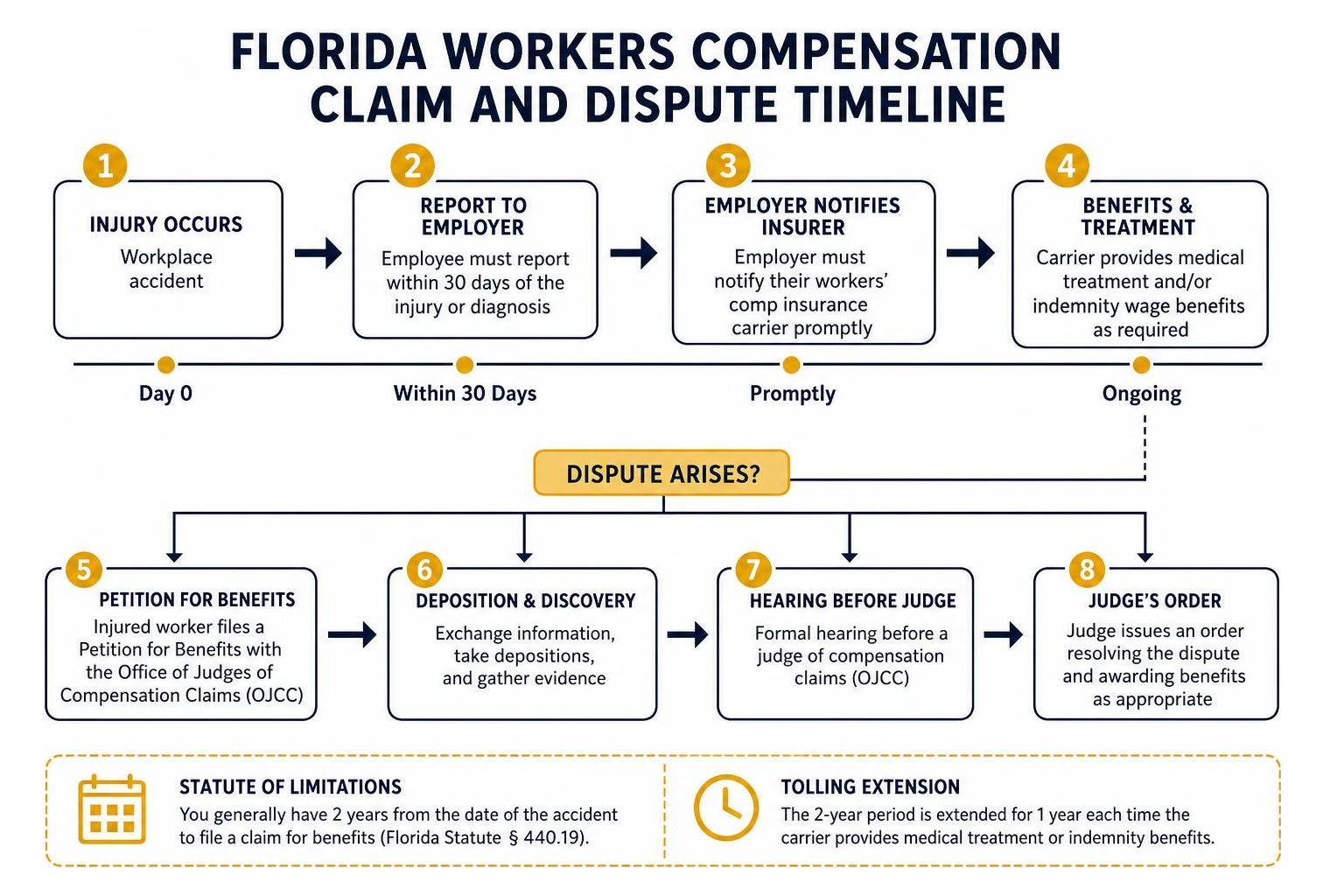
Under Florida law, injured employees must report their workplace accident to their employer within 30 days of the date of the injury (or within 30 days of when a doctor first informs you that your medical condition is work-related). Once reported, the employer has an obligation to notify their workers’ compensation insurance carrier promptly.
Furthermore, Florida enforces a strict two-year statute of limitations under Florida Statute § 440.19. You generally have two years from the date of the accident to file a formal claim for benefits. However, this period can be extended (or “tolled”) for one year each time the authorized workers’ compensation carrier provides medical treatment or indemnity wage benefits.
Florida State Rules vs Federal Workers’ Compensation Programs
A common source of confusion for injured workers is the difference between state workers’ compensation systems and federal programs. While the U.S. Department of Labor administers federal programs for specific employee groups, private-sector and municipal workers in Florida fall under state jurisdiction.
Federal programs include:
- Federal Employees’ Compensation Act (FECA): Covers non-military federal employees.
- Longshore and Harbor Workers’ Compensation Act (LHWCA): Covers maritime workers, dock workers, and harbor builders.
- Federal Black Lung Program & Energy Employees Occupational Illness Compensation Program: Targets specialized industrial hazards in mining and energy production.
In contrast, Florida’s state system applies to private employers with four or more employees (or one or more employees in the construction sector). The rules governing doctor choice, wage loss calculation, and dispute resolution differ significantly:
| Feature | Florida State Workers’ Compensation | Federal Programs (FECA / LHWCA) |
|---|---|---|
| Governing Law | Florida Statutes Chapter 440 | Various Federal Acts (e.g., 5 U.S.C. 8101) |
| Adjudication Body | Office of Judges of Compensation Claims (OJCC) | U.S. Department of Labor / Office of Administrative Law Judges (OALJ) |
| Doctor Selection | Employer/Carrier selects authorized treating doctor | Employee generally chooses treating physician |
| Initial Injury Reporting | Within 30 days of injury or diagnosis | Generally within 30 days; up to 3 years for formal FECA claim |
| Dispute Mechanism | Petition for Benefits to State Mediation to Final OJCC Hearing | Formal Claims with DOL District Office to Hearing / Board of Appeals |
Overcoming Claim Challenges and Strict Timelines
Insurance carriers routinely deploy defense tactics to minimize payouts or deny legitimate claims entirely. Common challenges include:
- Allegations of Delayed Reporting: Carriers may argue that because you waited a few days or weeks to report the injury, the incident happened outside of work.
- Pre-Existing Condition Defenses: Under Florida’s “major contributing cause” standard, your workplace accident must be more than 50% responsible for the resulting injury and need for medical treatment when compared to all other contributing factors combined. Insurers often use past medical records to claim your pain is merely an old injury resurfacing.
- Independent Medical Examinations (IMEs): Carriers can assign defense doctors who may downplay the severity of your condition, clear you for full duty before you have healed, or claim that ongoing medical care is no longer necessary.
We counter these tactics by gathering objective diagnostic imaging, obtaining thorough rebuttal statements from treating specialists, and ensuring every filing adheres strictly to statutory evidentiary standards.
Maximizing Benefits, Medical Care, and Dispute Resolution
Navigating the medical care system after a workplace accident can be frustrating. Under Florida law, the insurance carrier holds the legal right to select your authorized treating physician. If you seek care from an unauthorized private doctor without carrier approval or emergency justification, the insurer is generally not required to pay for those medical bills.

However, Florida law provides injured workers with the statutory right to request a one-time change of physician during the life of the claim. Exercising this right strategically—under the guidance of a knowledgeable attorney—can mean the difference between seeing a doctor who prioritizes the insurance carrier’s bottom line and one who genuinely focuses on your long-term medical recovery.
Handling Disputed and Denied Claims Through Mediation
When an insurance carrier refuses to authorize necessary surgery, denies physical therapy, or miscalculates your average weekly wage (AWW), the formal dispute process begins by filing a Petition for Benefits (PFB) with the OJCC.
Once a PFB is filed:
- Carrier Response: The carrier must either provide the requested benefits or file a formal response within statutory deadlines.
- State-Mandated Mediation: Florida law requires the parties to attend a formal mediation conference, overseen by an independent state mediator. This provides a confidential environment to resolve issues without the expense and delay of a trial. In fact, many workers’ compensation disputes settle at or shortly after mediation.
- Final Evidentiary Hearing: If issues remain unresolved after mediation, the case proceeds to a final hearing before a Judge of Compensation Claims, who reviews evidence, hears witness testimony, and enters a binding final compensation order.
Why Retaining the Best Workers Comp Lawyers in Florida Maximizes Your Settlement
Florida workers’ compensation cases do not involve subjective damages like “pain and suffering.” Instead, financial recovery centers on securing the full measure of statutory benefits you are owed:
- Temporary Total Disability (TTD) & Temporary Partial Disability (TPD): Wage replacement benefits paid while you are actively recovering and unable to work, or working under restricted hours and light-duty pay.
- Permanent Impairment Benefits (IBs): Payouts calculated once you reach Maximum Medical Improvement (MMI), based on your assigned permanent impairment rating.
- Lump-Sum Settlements: A negotiated payout where the insurer pays a lump sum in exchange for closing out future wage loss and/or medical benefits.
Retaining seasoned legal counsel levels the playing field against insurance claims teams. We evaluate your future medical expenses, assess long-term vocational loss, and negotiate from a position of documented evidence to secure the highest possible settlement.
Frequently Asked Questions About Florida Workers’ Compensation Claims
Navigating the workers’ compensation system raises many practical questions. Below are detailed answers to key concerns, and you can explore additional topics on our frequently asked questions page.
How do contingency fees work for workers’ compensation claims in Florida?
In Florida, workers’ compensation attorneys represent injured workers on a contingency fee basis. This means:
- You pay zero upfront retainers or out-of-pocket costs to hire an attorney.
- Legal fees and case costs are only paid if your attorney successfully secures benefits or recovers a settlement on your behalf.
- Florida Statute § 440.34 sets statutory guidelines for attorney fees, and all fee agreements and final settlement fees must be reviewed and approved by a Judge of Compensation Claims to ensure fairness. If no recovery is made, you owe no attorney fees.
When should an injured employee hire a workers’ compensation attorney?
You should consider consulting an attorney immediately after any workplace injury, but representation becomes critical if:
- Your claim is denied outright by the insurance company.
- Your weekly wage replacement checks are late, underpaid, or stopped without explanation.
- The carrier refuses to authorize diagnostic testing (such as MRIs), specialist referrals, or recommended surgeries.
- The employer or doctor pressures you to return to full-duty work before your body has healed.
- You are offered a settlement agreement and need to understand the true long-term value of your medical and wage rights.
What specific compensation and benefits can injured workers recover?
Under Chapter 440, eligible injured workers may receive:
- Medical Care: 100% coverage for all authorized, medically necessary treatment, including emergency care, doctor visits, surgery, physical therapy, prescription medications, and medical devices.
- Medical Travel Reimbursement: Mileage reimbursement for travel to and from authorized medical appointments and pharmacies.
- Lost Wage Replacement: Typically 66⅔% of your Average Weekly Wage (AWW), subject to state statutory maximums, during periods of temporary disability.
- Impairment and Permanent Disability Benefits: Monetary benefits paid if you sustain permanent physical limitations after reaching MMI.
- Reemployment and Vocational Assistance: Training and career counseling services if your injury prevents you from returning to your prior occupation.
Conclusion
A sudden workplace injury can upend your finances, physical well-being, and family stability. The workers’ compensation system was created to provide injured employees with prompt medical treatment and wage relief, but insurance carrier red tape and complex statutory deadlines can make obtaining those benefits challenging.
You do not have to fight the insurance companies alone. At Panzer Law, P.A., our team brings decades of focused workers’ comp experience across Florida, fighting tirelessly to ensure our clients receive every dollar and medical service they are legally owed. We operate strictly on a contingency fee model—meaning there are no upfront costs, and we only get paid if we recover compensation for you.
To protect your rights and ensure your claim is handled correctly from day one, consult an experienced Florida workers compensation lawyer today. Please contact us now to schedule your free, confidential case evaluation.
