

How Workers’ Comp Settlements Are Calculated
Average Payouts by Injury Severity and Type
A typical workers’ compensation settlement ranges from $2,000 to $15,000 for minor injuries, $15,000 to $75,000 for moderate injuries, and $75,000 to over $500,000 for severe or surgical cases, with catastrophic claims reaching $500,000 to $2,000,000 or more. When injured workers ask, “How much is a workers’ comp settlement worth?”, the total payout depends on the extent of medical treatment, permanent impairment ratings, and wage disruption. Across South Florida—from Palm Beach County through Miami-Dade County—claims backed by objective diagnostic evidence command the highest valuations.
- Minor Injuries ($2,000 to $15,000): These claims involve soft-tissue sprains, minor strains, or non-displaced hairline fractures treated conservatively with physical therapy, rest, and anti-inflammatory medications. They rarely result in lasting impairment or long-term lost wages.
- Moderate Injuries ($15,000 to $75,000): This tier includes herniated discs managed with epidural steroid injections, single-level arthroscopic joint repairs, or repetitive motion trauma such as carpal tunnel syndrome requiring minor surgery. Most workers in this category face several weeks or months of lost time and may retain minor permanent physical restrictions.
- Severe Injuries ($75,000 to $500,000+): When an injury demands invasive surgical intervention—such as spinal fusion, total joint replacement, or multi-level hardware reconstruction—settlements increase substantially. These cases reflect prolonged disability, substantial future medical requirements, and compromised earning capacity.
- Catastrophic Claims ($500,000 to $2,000,000+): Traumatic brain injuries (TBI), severe spinal cord damage causing paralysis, severe crush injuries, or limb amputations sit at the highest valuation level. These settlements account for lifetime attendant care, specialized medical equipment, ongoing pharmaceutical regimens, and total loss of future earnings.
Insurance carriers set financial reserves on claims early. When your medical records show documented structural damage rather than subjective complaints, adjusters must raise those reserve limits to reflect their true financial exposure.
Settlement Ranges by Injured Body Part
Statutory frameworks evaluate injuries either as “scheduled” member losses (specific limbs, extremities, vision, or hearing) or as “unscheduled” whole-body impairments (the neck, back, brain, and internal systems). The chart below illustrates representative benchmark ranges observed across national and regional data in 2026.
| Injury Category / Body Part | Typical Settlement Range (Conservative Care) | Typical Settlement Range (With Surgery) | Average Benchmark |
|---|---|---|---|
| Lumbar Spine / Back Strain | $12,000 – $35,000 | $60,000 – $150,000+ | $22,500 – $62,500 |
| Cervical Spine / Neck | $10,000 – $30,000 | $50,000 – $125,000+ | $38,400 |
| Shoulder / Rotator Cuff | $15,000 – $40,000 | $45,000 – $110,000+ | $54,200 |
| Knee (Meniscus / ACL) | $10,000 – $30,000 | $35,000 – $95,000+ | $48,700 |
| Wrist / Carpal Tunnel | $8,000 – $20,000 | $25,000 – $60,000+ | $36,800 |
| Head Injury / Moderate TBI | $40,000 – $90,000 | $120,000 – $400,000+ | $187,000 |
| Catastrophic Spinal Cord | N/A (Requires Surgery/Care) | $250,000 – $1,000,000+ | $485,000+ |
A workers’ compensation settlement is not a subjective personal injury award for pain and suffering. Instead, it is an administrative, formula-driven buyout of two primary statutory obligations: remaining wage replacement (indemnity) and reasonable future medical expenses. Understanding this baseline is an essential part of a practical guide to filing workers comp claims.
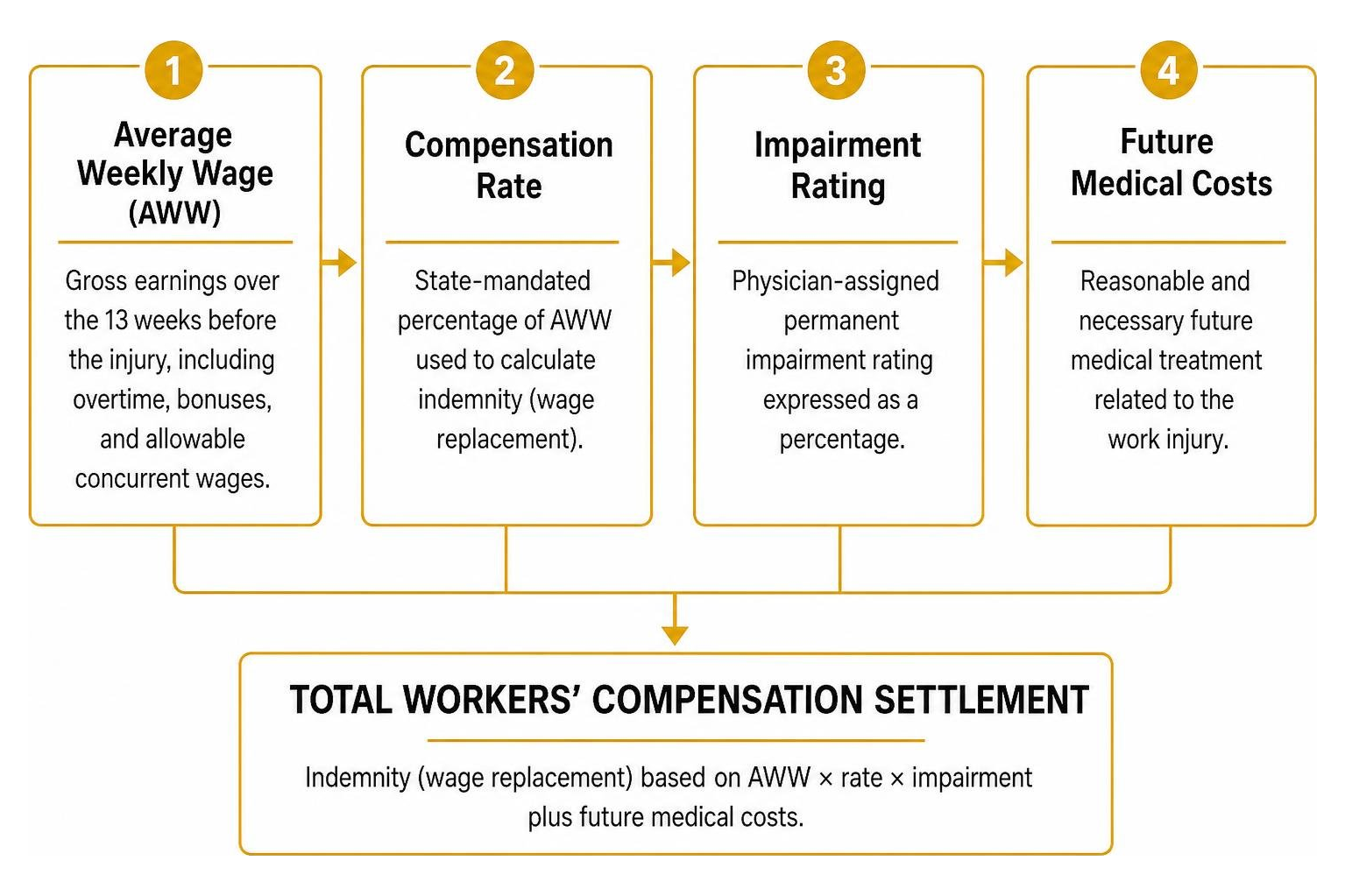
Determining Workers’ Comp Settlement Value by Formula
The wage-loss portion of your claim relies on statutory math established by state law. Adjusters and attorneys calculate the indemnity baseline through a structured sequence:
- Average Weekly Wage (AWW): The insurer calculates your gross earnings over the 13 weeks preceding your workplace accident, including overtime, bonuses, and allowable concurrent wages.
- Compensation Rate: In most jurisdictions, including Florida, your weekly temporary total disability rate is set at 66 2/3% (two-thirds) of your AWW, subject to an annual statutory maximum benefit cap.
- Maximum Medical Improvement (MMI): Once your treating physician determines your condition has stabilized and no further curative medical improvement is expected, you reach MMI.
- Permanent Impairment Rating (PIR): At MMI, your doctor assigns a percentage rating assessing your permanent functional loss using statutory medical guidelines.
- Impairment Benefits Duration: The state formula multiplies your impairment rating by a statutory number of weeks payable at your impairment benefit rate.
For example, if you earn an AWW of $1,200, your standard compensation rate is $800 per week. If an orthopedic surgeon assigns a 10% impairment rating to your spine upon reaching MMI, statutory rules dictate the exact number of weeks the insurer owes you in impairment benefits, establishing the indemnity floor of your settlement.
Future Medical Expenses and Medicare Set-Aside (MSA)
The medical portion of a settlement represents the projected cost of all necessary future care related to your workplace injury. To quantify this number, we frequently work with certified life-care planners who review your treatment history and calculate projected expenses for:
- Future revision surgeries or joint replacements
- Diagnostic imaging (MRIs, CT scans, X-rays)
- Physical therapy, chiropractic treatment, and home exercises
- Prescription pain management and anti-inflammatory medications
- Medical devices, braces, and assistive mobility equipment
When a settlement involves a claimant who currently receives Medicare or has a reasonable expectation of enrolling within 30 months, federal guidelines require a formal Medicare Set-Aside (MSA) arrangement. The MSA allocates a specific portion of the settlement funds exclusively for future injury-related medical treatment that Medicare would normally cover. Securing formal approval from the Centers for Medicare & Medicaid Services (CMS) ensures Medicare does not deny future medical coverage for your work-related condition.
Key Factors That Increase or Decrease Your Settlement Amount
Insurance adjusters evaluate risk. When an injured employee presents clear, well-documented medical evidence, the insurer’s potential financial exposure at trial rises, prompting higher settlement offers. If you are preparing to negotiate, it is wise to find local workmans comp lawyers near you who understand how local administrative judges interpret these evidentiary factors.
Surgery, Impairment Ratings, and Pre-Existing Conditions
Three clinical factors carry immense weight when valuing any settlement:
- Surgical Necessity: Cases involving surgery settle for 40% to 60% more on average than conservative care claims. Invasive procedures leave permanent anatomical changes, elevate impairment ratings, and increase the likelihood of future degenerative complications.
- Impairment Rating Disputes: A single digit in your impairment rating can swing your payout significantly. For instance, a 5% whole-person impairment versus a 15% rating can create a $30,000 difference under state statutory schedules for the exact same injury.
- Pre-Existing Conditions and Apportionment: Insurers routinely attempt to reduce settlement payouts by claiming your symptoms stem from pre-existing degenerative disc disease, prior arthritis, or old sports injuries. Under statutory apportionment rules, the carrier must prove that your pre-existing condition directly contributes to your current disability. Proper medical reporting from your treating physician showing that the workplace accident aggravated or accelerated your condition protects your claim’s full valuation.
State Law Differences and Florida Benefit Limits
Statutory benefit caps establish the ceiling for what any worker can recover. Because each state sets its own maximum weekly temporary disability rates and permanent impairment schedules, the exact same injury produces vastly different financial recoveries depending on geography.
In Florida, workers’ compensation benefits are governed by Chapter 440 of the Florida Statutes. Temporary total disability benefits are capped at strict weekly maximums that adjust annually, and impairment benefits follow a statutory sliding scale based on the assigned impairment percentage. Whether you work in a distribution hub in Boca Raton, a construction site in West Palm Beach, or a hospitality resort in Miami, your statutory rate applies statewide, making accurate wage reporting critical.
Settlement Types, Payment Timelines, and Legal Rights
Settling a workers’ comp claim is a formal legal contract that ends some or all of the insurer’s responsibilities. You must understand what rights you retain and what obligations you surrender before signing any agreement.
| Settlement Feature | Lump Sum (Compromise & Release / Washout) | Structured Settlement | Stipulation with Open Medicals |
|---|---|---|---|
| Payment Method | Single, one-time cash disbursement | Guaranteed periodic annuity payments | Ongoing weekly/bi-weekly statutory checks |
| Future Medical Rights | Closed permanently; claimant pays future care | Closed permanently; funded via annuity/MSA | Remains open; insurer pays authorized treatment |
| Claim Reopening | Barred (permanent finality) | Barred (permanent finality) | Permitted upon proving a worsening of condition |
| Best Suited For | Stable conditions, career transition, debt payoff | Catastrophic injuries requiring lifetime care | Ongoing surgeries with uncertain healing paths |
Lump Sum vs. Structured Settlements and Tax Exemptions
A lump sum settlement (commonly called a “washout” in Florida) provides immediate financial liquidity, allowing you to manage your own medical care and move forward without insurer interference. Conversely, structured settlements provide financial security through recurring annuity disbursements over months or years, which is particularly beneficial for catastrophic injuries.
Workers’ compensation settlements are entirely exempt from federal income tax under Section 104(a)(1) of the Internal Revenue Code (IRC). In almost all circumstances, you do not pay federal or state income taxes on your settlement proceeds. The only notable exception occurs if you receive Social Security Disability Insurance (SSDI) benefits alongside workers’ comp; in that scenario, your legal team must structure the settlement language with an explicit lifetime amortization clause to prevent an adverse SSDI offset.
Timeline to Receive Payment and Reopening Restrictions
Once both parties agree on a settlement figure, the legal closing process follows strict statutory stages:
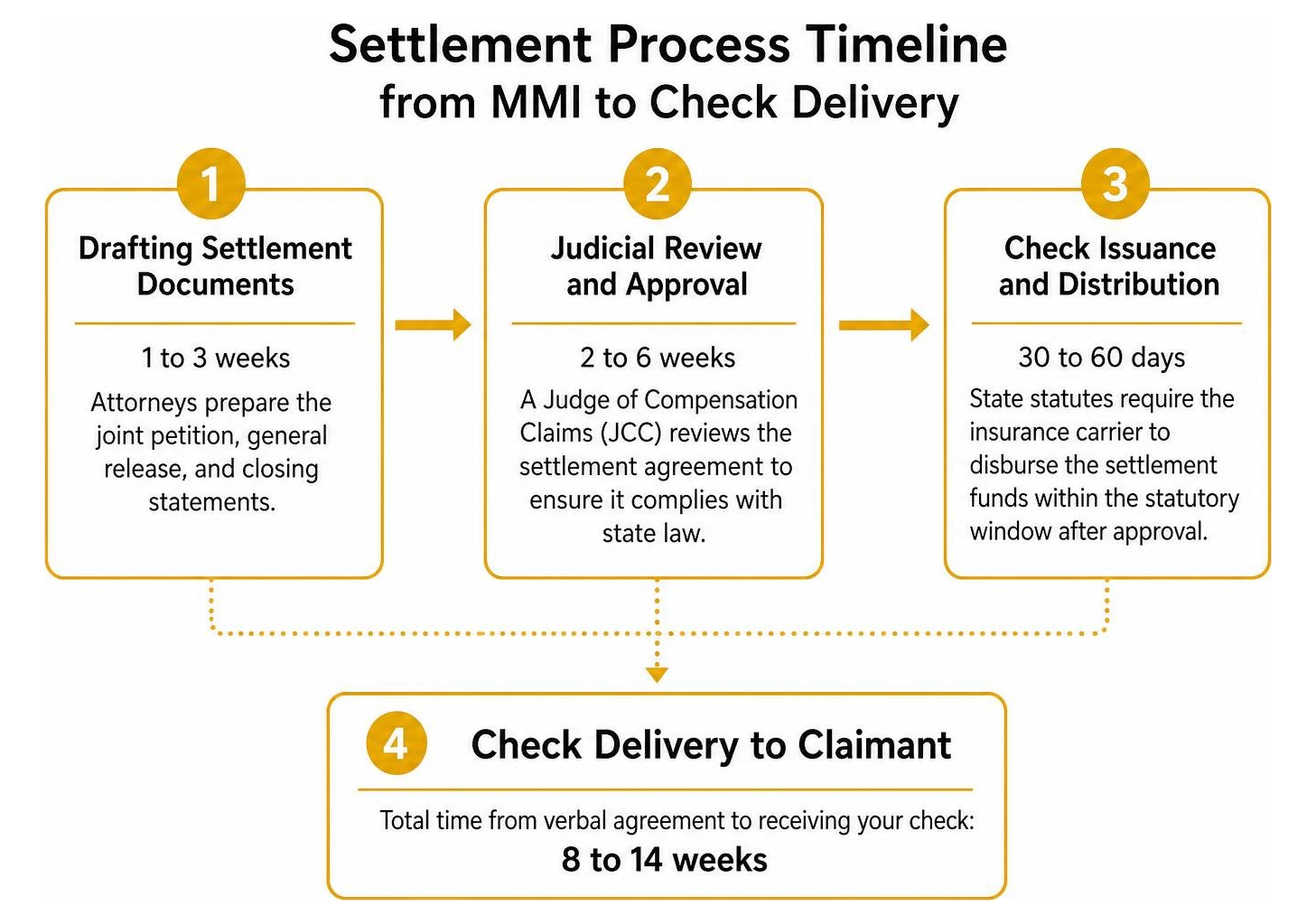
- Drafting Settlement Documents (1 to 3 weeks): Attorneys prepare the joint petition, general release, and closing statements.
- Judicial Review and Approval (2 to 6 weeks): A Judge of Compensation Claims (JCC) reviews the settlement agreement to ensure it complies with state law and adequately protects any statutory interests or child support obligations.
- Check Issuance and Distribution (30 to 60 days post-approval): State statutes require the insurance carrier to disburse the settlement funds within a specific statutory window following the approval order.
The total timeline from verbal agreement to receiving your check generally spans 8 to 14 weeks.
Critical Warning on Finality: Once a judge approves a full lump sum washout, your case is permanently closed. You cannot reopen your claim or demand additional funds from the insurance company if your condition deteriorates, if you require unanticipated surgery, or if your medication costs increase later.
Frequently Asked Questions About Workers’ Comp Settlements
For more answers regarding rights, statutory deadlines, and dispute resolution, explore our frequently asked questions resource.
How much is workers comp settlement with an attorney vs without?
Data across workers’ compensation commissions consistently shows that represented claimants secure significantly higher net payouts than unrepresented workers. Nationally, represented workers receive settlements averaging $58,200 compared to $19,400 for unrepresented claimants—roughly three times higher.
Workers’ compensation attorneys operate exclusively on a contingency fee basis (typically 15% to 25% regulated by state fee schedules), meaning there are no upfront costs, and legal fees are deducted solely as a percentage of the recovery obtained. Even after legal fees are paid, represented workers walk away with substantially higher net proceeds because an attorney identifies hidden future medical costs, disputes low impairment ratings, and negotiates from an informed position of trial readiness.
What happens to my medical coverage after accepting a settlement?
If you sign a full Compromise and Release (lump sum washout), the workers’ compensation carrier’s obligation to pay for your doctor visits, physical therapy, and prescriptions ends completely. You become financially responsible for all future care related to that body part.
You may use your settlement funds to pay for private treatment, or you may rely on personal health insurance once the buyout is finalized (subject to your private policy’s terms regarding pre-existing workplace conditions). If an MSA is included, you must pay injury-related bills directly from that designated set-aside account until those specific funds are exhausted according to CMS guidelines.
How do I know if I should accept or negotiate a settlement offer?
You should strongly consider rejecting an initial offer or countering if:
- You have not yet reached Maximum Medical Improvement (MMI).
- Your authorized treating physician believes you still need surgery, injections, or diagnostic testing.
- The insurance adjuster’s offer only covers past lost wages and completely ignores future medical costs.
- The carrier’s doctor assigned an artificially low permanent impairment rating that contradicts your physical limitations.
You should consider accepting an offer when your condition has stabilized, you have obtained a comprehensive medical cost projection, and the net payout gives you the financial security and independence you need to manage your health without insurance carrier delays.
Conclusion
Determining the true value of your workers’ compensation claim requires looking past generic averages and examining your specific average weekly wage, clinical impairment rating, surgical history, and lifetime medical needs. Insurance companies evaluate claims based on their own financial exposure—not your personal well-being.
At Panzer Law, P.A., we represent injured workers throughout Boca Raton, West Palm Beach, Miami, and across South Florida. We handle every phase of your claim, from securing authorized medical treatment to negotiating maximum lump sum settlements, under our strict no-recovery, no-fee model—meaning you pay no attorney fees or costs unless we recover money for you.
If you are evaluating an offer from the insurance company or want to know what your case is truly worth, consult with an experienced Florida workers’ compensation lawyer today for a free, confidential case review.
