
National Trends in Work Place Injury and Illness Rates
If you sustain a work place injury in Florida, your core rights include authorized medical treatment, partial wage replacement when you cannot perform your duties, and protection from retaliation for filing a lawful workers’ compensation claim. Employers must record qualifying incidents within 7 calendar days and report severe events such as fatalities, inpatient hospitalizations, amputations, or eye losses directly to OSHA within 8 to 24 hours. Understanding the broader safety landscape helps demonstrate how occupational hazards impact everyday employees across various sectors. Private industry employers reported 2.5 million nonfatal workplace injuries and illnesses in 2024, representing a 3.1 percent decrease from 2023. This shift brought the total recordable case (TRC) incidence rate down to 2.3 cases per 100 full-time equivalent (FTE) workers—the lowest rate recorded since 2003.
Over the past decade, general workplace conditions have benefited from heightened regulatory enforcement, expanded automation, and modern safety protocols. According to federal findings published in the Employer-Reported Workplace Injuries and Illnesses Data, the broader downward trend reflects steady improvements in hazard identification across high-risk environments.
However, lower aggregate rates do not mean occupational hazards have disappeared. While total incidents have dropped across private enterprise, hundreds of thousands of employees still sustain disabling conditions annually that require intensive medical interventions and prolonged time away from their jobs.
Most Common Types and Causes of Work Place Injury Incidents
Workplace incidents stem from a variety of physical hazards and repetitive strains. Over the 2023–2024 reporting cycle, overexertion, repetitive motion, and bodily conditions accounted for the single highest number of severe cases, totaling 946,290 incidents involving days away from work, job restriction, or transfer.
The primary events leading to nonfatal physical harm across job sites include:
- Overexertion and Bodily Reaction: Heavy lifting, carrying, pushing, and awkward postures leading to sprains, strains, and severe soft-tissue damage.
- Contact with Objects and Equipment: Being struck by falling debris, crushed in moving machinery, or compressed by heavy equipment.
- Slips, Trips, and Falls: Falls on the same level due to slick walkways, as well as catastrophic falls from elevated ladders, scaffolding, and roofs.
- Emerging Automation Hazards: The rapid adoption of industrial robotics and automated sorting machinery, which introduces new risks of pinch-point trauma and blunt-force impacts during maintenance.
A significant portion of physical trauma affects employees during their initial tenure. In OSHA’s federal incident report data, approximately 32 percent of recorded events happened within the worker’s first year on the job, highlighting gaps in initial safety training and ergonomic acclimation. When severe falls or equipment collisions occur, they can lead to complex issues surrounding medical management and long-term disability, including calculating appropriate settlements for spinal cord injuries.
Measuring Severity: DAFW, DJTR, and DART Metrics
Regulatory agencies use standardized metrics to track the physical severity and financial disruption caused by workplace harm:
- DAFW (Days Away From Work): Cases where an injury or illness causes an employee to miss at least one full day of work following the day of the incident. Over the 2023–2024 period, private industry saw 1.8 million DAFW cases, representing 61.5 percent of all combined severe cases, with a median absence of 8 days away from work.
- DJTR (Days of Job Transfer or Restriction): Cases where the employee remains at work but cannot perform their routine job duties or is reassigned to temporary modified tasks.
- DART (Days Away, Restricted, or Transferred): The cumulative metric combining both DAFW and DJTR cases, serving as the standard indicator of serious occupational disruption.
| Metric | Definition | Criteria for Recording | Typical Median Severity / Context |
|---|---|---|---|
| DAFW | Days Away From Work | Worker misses 1+ full calendar days beyond the day of injury | 8 median days away; reflects acute trauma requiring initial recovery |
| DJTR | Days of Job Transfer or Restriction | Worker is kept on modified duty or reassigned to alternate tasks | Tracks partial functional impairment without total work absence |
| DART | Days Away, Restricted, or Transferred | Aggregate sum of all DAFW and DJTR cases | Core benchmark for severe, life-altering, or work-limiting harm |
OSHA Recordkeeping Rules and Employer Reporting Requirements
Federal safety laws require covered employers to document work-related medical incidents to ensure accountability and monitor industry hazards. An event is classified as an OSHA recordable incident if it results in:
- Death;
- Loss of consciousness;
- Days away from work;
- Restricted work activity or job transfer;
- Medical treatment beyond standard first aid; or
- A significant injury or illness diagnosed by a licensed healthcare professional.
Employers must determine if an incident meets recording thresholds within 7 calendar days of receiving notice. Knowing what constitutes mandatory recordkeeping is critical, and businesses can review compliance materials via the official OSHA Recordkeeping Forms Package.
Understanding Forms 300, 300A, and 301
Federal occupational reporting relies on three standardized tracking forms:
- Form 300 (Log of Work-Related Injuries and Illnesses): An ongoing, detailed ledger where employers document each recordable incident, identifying the worker’s department, job title, date of injury, specific injury description, and resulting lost or restricted workdays.
- Form 300A (Summary of Work-Related Injuries and Illnesses): An aggregated annual summary showing total case counts, total lost workdays, and total hours worked across the establishment. Employers must certify and physically post Form 300A in a conspicuous location accessible to all employees from February 1 through April 30 of each year.
- Form 301 (Injury and Illness Incident Report): An individual case report completed for each recordable event, detailing how the incident occurred, the equipment involved, and the specific medical treatment provided.
Employers must retain these logs for at least 5 years following the end of the calendar year they cover. To protect worker dignity and medical privacy, sensitive diagnoses—such as mental health conditions, reproductive illnesses, or intimate injuries—must be recorded as “privacy concern cases,” omitting the individual’s name from the publicly accessible Form 300 log.
OSHA ITA Reporting vs. BLS SOII Data Limitations

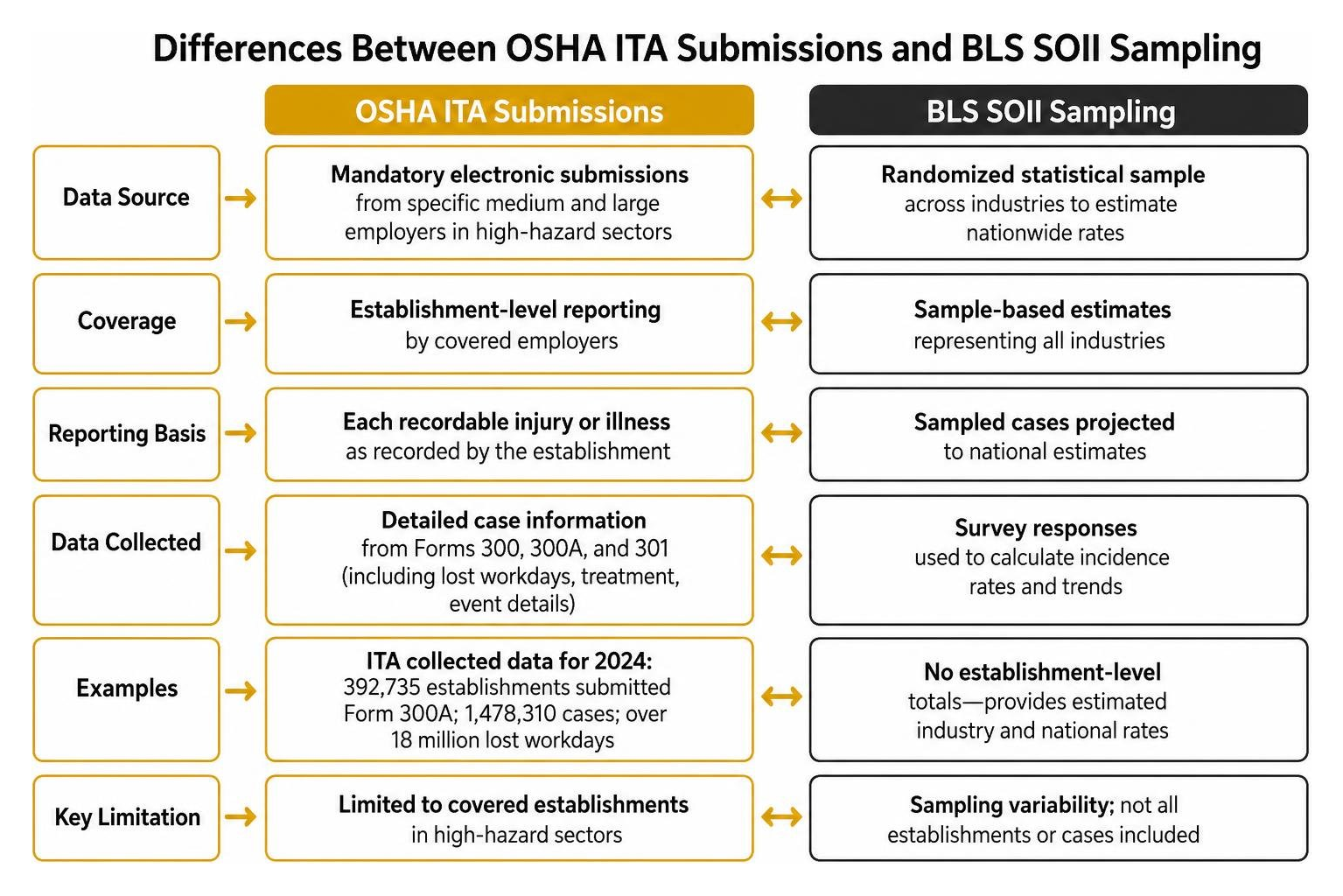
There is an important methodological difference between data gathered through OSHA’s Injury Tracking Application (ITA) and the Bureau of Labor Statistics Survey of Occupational Injuries and Illnesses (SOII). While the BLS SOII uses a randomized statistical sample across industries to estimate nationwide rates, the OSHA ITA collects mandatory, establishment-level electronic submissions from specific medium and large employers operating in high-hazard sectors.
Out of 392,735 establishments that submitted Form 300A data to the ITA for 2024, roughly 57 percent recorded at least one work-related injury or illness, totaling 1,478,310 cases. Approximately 35 percent of these ITA cases required days away from work, generating over 18 million lost workdays nationwide.
When analyzing public injury data, safety professionals must navigate specific limitations outlined in the Injury Tracking Application Case Detail Data Dictionary:
- Two-Digit OIICS Coding: Public records utilize two-digit Occupational Injury and Illness Classification System (OIICS) codes rather than granular four-digit codes, grouping broad categories (such as general fractures or falls) without deeper sub-classification.
- Automated NIOCCS Job Coding: Occupations are assigned using the National Institute for Occupational Safety and Health (NIOSH) Industry and Occupation Computerized Coding System (NIOCCS), which applies machine learning algorithms to job titles and NAICS codes with varying probability thresholds.
- PII Redactions: Stringent automated and manual redactions remove personal identifiers, which helps preserve medical privacy but limits granular case analysis.
Industry Breakdown and High-Risk Occupational Hazards
Occupational risk varies drastically depending on the day-to-day physical demands of the work environment. High-density physical handling and industrial manufacturing exhibit far higher injury rates than clerical or administrative environments. For example, while the information sector routinely reports low incident rates (averaging 0.7 cases per 100 FTE workers), industrial supply chains, healthcare systems, and storage facilities face continuous physical challenges.
High-Incidence Sectors and Vulnerable Worker Demographics
Healthcare and social assistance, transportation and warehousing, retail trade, and manufacturing account for nearly two-thirds of all nonfatal incidents reported through OSHA systems. Within these industries, specific occupational titles face disproportionately high hazards:
- Laborers and Freight Movers: High rates of severe lumbar herniations, rotator cuff tears, and crush injuries from manual material handling.
- Stockers and Order Fillers: Repetitive motion trauma, acute shoulder strains, and impact injuries from fallen warehouse inventory.
- Registered Nurses and Healthcare Support Staff: Back injuries from patient transfers, violent interactions, and sharp-object exposures.
- Young Workers (Ages 14–19): While representing approximately 3 percent of total reported workplace injuries, young workers account for 36 percent of their injuries within retail trade environments, often involving machinery cuts, deep lacerations, and slips during shifts.
When workplace events result in life-altering physical conditions, navigating medical evaluations and insurance adjustments requires a clear strategy for evaluating catastrophic injury claims.
COVID-19 and Respiratory Illness Trajectories
Workplace illnesses saw substantial shifts in recent reporting cycles. Illness cases in private industry dropped 26.0 percent in 2024 to 148,000 cases, driven largely by a 46.1 percent decrease in respiratory illness cases down to 54,000.
Under the specific classification for coronavirus (novel), the annualized DAFW incidence rate in private industry was 5.6 cases per 10,000 FTE workers over the 2023–2024 period. Healthcare support occupations experienced the highest annualized incidence rate for coronavirus cases at 32.4 cases per 10,000 FTE workers, underscoring the ongoing infectious disease risks borne by frontline clinical caregivers.
Protecting Your Rights and Calculating Injury Incidence Rates
Accurately evaluating safety performance allows employers to address hazards proactively while helping employees recognize whether their workplace adheres to industry-standard safety benchmarks. Standardizing incident tracking across organizations of different sizes requires normalizing case counts against standard work hours.
Legal Protections Following a Serious Work Place Injury
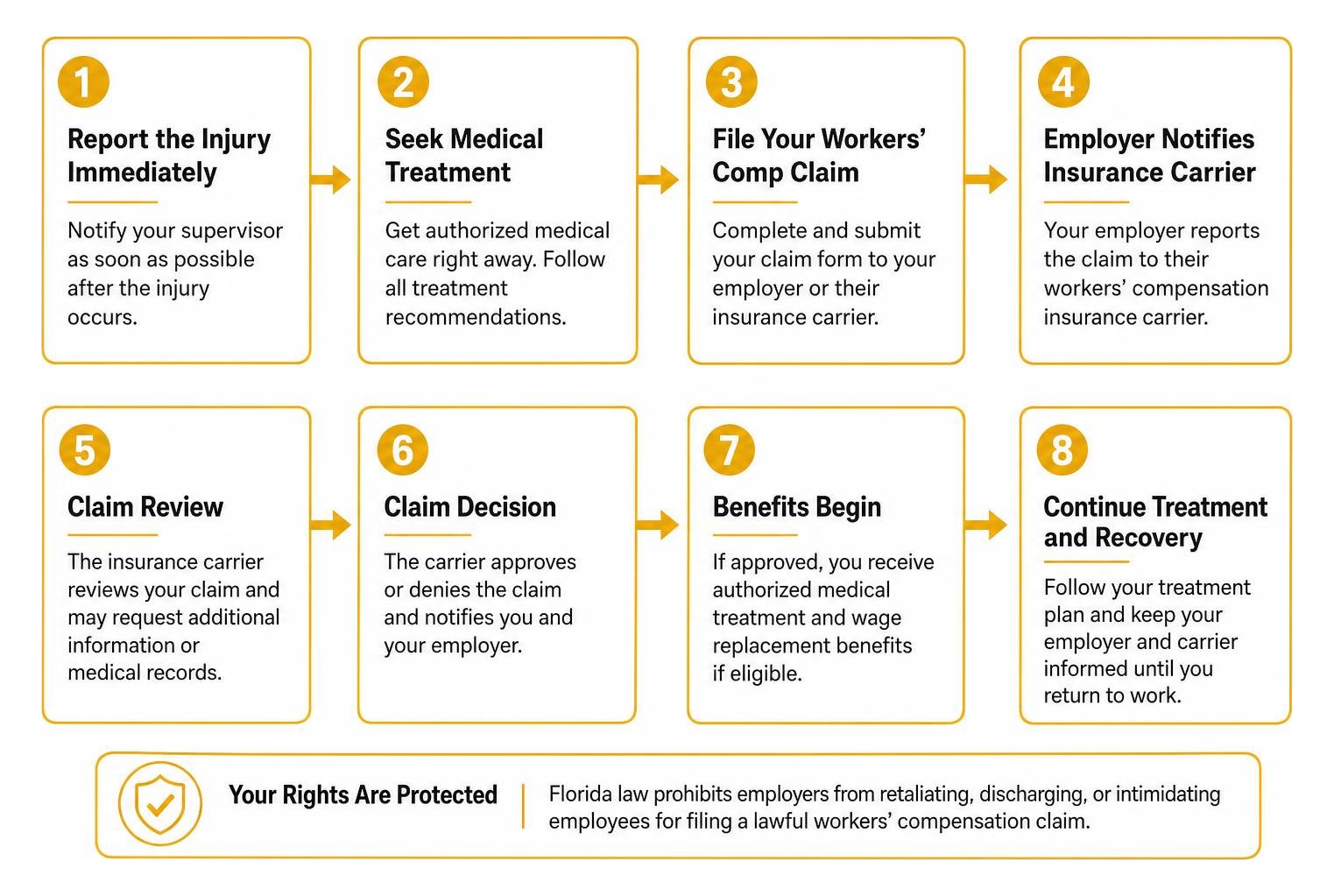
When you sustain an injury on the job in Florida, statutory workers’ compensation frameworks establish key legal rights. Employees are entitled to reasonable and necessary authorized medical treatment, including emergency room care, diagnostic testing, physical therapy, prescription medication, and surgical interventions. In addition, when an injury prevents an employee from performing their duties, partial wage replacement benefits (such as Temporary Total Disability or Temporary Partial Disability) help offset lost income.
Florida law strictly prohibits employers from retaliating, discharging, or intimidating an employee for filing a lawful workers’ compensation claim. To protect these statutory rights, injured employees should follow our comprehensive guide to filing workers’ compensation claims to ensure all reporting and documentation steps are completed properly.
Calculating Establishment Incidence Rates and Benchmarks
Employers and safety teams calculate standardized incidence rates to evaluate workplace safety over time. The federal standard uses a base of 200,000 total hours worked—the equivalent of 100 full-time employees working 40 hours per week for 50 weeks per year.
To calculate the Total Recordable Case (TRC) Incidence Rate, multiply the total number of recordable injuries and illnesses by 200,000, then divide that result by the total employee hours worked during the year.
To calculate the DART Incidence Rate, add the total Days Away From Work (DAFW) cases and the total Days of Job Transfer or Restriction (DJTR) cases, multiply that sum by 200,000, then divide by the total employee hours worked during the year.
By calculating these rates annually, organizations can benchmark their internal safety performance against national BLS averages, identify rising hazards in specific departments, and implement targeted safety interventions—such as modernizing machine guards, investing in mechanical lifting assists, or scheduling ergonomic audits.
Frequently Asked Questions about Workplace Safety and Claims
What is the formula for calculating an OSHA recordable incidence rate?
The formula normalizes injury numbers across organizations by multiplying the total number of recordable injuries and illnesses by 200,000 (the base for 100 full-time workers) and dividing that figure by the total number of hours worked by all employees during the calendar year.
How long do employers have to record and report a work-related incident?
Employers have 7 calendar days after receiving notice of an injury to determine whether it is recordable and enter it into their OSHA Form 300 log. For severe events—such as work-related fatalities (which must be reported within 8 hours) or inpatient hospitalizations, amputations, and eye losses (which must be reported within 24 hours)—employers must notify OSHA directly. In addition, the annual Form 300A summary must remain publicly posted in the workplace from February 1 through April 30.
What is the difference between DAFW and DART cases?
DAFW (Days Away From Work) tracks only those incidents where an injured worker misses at least one full calendar day of work beyond the day of the incident. DART (Days Away, Restricted, or Transferred) is a broader severity metric that combines DAFW cases with instances where an employee remains on the job under restricted duties or temporary job reassignment (DJTR).
Conclusion
While national workplace safety trends show record-low incident rates across private industry, serious physical injuries and occupational illnesses remain a reality for thousands of workers every day. Understanding your legal protections, reporting rules, and recovery options is essential if an unexpected accident occurs on the job.
If you have questions about your medical care, lost wages, or claim status after an injury in Miami, Boca Raton, West Palm Beach, or throughout Palm Beach and Miami-Dade counties, our team is here to help. At Panzer Law, P.A., we operate on a no-recovery, no-fee model—meaning you pay no attorney fees or costs unless we secure financial compensation for your case. We invite you to schedule a free consultation by consulting a Florida workers’ compensation attorney today to ensure your rights and recovery remain fully protected.
