

The 5-Step Process for Filing Workmans Comp Claim
To file a workers’ comp claim, follow these five steps: seek immediate medical treatment and document your injuries, notify your employer in writing within statutory deadlines, complete and file your state claim paperwork, track employer and insurance carrier response deadlines, and then receive benefits or challenge a denial.
Navigating an injury on the job can feel overwhelming. Between dealing with physical pain and worrying about missed paychecks, handling insurance paperwork is probably the last thing you want to do. However, following a structured process protects your legal rights and ensures you receive the benefits you are owed.
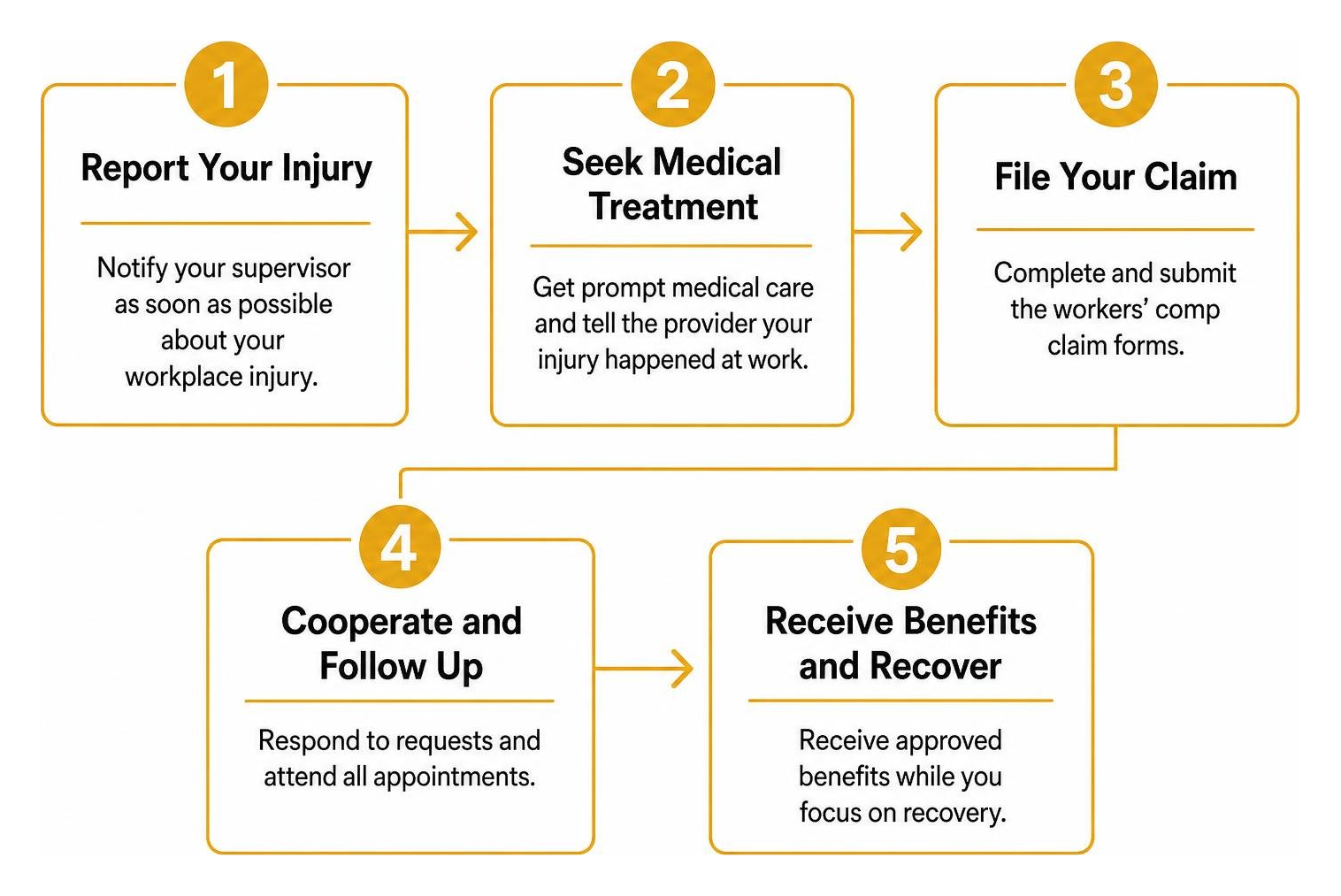
Following a practical guide to filing workers comp claims allows you to avoid procedural missteps that insurance carriers frequently use to delay or dismiss legitimate cases.
Step 1: Seek Immediate Medical Treatment and Document Your Injuries
Your health comes first. If you suffer a severe or life-threatening accident, seek emergency medical care immediately at the nearest hospital or emergency room. Tell the treating medical staff right away that your injury occurred while performing your job duties.
For non-emergency situations, report to an authorized occupational medical provider. During your examination, give your physician an honest, detailed account of how the accident happened. Ensure that the doctor writes down every body part that hurts—even minor aches can develop into severe conditions later. Always request copies of your intake sheets, medical diagnoses, treatment plans, work restriction notes, and receipts for your personal records.
Step 2: Notify Your Employer in Writing Within Statutory Deadlines
Verbal notification in the breakroom is not enough. To protect your claim against disputes, submit a formal written notice of your injury to your direct supervisor or human resources department as soon as possible. Most states enforce strict reporting windows—often requiring notice immediately or within 30 days of the incident.
When drafting your written accident report, include these vital details:
- The exact date, time, and specific physical location of the accident
- A clear, factual description of what you were doing when the injury occurred
- All equipment, machinery, tools, or environmental factors involved
- A comprehensive list of every affected body part and symptom
- Names and contact information of any coworkers or third parties who witnessed the accident
Always keep a signed, time-stamped copy of this notification for your files.
Step 3: Completing and Filing Workmans Comp Claim Paperwork
Once you report the injury, you must complete the official employee claim documentation required by your state’s workers’ compensation board. Review your state workers’ compensation agency’s official filing instructions to understand how it processes initial filings.
When completing the paperwork:
- Provide accurate personal contact details and employment background.
- State whether the condition stems from a sudden workplace accident or a cumulative occupational disease developed over time.
- Clearly describe every injured body part. In modern electronic filing systems, every affected body part must be listed individually rather than grouped under a generic label.
- Sign and date the required medical authorization disclosures so the insurance administrator can review relevant treatment records.
- Submit the forms through certified mail with return receipt requested or through your state’s designated electronic filing portal.
Step 4: Track Employer and Insurance Carrier Response Deadlines
Filing your paperwork triggers mandatory legal deadlines for your employer and their insurance carrier. In many jurisdictions, employers must file a First Report of Injury within 10 to 21 days of receiving notice.
Insurance claims administrators must also adhere to strict response timelines. Tracking these dates ensures that the insurance carrier does not unnecessarily stall your medical care or wage replacement.
Step 5: Receive Benefits or Challenge a Claim Denial
If the insurer accepts your claim, you will begin receiving authorized medical care and wage loss payments based on your statutory disability rating.
If the insurer delays, disputes, or issues a formal notice of denial, you must act quickly. You have the right to challenge adverse decisions through administrative dispute resolution, such as requesting an Independent Medical Review (IMR), attending state-sponsored mediation, or filing a formal petition for a hearing before a workers’ compensation judge.
Filing Requirements to Verify in Your State
Workers’ compensation laws are governed at the state level. Each jurisdiction maintains distinct administrative boards, statutory reporting deadlines, and specific claim forms.
| Filing checkpoint | Initial Injury Reporting Deadline | Formal Claim Filing Deadline | Employer/Insurer Response Time | Key State Agency / Form |
|---|---|---|---|---|
| Injury notification and claim filing | Confirm the injury reporting deadline | Confirm the claim filing deadline | Check the carrier’s response deadline | Verify the required employee claim form |
| Employer reporting and separate employee claims | Confirm when to notify your employer | Verify whether a separate employee claim is required | Check the employer’s injury-report deadline | Verify employer and employee filing requirements |
| Submission records and claim status | Keep proof of injury notification | Keep proof of claim submission | Confirm when a status notice is due | Check the agency’s claim-status guidance |
| Insurer reporting obligations | Verify the reporting requirements | Verify the filing requirements | Check the insurer’s reporting obligations | Consult the workers’ compensation agency |
| Submission methods and electronic filing | Confirm how to submit injury notice | Confirm the filing deadline and submission method | Track applicable response deadlines | Verify the official filing portal, if available |
Choosing and Changing Your Treating Physician Under State Guidelines
The rules governing which doctor treats your workplace injury depend on state law:
- Medical Provider Networks (MPNs) and Panels: Depending on state law, employers may use approved networks or posted panels of physicians. You generally must choose your initial treating doctor from this designated list.
- Pre-Designation: In some jurisdictions, you may treat with your personal primary care physician if you formally pre-designated them in writing before your injury occurred.
- Switching Physicians: If you are dissatisfied with your recovery progress or medical recommendations, most state frameworks allow you to request a one-time change of physician within the approved network or seek an Independent Medical Examination (IME) to resolve disagreements regarding your care plan.
Types of Workers’ Compensation Benefits You Can Recover
Workers’ compensation is designed to protect your livelihood and cover necessary medical expenses while you recover from a job-related injury.

Understanding the scope of available benefits can help you avoid accepting an inadequate settlement. To learn more about how benefits are structured, review our Florida workers comp lawyer claim representation guide.
Medical Coverage and Mileage Reimbursement
Workers’ comp covers 100% of reasonable and necessary medical treatments related to your accepted workplace injury, without copays or deductibles. Covered medical benefits typically include:
- Emergency room visits, surgical procedures, and hospital stays
- Prescription medications prescribed by authorized doctors
- Physical therapy, chiropractic care, and rehabilitation services
- Assistive medical devices, braces, prosthetics, and wheelchairs
- Diagnostic testing including MRIs, CT scans, and X-rays
- Reasonable mileage and travel reimbursement for trips to and from authorized medical appointments
Temporary and Permanent Disability Payments
If your doctor places you on work restrictions or declares you unable to work during your recovery, you may qualify for wage-loss disability benefits:
- Average Weekly Wage (AWW): Wage benefits are calculated using your average gross earnings prior to the injury. In most states, temporary disability pays roughly two-thirds (66 2/3%) of your pre-injury AWW, up to statutory state maximums.
- Temporary Total Disability (TTD): Paid when you are medically unable to work at all while recovering.
- Temporary Partial Disability (TPD): Paid when you return to light-duty or part-time work at a reduced wage compared to your pre-injury earnings.
- Permanent Partial Disability (PPD): Awarded when you reach Maximum Medical Improvement (MMI) but retain permanent functional limitations or impairment ratings as determined by your physician.
- Permanent Total Disability (PTD): Reserved for severe, catastrophic injuries that permanently prevent you from engaging in any meaningful employment.
What to Do If Your Workers’ Comp Claim Is Denied or Delayed
Insurance carriers frequently look for reasons to deny claims. Common grounds for denial include allegations of late injury reporting, disputes over whether the injury arose out of employment, or claims that the condition is related to a pre-existing medical issue.
If your claim is disputed or denied:
- Demand Written Notice: Insurers are legally required to state the specific factual and legal grounds for denying your claim in writing.
- Gather Missing Evidence: Obtain updated medical records, diagnostic imaging, and witness statements that directly refute the insurer’s denial reasons.
- Request Administrative Review: Depending on your jurisdiction, you can file a formal dispute, request an Independent Medical Review (IMR), or schedule Alternative Dispute Resolution (ADR) and mediation through the state workers’ compensation board.
- Consult an Attorney: Having experienced legal representation ensures your rights are protected throughout the appeals process. You can find local workmans comp lawyers near you to guide you through formal hearings and settlement negotiations.
Frequently Asked Questions About Filing a Workers’ Comp Claim
For answers to common concerns about workplace accident claims, visit our frequently asked questions page.
How soon after an accident must I report my injury to my employer?
You should report your injury immediately. While many state laws provide up to 30 days to notify your employer in writing, delaying your report gives insurance carriers an excuse to question the legitimacy of your injury.
What happens if I miss the formal filing deadline for my claim?
Failing to file your claim within your state’s statute of limitations—typically between one and two years—can result in the permanent loss of your right to medical treatment and wage benefits. Limited exceptions exist for good cause or undiscovered occupational diseases, but missing standard statutory deadlines generally bars recovery.
Can my employer fire or retaliate against me for filing a claim?
No. State workers’ compensation laws strictly prohibit employers from firing, demoting, harassing, or retaliating against an employee for exercising their legal right to file a claim. If your employer retaliates against you, you may have grounds for a separate civil lawsuit.
Conclusion
Filing a workers’ compensation claim requires close attention to detail, strict compliance with statutory deadlines, and thorough medical documentation. Taking the correct steps immediately after an accident helps ensure you receive the medical care and wage loss benefits you deserve.
At Panzer Law, P.A., we have spent more than three decades advocating for injured workers. We operate on a contingency fee model—meaning there are no upfront costs and you pay no attorney fees unless we successfully recover compensation for your claim. If you need dedicated guidance, contact our team at workers comp law firm Panzer Law to schedule your free consultation.
