

How to Choose a Workers’ Comp Law Firm After a Workplace Injury
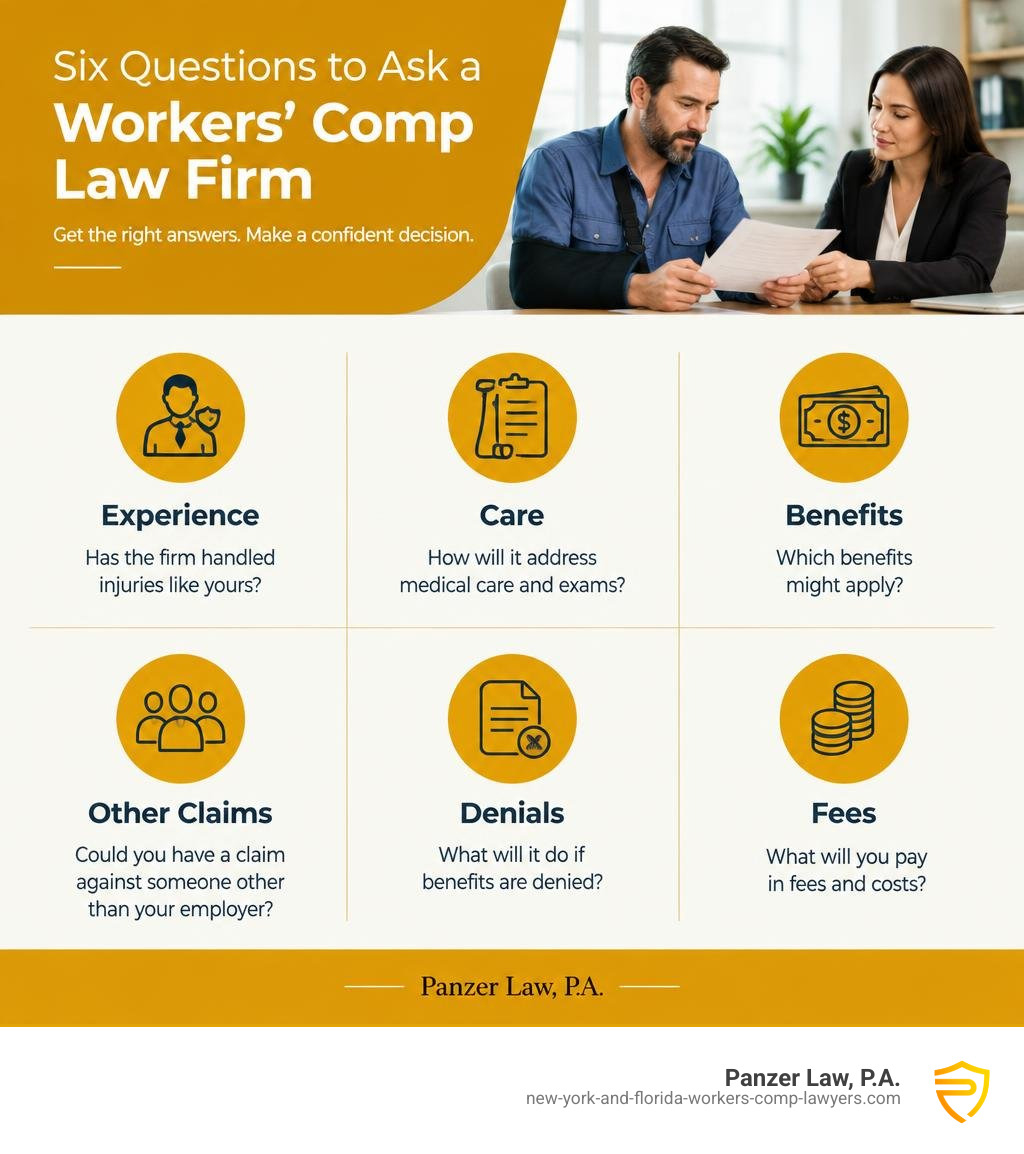
At your first consultation, ask six things: Has the firm handled injuries like yours? How will it address medical care and exams? Which benefits might apply? Could you have a claim against someone other than your employer? What will it do if benefits are denied? What will you pay in fees and costs? Clear answers will help you compare firms before you sign an agreement.
If your medical care or wage benefits are delayed, bring your injury report, medical records, pay information, and any letters from the insurer. You do not need to have every document to ask for help.
I’m Gil Panzer, owner and attorney at Panzer Law, P.A., a workers comp law firm representing injured workers in Florida and New York. I’ve practiced law for over three decades, helping clients with workers’ compensation claims, medical care, and settlements. According to the U.S. Bureau of Labor Statistics, private industry employers reported 2.6 million nonfatal workplace injuries and illnesses in 2023, underscoring how common these claims are.
Preparing for Your Initial Consultation with a Workers Comp Law Firm

Entering an initial legal meeting prepared can dramatically accelerate the progress of your case. Workplace injuries create immediate financial and physical strain, but walking into a legal consultation with the right materials gives your attorney an immediate advantage over insurance adjusters looking to reduce payouts.
Across the United States, roughly 2.8 million nonfatal workplace injuries and illnesses occur annually. When an accident strikes, gathering critical records helps substantiate your claim under current October 2026 legal standards. When preparing for your meeting, compile the following core items:
- Written Injury Notification: Documentation showing that you notified your employer of the injury within statutory deadlines.
- Incident Reporting Records: Official workplace incident logs, employer-generated injury reports, or supervisor memos detailing the event.
- Wage History Records: Recent pay stubs, W-2 forms, or direct deposit summaries covering the 13 weeks prior to the injury to establish your average weekly wage.
- Medical Treatment Documentation: Emergency room intake summaries, diagnostic test results, physical therapy notes, and prescription receipts.
- Employer and Insurer Correspondence: Any letters, emails, or texts regarding your work status, light-duty offers, or benefit delay notices.
- Witness Statements and Scene Evidence: Contact information of co-workers who saw the incident, photographs of the hazard, or video footage.
Taking these steps ensures you can efficiently find local workmans comp lawyers near you and receive an accurate preliminary assessment of what your case is worth.
The 6 Essential Questions to Evaluate Your Legal Representation
Selecting legal counsel is one of the most critical decisions you will make during your recovery. Not all law practices approach workplace injury claims with the same depth of trial readiness or technical focus. Use the following six questions to assess whether an advocate possesses the skill, resources, and dedication required to protect your livelihood.
1. What Is Your Experience Handling Specific Workplace Injury and Occupational Disease Claims?
Workplace injuries fall into two primary categories: acute industrial accidents and progressive occupational diseases. An acute industrial accident occurs as a single, unexpected event—such as a fall from scaffolding on a construction site, an equipment crush injury in a warehouse, or a motor vehicle crash during a delivery route. In contrast, an occupational disease develops over time due to repetitive physical stress or prolonged exposure to toxic environmental elements.
Certain industries present distinct, heightened hazards:
- Construction: High risk of traumatic brain injuries, spinal fractures, and electrocution.
- Transportation and Warehousing: High rates of severe musculoskeletal strains, joint tears, and vehicular impact injuries.
- Agriculture and Forestry: Exposure to dangerous machinery, repetitive strain, and chemical pesticides.
- Healthcare and Hospitality: Slip-and-fall trauma, back injuries from lifting patients, and exposure to infectious pathogens.
During your consultation, ask the attorney how many cases they have handled that mirror your specific medical diagnosis and industry setting. A firm seasoned in handling both acute trauma and complex occupational illnesses will understand how to connect your diagnosis directly to your workplace duties with sound medical evidence.
2. How Will Your Workers Comp Law Firm Approach Medical Treatment and Independent Medical Exams?
Medical benefits represent the backbone of your recovery. Under workers’ compensation rules, your employer’s insurance carrier generally selects or authorizes the treating physician. However, disputes frequently arise over diagnostic testing, surgical recommendations, and physical therapy regimens.

Insurance carriers routinely attempt to limit care through internal utilization reviews or by demanding an Independent Medical Examination (IME) or Defense Medical Evaluation (DME). These exams are performed by physicians chosen and compensated by the insurance carrier. These evaluations often attempt to argue that your condition is pre-existing, non-work-related, or completely healed.
Ask the attorney how they counter adverse IME reports. An experienced firm will:
- Coordinate with your authorized treating doctors to obtain comprehensive narrative reports.
- Cross-examine defense medical examiners on their methodology and potential carrier bias.
- Utilize statutory dispute mechanisms to request alternate authorized providers or second medical opinions when necessary.
- Ensure all necessary diagnostic imaging, specialized surgeries, and long-term rehabilitation programs receive proper carrier authorization.
3. What Types of Workers’ Compensation Benefits and Settlement Options Apply to My Case?
Workers’ compensation benefits are designed to replace lost income and pay for necessary medical rehabilitation. Generally, wage replacement benefits equal approximately two-thirds of your average weekly wage, subject to statutory maximum caps. Reviewing our top rated workers comp lawyer a practical guide can help you better understand the spectrum of available recovery options.
The primary forms of disability benefits include:
| Benefit Category | Description | Primary Purpose | Duration / Payout Basis |
|---|---|---|---|
| Temporary Total Disability (TTD) | Paid when a doctor states you cannot work at all during recovery. | Replaces lost income while you undergo active medical care. | Bi-weekly payments equal to roughly 66 2/3% of average weekly wage up to statutory caps. |
| Temporary Partial Disability (TPD) | Paid when you can work light duty but earn less than 80% of pre-injury pay. | Bridges the gap between reduced wages and pre-injury income. | Percentage of wage difference while under temporary medical restrictions. |
| Permanent Partial Disability / Impairment (PPD) | Paid once you reach Maximum Medical Improvement (MMI) with lasting impairment. | Compensates for permanent physical loss or loss of bodily function. | Based on an assigned impairment rating percentage schedule. |
| Permanent Total Disability (PTD) | Paid when catastrophic injuries permanently prevent any gainful employment. | Provides ongoing financial support for life-altering conditions. | Extended wage benefits, often continuing until age 75 or lifetime depending on statutes. |
Ask your legal advocate whether your case is best suited for ongoing bi-weekly benefit administration or a negotiated lump-sum settlement. A lump-sum settlement closes out medical or wage obligations in exchange for a single payment, which requires careful calculation to ensure future medical costs and Medicare interests are fully protected.
4. How Could a Third Party’s Negligence Affect My Workers’ Comp Case?
Workers’ compensation is a no-fault system that generally shields your direct employer from standard personal injury lawsuits. However, if an outside individual or company contributed to your injury, you may have the right to file a separate third-party personal injury lawsuit alongside your workers’ compensation claim.
Common third-party scenarios include:
- A negligent motorist colliding with your vehicle while you are driving for work.
- A subcontractor on a multi-employer construction site creating an unsafe hazard.
- The manufacturer of a defective machine, tool, or safety harness that failed during operation.
- A commercial property owner failing to maintain safe premises during a business visit.
Third-party lawsuits allow you to recover damages not provided by workers’ compensation, such as 100% of past and future lost earnings, pain and suffering, and emotional distress. Ask your attorney how they coordinate both actions and manage statutory subrogation liens, where the workers’ comp insurer seeks reimbursement from the third-party settlement.
5. What Steps Will Your Workers Comp Law Firm Take if My Claim Is Denied?
If an insurer refuses to pay your medical bills or denies wage-loss benefits, you need an aggressive, systematic plan of action. A quality law firm will outline a clear procedural timeline to overturn that denial.
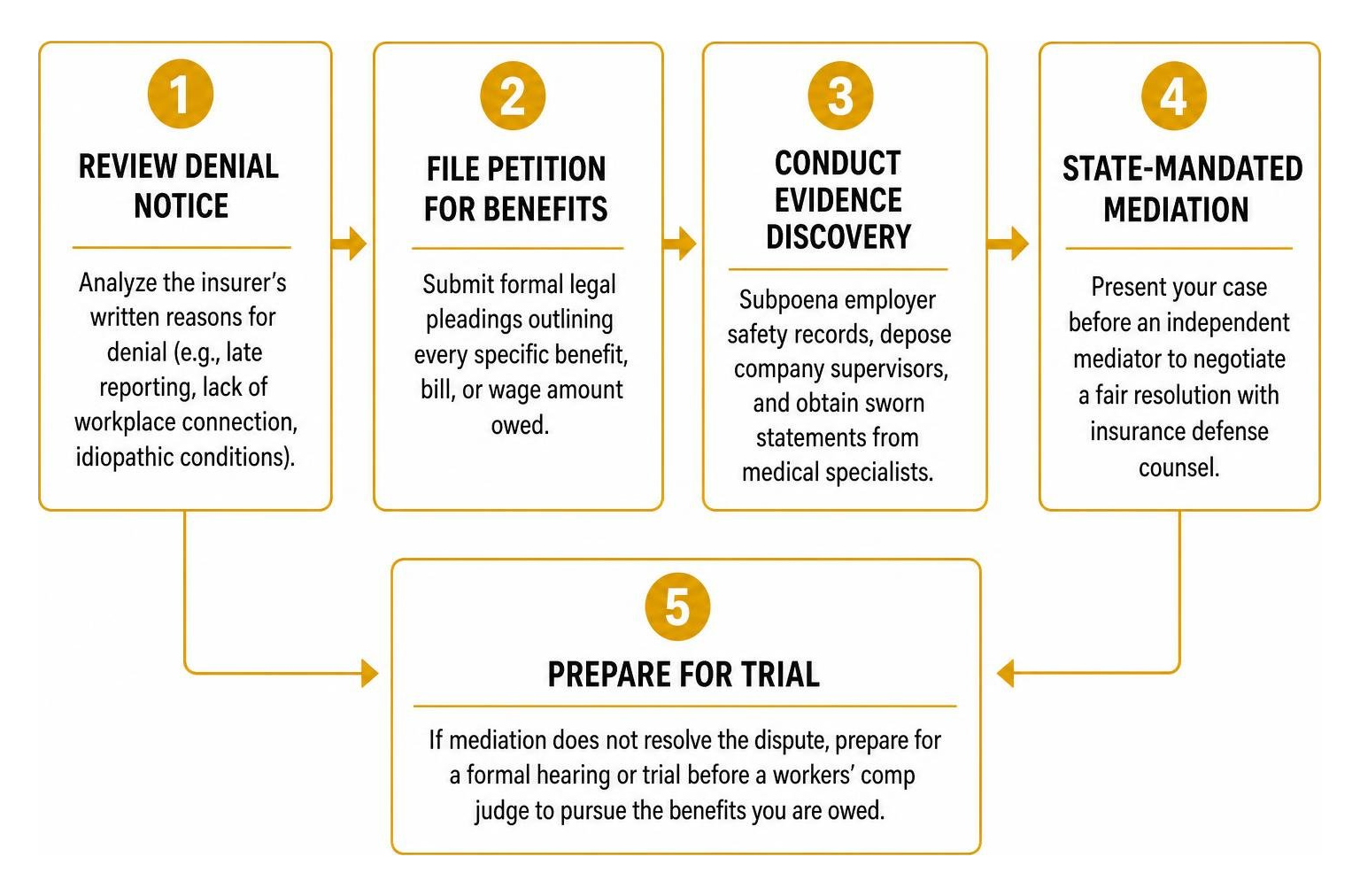
When an insurer issues a formal denial, the legal team should take immediate steps:
- Review the Notice of Denial: Analyze the carrier’s written reasons (e.g., alleging late reporting, lack of workplace connection, or idiopathic conditions).
- File a Formal Petition for Benefits: Submit formal legal pleadings outlining every specific benefit, bill, or wage amount owed.
- Conduct Evidence Discovery: Subpoena employer safety records, depose company supervisors, and obtain sworn statements from medical specialists.
- Participate in State-Mandated Mediation: Present your case before an independent mediator to negotiate a fair resolution with insurance defense counsel.
- Proceed to Final Trial / Merits Hearing: If the insurance company refuses to provide reasonable benefits, your attorney must be prepared to try your case before a workers’ compensation judge.
6. What Is Your Fee Structure and How Do Contingency Agreements Work?
Understanding how your legal representation is financed ensures total peace of mind. Reputable workers’ compensation lawyers represent injured employees on a contingency fee basis.
Under a contingency fee arrangement:
- You pay zero upfront retainers or out-of-pocket hourly rates.
- Attorney fees are paid only as a percentage of the financial benefits or settlement secured on your behalf.
- If no compensation is recovered, you owe no attorney fees.
Ask for total transparency regarding case costs, such as medical record fees, expert deposition costs, and court filing expenses. Your attorney should clearly explain how these expenses are advanced and recovered upon successful resolution of your case, ensuring you never face unexpected out-of-pocket bills.
Common Mistakes That Can Jeopardize Your Workers’ Compensation Case
Securing full workers’ comp benefits requires strict adherence to statutory rules. Many valid claims are delayed or completely denied due to avoidable errors early in the process:
- Delayed Injury Reporting: Waiting too long to report your injury to a supervisor can bar your claim under statutory deadlines.
- Seeking Unauthorized Medical Care: Except in life-threatening emergencies, treating with an unapproved physician without carrier authorization can leave you personally responsible for the bills.
- Omitting Medical History: Failing to disclose a prior injury to your treating physician allows insurance adjusters to argue that you committed fraud or concealed pre-existing conditions.
- Communicating Unrepresented with Claims Adjusters: Providing recorded statements or discussing settlement values directly with insurance adjusters without legal guidance can significantly undervalue your claim.
- Posting on Social Media: Insurance investigators actively monitor public social media profiles for photos or comments that could be taken out of context to argue you are not injured.
Frequently Asked Questions About Hiring Legal Counsel
How soon after a workplace injury should I contact an attorney?
You should reach out to legal counsel as soon as you have reported the injury to your employer and received emergency medical treatment. Early legal guidance ensures critical evidence is preserved, accident reports are filed accurately, and the insurance carrier does not direct your care toward unfavorable clinics. If you have additional concerns about statutory timelines, review our frequently asked questions for further information.
How do I know if my workers’ comp claim has officially been denied?
You will typically receive a formal written Notice of Denial (or Notice of Claim Denial) from the insurance company via certified mail. Additionally, if the authorized pharmacy rejects your injury prescriptions, or if the insurance adjuster states over the phone that benefits will not be issued, your claim is effectively being contested and demands immediate legal intervention.
Do I have to pay upfront costs for a workers’ comp consultation?
No. Reputable workers’ compensation law firms provide free, zero-obligation initial case evaluations. All subsequent representation is handled on a contingency fee schedule, meaning there are never any out-of-pocket costs to begin your case.
Conclusion
A serious workplace injury brings physical pain and unexpected financial stress, but you do not have to fight insurance companies alone. Asking these six critical questions will help you select legal representation that delivers trial experience, proactive medical management, and proven settlement results.
At Panzer Law, P.A., we exclusively represent injured workers across Florida and New York, ensuring our clients receive every dollar of wage compensation and every medical treatment authorized by law. Whether your accident occurred in Boca Raton, Miami, West Palm Beach, or throughout Palm Beach County and Miami-Dade County, our team provides dedicated advocacy with no fees or costs unless we recover funds for you.
If your benefits have been delayed, underpaid, or denied, consult an experienced Florida workers’ compensation lawyer today. Contact us to schedule your free, confidential case evaluation and take the first step toward securing the recovery you deserve.
