

How to Find a Work Injury Attorney Near You
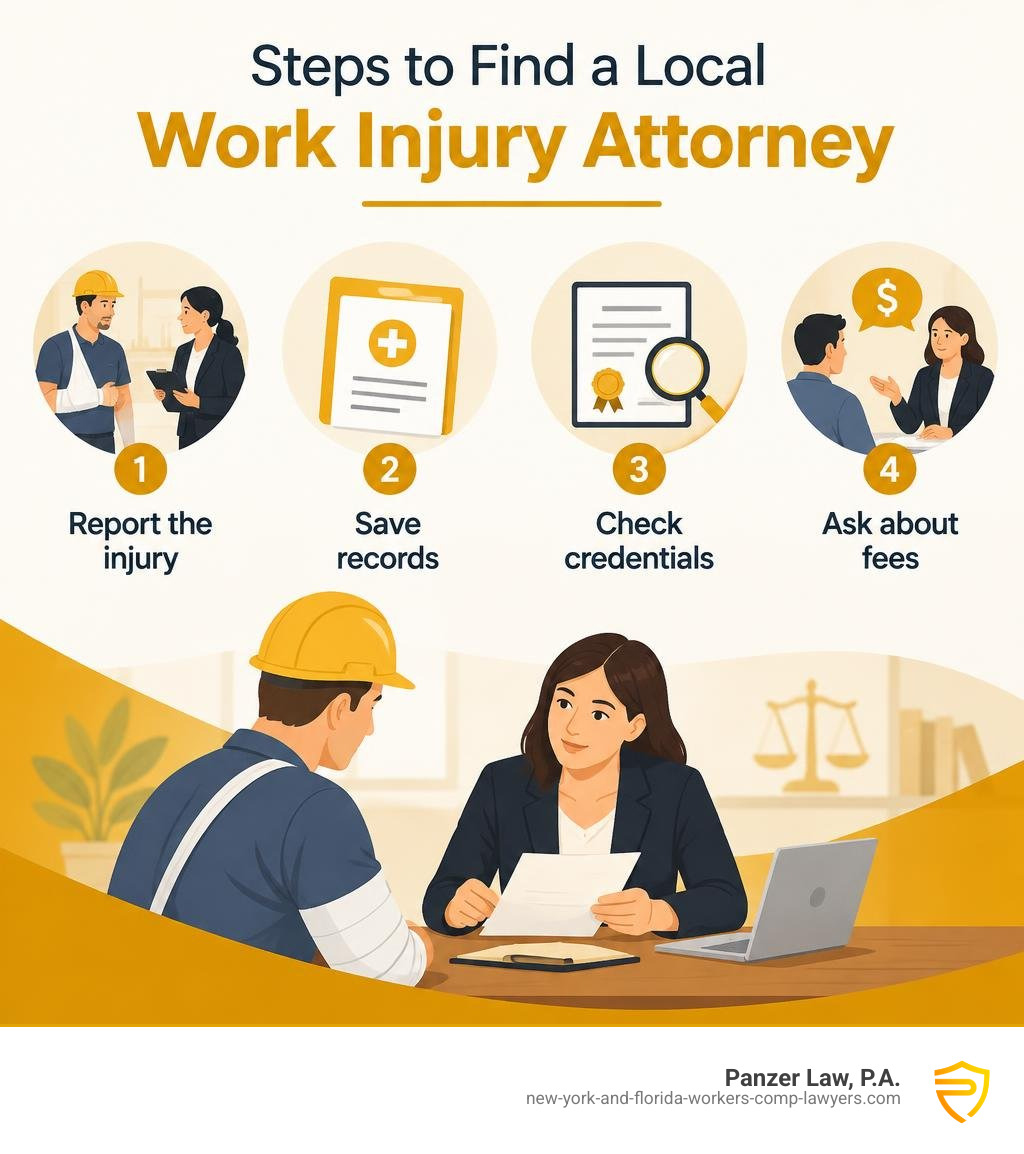
To find a work injury attorney near you, start with lawyers licensed in your state who regularly handle workers’ compensation claims. Check their state bar records, then use a free consultation to ask who will handle your case, how they would address delayed benefits, and what fees or costs you might owe.
If you were hurt at work in Florida, report the injury to your employer as soon as possible. You generally have 30 days to give notice. Seek medical care, keep copies of your records, and tell the lawyer if treatment or wage payments have been denied or delayed.
I’m Gil Panzer, owner and attorney at Panzer Law, P.A., and I have more than three decades of legal experience representing injured workers in Florida and New York. If you searched for a work related injury attorney near me, this guide will help you compare local lawyers and prepare for that first conversation.
Immediate Steps to Take After a Workplace Accident
Experiencing an injury on the job disrupts your life in an instant. Across the country, workplace accidents remain a staggering reality—U.S. workers incurred 2.48 million injuries in 2024 alone. Knowing what to do in the immediate aftermath of an accident protects both your physical recovery and your legal rights.
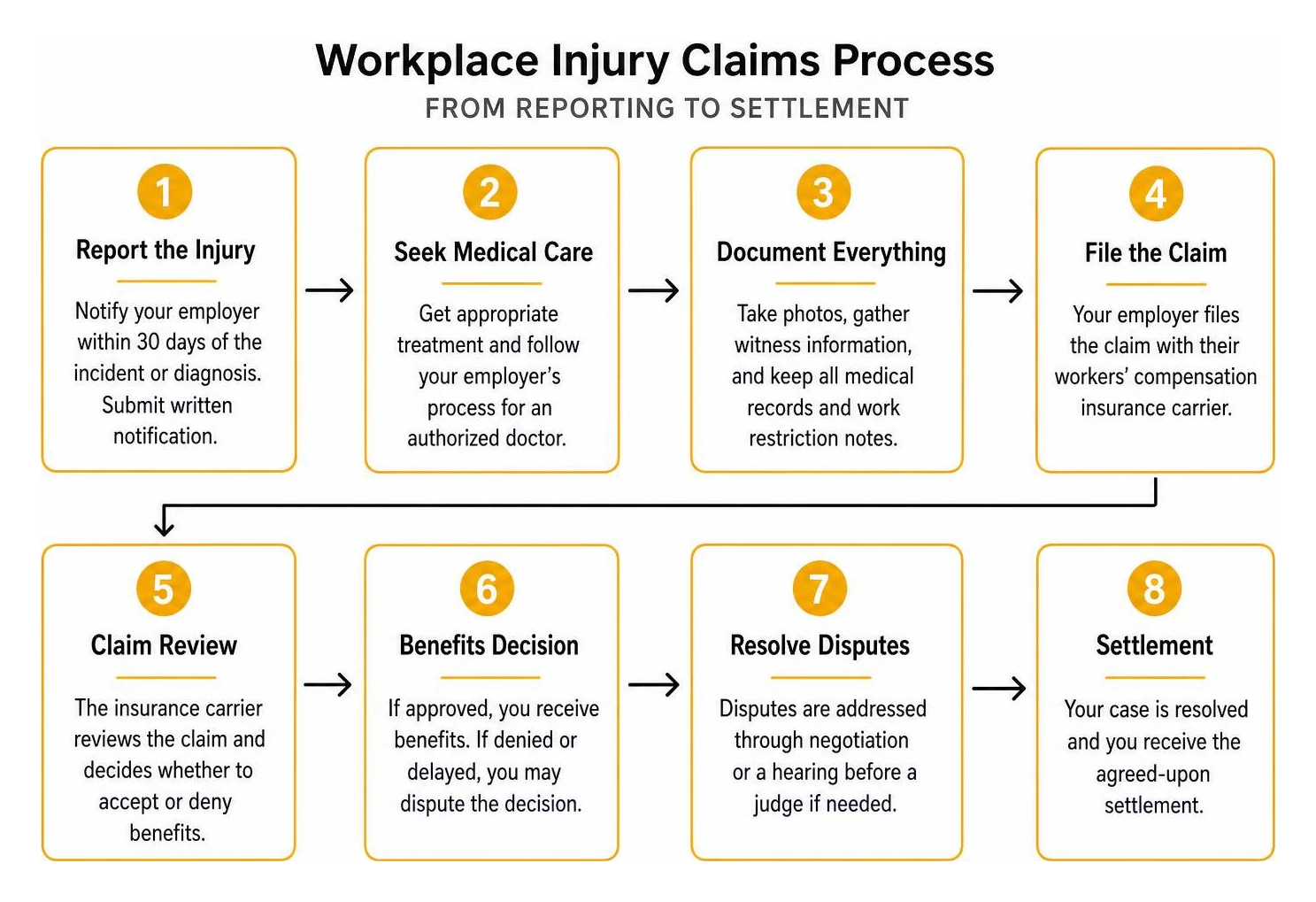
First, seek emergency medical care immediately if your injuries are severe. If you are stable, your immediate obligation under Florida law is to formally notify your employer. You must report the accident within 30 days of the incident or within 30 days of when a doctor first informs you that your condition is job-related. Failing to meet this 30-day reporting window gives the insurance carrier an easy excuse to deny your entire claim.
When reporting your accident:
- Submit written notification: Do not rely exclusively on a verbal conversation with a supervisor. Send an email or fill out an official incident report form, and keep a timestamped copy for yourself.
- Request an authorized treating physician: In Florida, your employer’s workers’ compensation insurance carrier selects your doctor. Except in life-threatening emergencies, treating with an unauthorized personal physician without insurer approval can leave you responsible for the bills.
- Document everything: Take clear photographs of the accident scene, your physical injuries, any defective equipment, and write down the names and contact details of any eyewitnesses.
- Preserve financial and medical records: Keep a dedicated folder containing all work restriction notes, diagnostic results, mileage logs for medical appointments, and out-of-pocket receipts.
Many injured employees wonder whether their situation calls for a workers’ comp claim or a personal injury lawsuit. Understanding the fundamental differences between these two legal avenues is vital when evaluating your legal options with a Florida workers compensation lawyer.
| Feature | Workers’ Compensation Claim | Third-Party Personal Injury Lawsuit |
|---|---|---|
| Fault Requirement | No-fault system (benefits apply even if you caused the accident) | Must prove another party acted with negligence |
| Target Defendant | Employer’s workers’ comp insurance carrier | Negligent third party (subcontractor, equipment manufacturer, driver) |
| Medical Coverage | 100% of reasonable, authorized medical treatment | Past and future medical expenses recovered as damages |
| Wage Replacement | Percentage of pre-injury Average Weekly Wage (typically 66 2/3%) | 100% of past and future lost earning capacity |
| Pain and Suffering | Not available under state statute | Fully recoverable as non-economic damages |
When to Search for a Work Related Injury Attorney Near Me
While minor injuries with cooperative employers may resolve smoothly, complex claims require specialized legal counsel. You should immediately look to find local workmans comp lawyers near you if you encounter any of the following warning signs:
- Claim Denials or Benefit Delays: The insurance adjuster sends a formal notice denying your claim, alleging your injury occurred off the clock, or fails to deliver your biweekly indemnity checks on time.
- Disputes Over Injury Severity: The authorized physician minimizes your pain, refuses to order essential diagnostics like MRIs, or claims your condition stems from a “pre-existing” degenerative issue.
- Pressure to Return to Full Duty: Your employer demands that you perform tasks that violate the physical restrictions established by your treating doctor.
- Threats and Workplace Retaliation: Your employer cuts your hours, demotes you, or threatens termination because you exercised your right to report an on-the-job injury.
Understanding Your Workers’ Compensation Benefits and Third-Party Claims
Under Florida’s statutory framework, an injured employee is entitled to several core categories of benefits. Authorized medical benefits cover doctor visits, surgeries, physical therapy, prescription medications, assistive medical devices, and travel reimbursement for medical appointments.
When your injury prevents you from working, indemnity benefits step in. These include:
- Temporary Total Disability (TTD): Paid at approximately 66 2/3% of your pre-injury Average Weekly Wage (AWW) if you cannot work at all during recovery.
- Temporary Partial Disability (TPD): Paid when you can return on light-duty restrictions but earn less than 80% of your pre-injury earnings.
- Permanent Impairment Benefits (PIB): Financial compensation awarded once you reach maximum medical healing, based on a permanent impairment rating assigned by your doctor.
- Vocational Rehabilitation: Training and education assistance if your permanent restrictions prevent you from returning to your past occupation.
In certain workplace accidents, liability extends beyond your direct employer. If you were injured on a job site due to a careless subcontractor, a defective piece of heavy machinery, or a reckless motorist while driving for work, you may pursue a third-party civil lawsuit in addition to your workers’ compensation benefits. Seeking guidance from seasoned workers’ compensation lawyers in Miami-Dade County allows you to pursue both avenues simultaneously, maximizing your overall financial recovery.
How to Choose the Best Work Related Injury Attorney Near Me
Selecting the right legal advocate is one of the most critical decisions you will make during your recovery. Not all attorneys possess the trial readiness and procedural knowledge required to outmaneuver aggressive insurance defense firms.

To identify an advocate who will fiercely protect your interests, follow these proven evaluation criteria outlined in our top rated workers comp lawyer practical guide:
- Verify Specialized Focus: Workers’ compensation operates under an entirely unique administrative legal system. A general practice attorney who handles unrelated legal matters will rarely have the nuanced tactical insight needed for complex medical hearings. Look for deep subject-matter dedication and specific administrative board certifications in their jurisdiction.
- Review State Bar Standing: Always search your state’s bar association directory to confirm that the attorney is an active member in good standing with zero disciplinary suspensions or formal reprimands.
- Assess Trial Experience and Resources: Insurance carriers track which lawyers actually take cases to trial before the Judge of Compensation Claims and which ones quickly accept low settlement offers. You want a firm with the financial resources to hire credible medical experts and litigate aggressively.
Essential Questions to Ask a Work Related Injury Attorney Near Me
During your initial consultation, you are interviewing the lawyer to see if they are the right fit for your case. Bring these direct questions to the table:
- How many years have you specifically focused on workers’ compensation litigation?
- Will you personally handle my depositions and hearings, or will my file be passed to an inexperienced paralegal?
- What is your specific strategy for overcoming the insurance company’s current defenses or delays in my claim?
- How frequently will your team provide me with updates regarding my medical authorizations and settlement posture?
- Do you advance all litigation costs, and what happens to those costs if we do not win?
Understanding Legal Fees and the Contingency Model
Hiring premier legal representation should never depend on whether you have cash in the bank while out of work. Legitimate workers’ compensation lawyers operate strictly on a contingency fee basis.
Under this model:
- You pay zero upfront retainers or hourly out-of-pocket fees.
- Your attorney only receives payment if they successfully recover benefits, back pay, or a lump-sum settlement on your behalf.
- Attorney fees in workers’ compensation are regulated and capped by state law. In Florida, fees are based on a statutory sliding scale (typically 20% of the first $5,000 in benefits secured, 15% of the next $5,000, and 10% of remaining amounts over a ten-year period), or determined through court-approved carrier-paid fees when the insurer wrongfully denies benefits.
Whether you work with our team in South Florida or consult a New York workers compensation lawyer, a clear, transparent contingency fee agreement ensures your legal team’s financial interests remain completely aligned with your own.
Navigating Denials, Settlement Valuations, and Case Timelines
If the insurance carrier denies your medical treatment or cuts off your wage checks, your lawyer will file a formal Petition for Benefits (PFB) with the Office of the Judges of Compensation Claims. This document outlines the exact benefits the carrier has wrongfully withheld.

The filing of a PFB triggers mandatory statutory timelines, requiring the insurer to either provide the requested benefits within a strict window or attend formal mediation proceedings. If the carrier refuses to act reasonably at mediation, your attorney will present medical evidence, deposition testimony, and legal briefs at a formal evidentiary trial before the judge.
What Determines a Reasonable Workers’ Comp Settlement?
A reasonable settlement is never a random number—it is a detailed calculation designed to secure your long-term financial stability. Severe injuries carry substantial financial stakes; for instance, National Safety Council data indicates that neck injuries averaged $70,575 per lost-time claim across 2022 and 2023.
Key factors that determine the value of your settlement include:
- Future Medical Exposure: The projected cost of all future surgeries, physical therapy, diagnostic scans, and prescription medications over your lifetime.
- Average Weekly Wage (AWW) Calculations: Errors in how the insurer initially calculated your pre-injury earnings can significantly reduce your settlement value if left uncorrected.
- Permanent Impairment Rating (PIR): The formal impairment percentage assigned once you reach Maximum Medical Improvement (MMI).
- Loss of Earning Capacity: Your demonstrated inability to return to your prior wages or find sedentary work within your local labor market.
A word of caution: Insurance adjusters frequently dangle quick, lowball settlement offers to unrepresented workers before they reach MMI. Accepting an early buyout permanently closes your right to future medical care for that injury.
How Long Does a Workers’ Compensation Settlement Take?
Settlement negotiations cannot responsibly occur until you reach Maximum Medical Improvement (MMI)—the point where your treating doctors determine your condition has stabilized and is unlikely to improve further.
Straightforward claims where liability is undisputed may settle within several months. Conversely, contested claims involving disputed surgeries, Independent Medical Examinations (IMEs), or complex third-party liability can take a year or more to reach a favorable resolution. A dedicated legal team keeps the carrier’s feet to the fire, preventing unnecessary administrative stalls while ensuring your case is built for maximum recovery.
Frequently Asked Questions About Work Injury Claims
Navigating an injury claim raises countless legal and logistical questions. We provide detailed answers below, and you can explore our comprehensive frequently asked questions page for additional resources.
Can I sue my employer directly for a job-related injury?
In the vast majority of cases, no. Workers’ compensation is an exclusive remedy system. In exchange for receiving guaranteed medical care and wage benefits without proving fault, employees surrender the right to sue their employer in civil court for ordinary negligence. However, critical exceptions apply:
- Intentional Torts: Your employer engaged in conduct virtually certain to result in injury or death.
- Uninsured Employers: Your employer failed to carry mandatory workers’ compensation insurance coverage.
- Gross Negligence: Situations involving extreme safety violations that bypass statutory immunity.
What happens if my employer refuses to report my injury?
It is illegal for an employer to hide or refuse to report a documented work injury. If your supervisor refuses to file a First Report of Injury with their insurance company, an attorney can bypass your employer entirely. Your lawyer will identify the carrier through state administrative databases, submit your claim directly, and file an immediate Petition for Benefits to compel prompt medical authorization.
How long do I have to file a claim after getting hurt at work?
Statutory deadlines vary significantly across states. In Florida, you must give formal notice to your employer within 30 days of the accident, and you have two years from the date of injury (or from the date of your last authorized medical treatment) to file a formal Petition for Benefits. Missing these strict statutes of limitations will permanently bar you from recovering compensation.
Conclusion
A workplace accident can shake your financial foundation, but you do not have to confront insurance carriers and their defense lawyers alone. Having a relentless advocate by your side levels the playing field, protects your medical treatment, and secures the full value of the benefits you have earned through your hard work.
At Panzer Law, P.A., we bring decades of dedicated experience fighting for injured workers across South Florida—including Boca Raton, Miami, West Palm Beach, Palm Beach County, and Miami-Dade County. We handle every case under our strict no-recovery, no-fee promise, meaning you owe us nothing unless we win compensation for you.
Take the first step toward reclaiming your future. Contact us today or schedule a free consultation to speak directly with an experienced advocate who will put your recovery first.
