

Understanding the Free Consultation Workers Comp Process
Navigating an on-the-job injury can feel overwhelming. Between dealing with physical recovery, managing doctor appointments, and worrying about how you will pay your bills, adding legal disputes to the mix is the last thing you need. That is where a formal case evaluation becomes an essential resource for injured workers.
In everyday language, a consultation refers to a meeting where you seek expert advice or formal deliberation on an important matter. In the legal sphere, a free consultation is a structured, zero-risk opportunity to sit down with a dedicated legal professional who understands the system inside and out.
When you attend a case evaluation, our primary objective is to review your current legal rights, assess the strength of your case, and outline a straightforward strategy. Many injured employees are unaware that Florida’s workers’ compensation system operates under rigid statutory frameworks. A single misstep—like failing to provide specific written notices or seeing an unauthorized physician—can severely jeopardize your right to benefits. By looking at your incident details early, we help guide you through the initial steps covered in A Practical Guide to Filing Workers Comp Claims so you do not accidentally harm your case before it even gets off the ground.
What Happens During a Free Consultation Workers Comp Meeting
A standard initial meeting typically lasts between 30 and 60 minutes, depending on the complexity of your injury and where you currently stand in the claims process. During this confidential session, we conduct a structured intake to get the full picture of your situation:
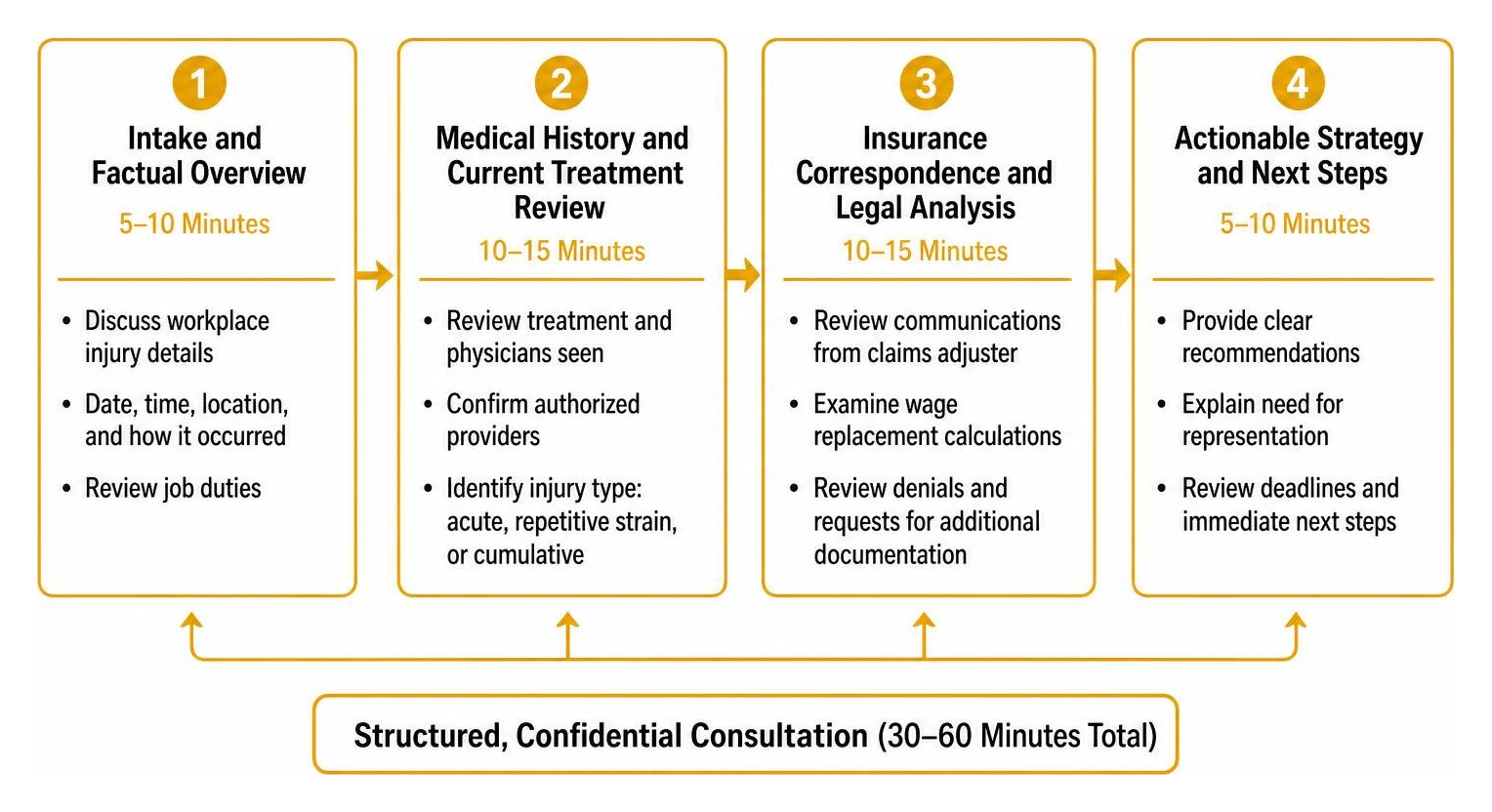
- Intake and Factual Overview (5–10 Minutes): We begin by discussing the circumstances surrounding your workplace injury. We will ask about the date, time, physical location, and exact mechanism of how the injury occurred, as well as your job duties.
- Medical History and Current Treatment Review (10–15 Minutes): We review any treatment you have received, the physicians you have seen, and whether the employer or insurance carrier authorized those providers. We also explore whether you are dealing with an acute trauma, a repetitive strain condition, or a cumulative occupational injury.
- Insurance Correspondence and Legal Analysis (10–15 Minutes): We examine all communications you have received from the workers’ compensation claims adjuster. This includes wage replacement calculations, notices of denial, or requests for additional documentation.
- Actionable Strategy and Next Steps (5–10 Minutes): Finally, we provide clear recommendations. We explain whether you need formal representation, what deadlines apply, and what initial actions should be taken immediately to protect your benefits.
Everything discussed during this meeting is strictly confidential and protected by attorney-client privilege, even if you decide not to hire our firm moving forward.
How Legal Guidance Preserves Deadlines and Maximizes Claim Value
One of the greatest hazards facing injured workers is delay. Most individuals wait weeks or months before speaking to an attorney, assuming the insurance carrier will automatically treat them fairly. Unfortunately, claims adjusters are trained to protect the insurer’s bottom line, which often leads to undervalued settlements or missed statutory windows.
In Florida, you must report an on-the-job injury to your employer within 30 days of the incident, or within 30 days of when a doctor first informs you that your medical condition is work-related. Missing this critical window can result in a complete forfeiture of your right to workers’ comp benefits. Beyond the initial notification, the general statute of limitations requires petitions for benefits to be filed within strict statutory periods—usually within two years of the injury date, or within one year of the last payment of indemnity benefits or provision of authorized medical treatment.
Failing to secure professional advice can also carry a steep financial penalty. Consider a common scenario: without legal counsel, an injured construction worker suffering from a severe lumbar disc injury might accept an early settlement offer of $15,000 from the insurance company. However, an experienced attorney reviewing the case might discover that the worker is entitled to ongoing medical coverage and permanent impairment benefits valued at $40,000 or more. That is a $25,000 difference caused simply by lacking seasoned representation. When you need local support across South Florida, taking the initiative to Find Local Workmans Comp Lawyers Near You ensures that your future medical care and disability rights remain fully protected.
How to Prepare and What to Bring to Your Case Evaluation
To make the most of your consultation, arriving organized will help your attorney analyze the nuances of your claim quickly and give you actionable advice.

Gathering your documents ahead of time ensures that no critical detail is missed. Here is a helpful checklist of essential items to bring to your consultation:
- Incident and Employer Reports: A copy of the written injury report provided to your supervisor, the First Report of Injury form, or any incident logs generated by your workplace.
- Medical Records and Discharge Papers: Emergency room discharge summaries, urgent care notes, diagnostic test results (such as X-rays, MRIs, or CT scans), work-status slips outlining your physical restrictions, and future treatment plans.
- Insurance Carrier Correspondence: Any letters, emails, or formal notices from the insurance company, especially letters denying benefits, adjusting wage amounts, or assigning a claim number.
- Wage and Employment Documentation: Recent pay stubs (covering the 13 weeks prior to the injury date if available), tax forms (W-2 or 1099), and your job description.
- Visual Evidence: Photographs or videos of the accident scene, broken machinery, defective equipment, hazardous floor conditions, and your visible injuries.
- Witness Information: Names, job titles, and contact details of any coworkers or third parties who saw the accident take place or can testify to the physical conditions of the job site.
Key Questions to Ask During Your Free Consultation Workers Comp Review
A consultation is not just an opportunity for an attorney to evaluate your claim; it is also your chance to evaluate the attorney. You want to make sure you are partnering with a lawyer who has deep familiarity with workers’ compensation matters.
Consider asking these essential questions during your meeting:
- How many years of experience do you have handling workers’ compensation claims in Florida?
- What specific challenges or hurdles do you see with my case?
- How will your firm handle communications, and how frequently will I receive updates regarding my claim?
- What is the estimated timeline for resolving the disputes in my case, such as securing medical authorization or back wages?
- If the insurance company refuses to negotiate fairly, are you prepared to take my claim before a Judge of Compensation Claims?
Working with a dedicated Florida Workers Compensation Lawyer ensures you have an advocate who understands the specific tactics insurance companies use to undervalue your claim.
How Contingency Fees and No-Fee-Unless-You-Win Agreements Work
Many injured workers hesitate to call a lawyer because they worry about exorbitant legal fees. However, workers’ compensation attorneys operate under a contingency fee model. This means you never pay any upfront retainers or out-of-pocket hourly rates.
Under Florida law, attorney fees in workers’ compensation claims must adhere to strict statutory guidelines and are subject to oversight and approval by a Judge of Compensation Claims (JCC). If we do not recover money or secured benefits for you, you owe us nothing.
| Feature | Contingency Fee Structure | Traditional Hourly Legal Billing |
|---|---|---|
| Upfront Retainer | $0 (No upfront payment required) | Often thousands of dollars upfront |
| Hourly Invoices | None (You are never billed per hour) | Monthly bills for phone calls, emails, and research |
| Payment Trigger | Paid only upon successful financial recovery | Paid regardless of case outcome |
| Judicial Oversight | Fees must be approved by a workers’ comp judge | Governed by private contract |
| Financial Risk | Zero financial risk to the injured worker | Client assumes all financial risk |
This structure ensures that legal representation is accessible to everyone, aligning our interests directly with yours: our goal is to maximize your recovery while eliminating your financial stress.
When to Schedule Legal Help and Handling Denied Claims
Knowing when to schedule a consultation can mean the difference between a smooth recovery and months of financial hardship. If your claim is progressing without disputes and all authorized care is being provided promptly, you may simply want a baseline understanding of your rights. However, several clear warning signs demand immediate legal intervention.

If you are facing roadblocks, connecting with a professional to Find a Florida Workers Comp Lawyer for Your Claim can immediately reset the balance of power between you and the insurance company.
Critical Triggers for Booking an Immediate Consultation
You should reach out for a legal review right away if you encounter any of the following scenarios:
- Delayed or Incorrect Wage Replacement: Your indemnity checks (temporary total or partial disability benefits) are arriving late, stopping unexpectedly, or are calculated incorrectly based on your average weekly wage.
- Unauthorized or Delayed Medical Care: The insurance adjuster refuses to authorize specialist consultations, diagnostic tests (like an MRI), necessary surgeries, or physical therapy prescribed by your treating physician.
- Premature Maximum Medical Improvement (MMI): An authorized doctor suddenly claims you are fully healed and gives you a 0% impairment rating despite lingering pain and physical limitations.
- Workplace Retaliation or Harassment: Your employer cuts your hours, demotes you, threatens termination, or creates a hostile environment because you reported an injury or filed a claim.
- Lowball Settlement Offers: The adjuster contacts you out of the blue offering a quick lump-sum payment if you agree to close out your medical rights and release your claim.
Overcoming Common Reasons Insurers Deny Work Injury Claims
Insurance companies frequently deny legitimate workers’ compensation claims in an effort to avoid paying expensive medical bills and ongoing wage benefits. Common denial rationales include:
- Alleged Missed Deadlines: The insurer claims you failed to report the accident to your supervisor within the mandatory 30-day reporting window.
- Pre-Existing Condition Arguments: The carrier asserts that your pain is the result of an older non-work injury or degenerative disc disease rather than the specific workplace incident.
- Injury Outside Course of Employment: The claims adjuster argues that the accident occurred during your personal commute (the “going and coming” rule) or while engaged in prohibited horseplay.
- Insufficient Objective Medical Evidence: The insurance company contends that the medical documentation does not clearly connect your current physical limitations to the workplace incident.
During a case evaluation, we review the exact denial language, identify the evidentiary gaps, and assemble the necessary medical records and witness testimony to challenge the denial before a judge.
Debunking Common Myths About Free Legal Consultations
Misunderstandings often keep injured workers from taking advantage of legal help. Let’s set the record straight on a few common myths:
- Myth 1: “A free consultation comes with hidden strings attached.” Reality: A free consultation is genuinely 100% free. There are no hidden administrative charges, secret consultation fees, or surprise bills sent to your home afterward.
- Myth 2: “I will be pressured into signing a contract immediately.” Reality: An ethical consultation is an educational session designed to inform you of your rights. You are under zero obligation to retain the attorney and are encouraged to take your time making the decision that is best for your family.
- Myth 3: “Consulting a lawyer means I have to sue my boss.” Reality: Workers’ compensation is an administrative, no-fault insurance system. You are filing a claim against the employer’s insurance policy, not bringing a lawsuit against your employer personally.
- Myth 4: “I can handle everything myself since workers’ comp is no-fault.” Reality: While the system is designed to provide benefits regardless of fault, the legal and procedural rules are complex. Adjusters use these rules to minimize payouts, making legal experience invaluable.
For more answers to common concerns about workplace injuries, visit our Frequently Asked Questions page.
Frequently Asked Questions About Workers Comp Consultations
How long does a free workers’ comp consultation take?
A free workers’ comp consultation typically lasts between 30 and 60 minutes. This provides ample time to review your accident details, examine medical documentation and wage statements, identify critical filing deadlines, and outline a clear legal strategy tailored to your specific situation.
Will my employer find out if I schedule a free consultation?
No. Your consultation is completely confidential and protected by attorney-client privilege from the moment you contact our office. We will never contact your employer or inform their insurance adjuster that you have requested a legal case review without your explicit consent and formal retention.
Do I have to hire the attorney after the initial meeting?
No, there is absolutely no obligation to hire the attorney after your free case review. The consultation is an informational, no-pressure opportunity for you to understand your legal rights, assess your options, and determine if our firm is the right fit for your needs.
Conclusion
Suffering an injury on the job disrupts your life, your health, and your household income. Navigating Florida’s complex workers’ compensation rules alone puts you at an immediate disadvantage against experienced insurance adjusters whose goal is to minimize claim payouts.
Scheduling an evaluation gives you complete clarity on your rights, safeguards your statutory filing deadlines, and ensures your medical needs are taken seriously—all with zero out-of-pocket financial risk.
At Panzer Law, P.A., our team has dedicated over three decades to protecting injured workers across South Florida, including Miami-Dade County and Palm Beach County, with offices conveniently located in Miami, Boca Raton, and West Palm Beach. To take control of your claim and start pursuing the full benefits you deserve, connect directly with our Workers Comp Law Firm Panzer Law today to schedule your complimentary case review.
