

How a Workers’ Comp Attorney in West Palm Beach Can Help
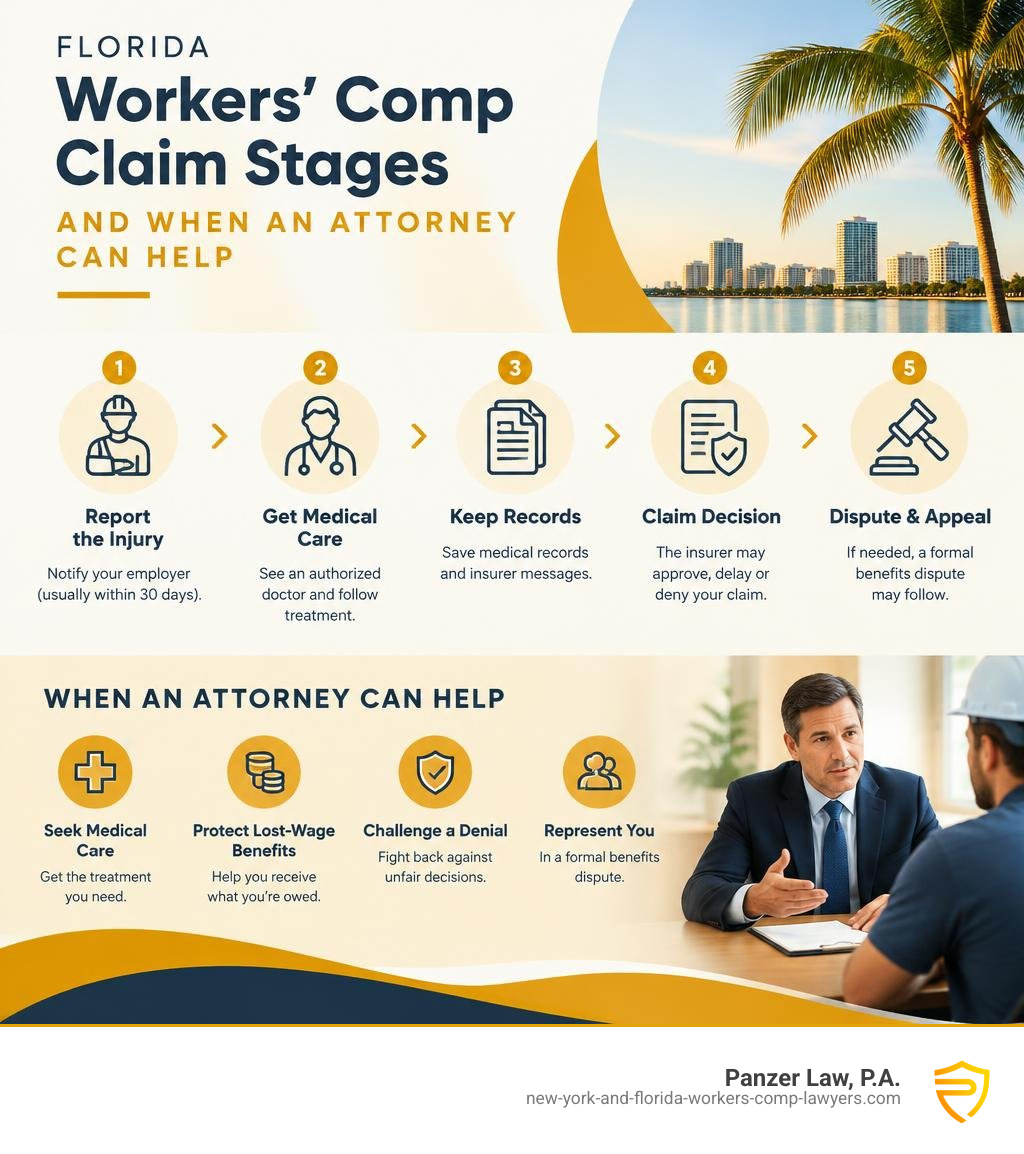
If your work injury claim is delayed or denied, a workers’ comp attorney can help you seek medical care and lost-wage benefits. Report the injury to your employer as soon as possible, generally within 30 days. Ask which doctor is authorized to treat you, and keep copies of your medical records and messages from the insurer.
A lawyer can also challenge a denial, address delayed treatment, and represent you in a formal benefits dispute. You do not have to sort through those steps alone.
I’m Gil Panzer, owner and attorney at Panzer Law, P.A., and I’ve represented injured workers for more than three decades. Working with an experienced workers comp attorney West Palm Beach employees trust ensures your statutory rights remain protected. This guide helps you understand your legal options and how partnering with the best workers comp lawyers in florida can safeguard your recovery. If you have questions about your claim, speaking with a Florida workers’ compensation lawyer or finding an experienced workers compensation lawyer in florida can make all the difference.
Understanding the Role of a Workers Comp Attorney West Palm
At its core, the term “attorney” refers to an authorized representative empowered to act on behalf of another in legal proceedings. In administrative and civil law, an attorney-at-law provides formal counsel, drafts legal pleadings, conducts negotiations, and presents evidence before judicial tribunals. In workplace injury law, finding a dedicated workers comp attorney in West Palm Beach ensures you have an advocate who understands the intricate balance between statutory employer obligations and employee rights.
Unlike general practitioners who manage diverse civil lawsuits, workers’ compensation lawyers dedicate their practices to statutory benefit schemes. When you retain an attorney, they step into your shoes for all communication with insurance adjusters, claims examiners, employer defense panels, and administrative judges. They handle every legal filing, protect your privacy, and ensure insurance carriers do not circumvent state requirements.
Workers’ Compensation-Specific Legal Advocacy
The Florida workers’ compensation legal framework operates under Chapter 440 of the Florida Statutes. This system is administrative and operates largely outside standard civil trial courts. Disputed claims are resolved before the Office of the Judges of Compensation Claims (OJCC), a specialized state division created to handle benefit conflicts swiftly.
Insurance carriers retain experienced defense counsel whose primary objective is to limit financial payouts. These adjusters often argue that your condition stems from a pre-existing injury, question your work restrictions, or deny recommended surgeries. As claimant advocates, we balance the scales. We gather supportive medical records, depose authorized physicians, file formal Petitions for Benefits, and negotiate settlements that account for your future care needs.
Professional Standards, Bar Standing, and Ethical Regulations
Any attorney representing injured employees in Florida must maintain active membership and good standing with The Florida Bar. Maintaining good standing requires strict compliance with continuing legal education, ethical conduct standards, and client trust accounting rules. The Florida Bar’s attorney discipline and ethics rules govern these professional obligations.
In Florida’s court systems and administrative databases, an attorney’s ability to file pleadings and access records depends directly on their active Bar status. If an attorney fails to maintain good standing, their access to judicial filing portals is revoked immediately. When choosing legal representation, confirming that your lawyer is an active member in good standing with The Florida Bar guarantees your claim is managed with professionalism, ethics, and care.
Navigating the Florida Workers’ Compensation Claims Process
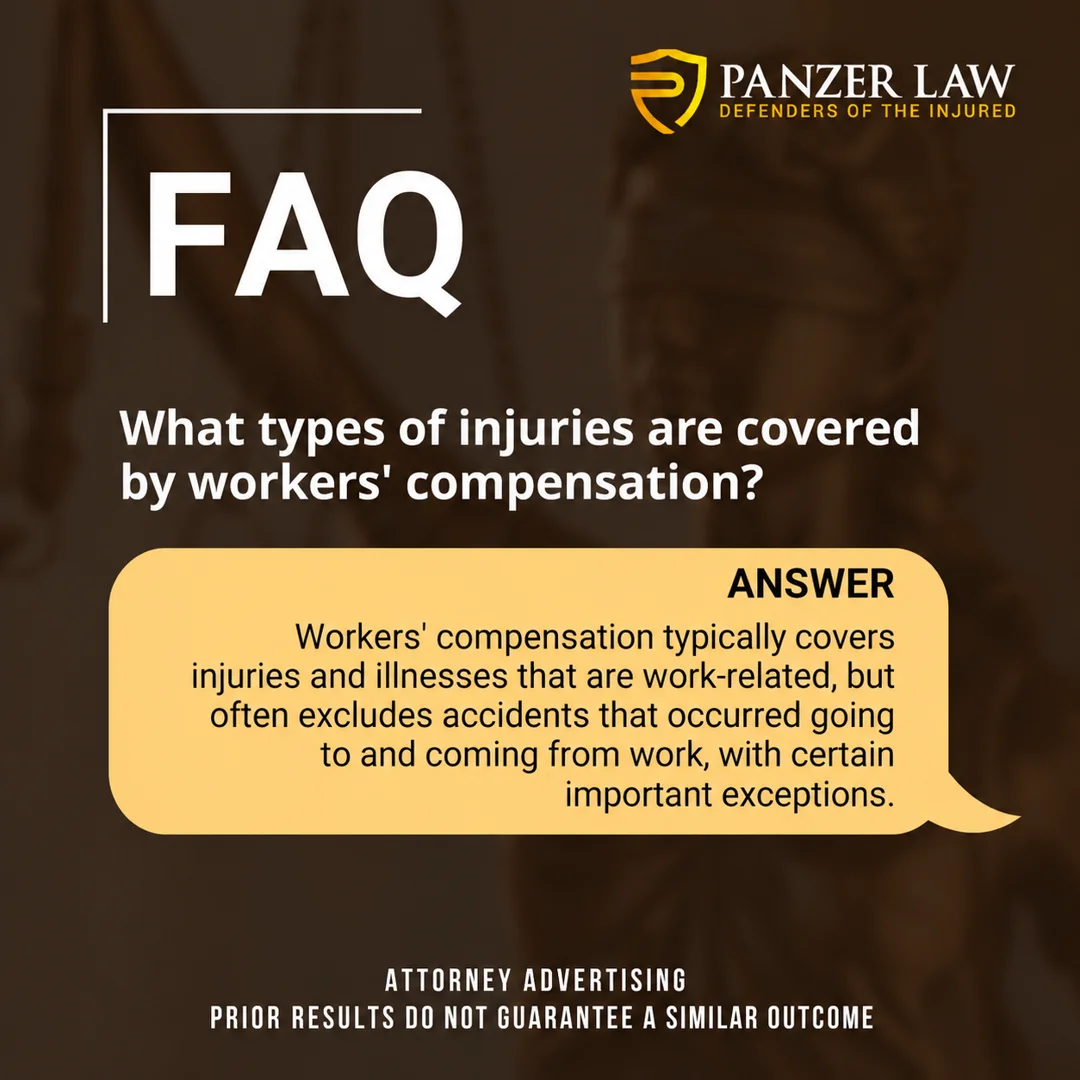
The Florida workers’ compensation system requires careful attention to statutory timelines and procedural rules. Missing a deadline or visiting an unauthorized clinic can jeopardize your entire claim.
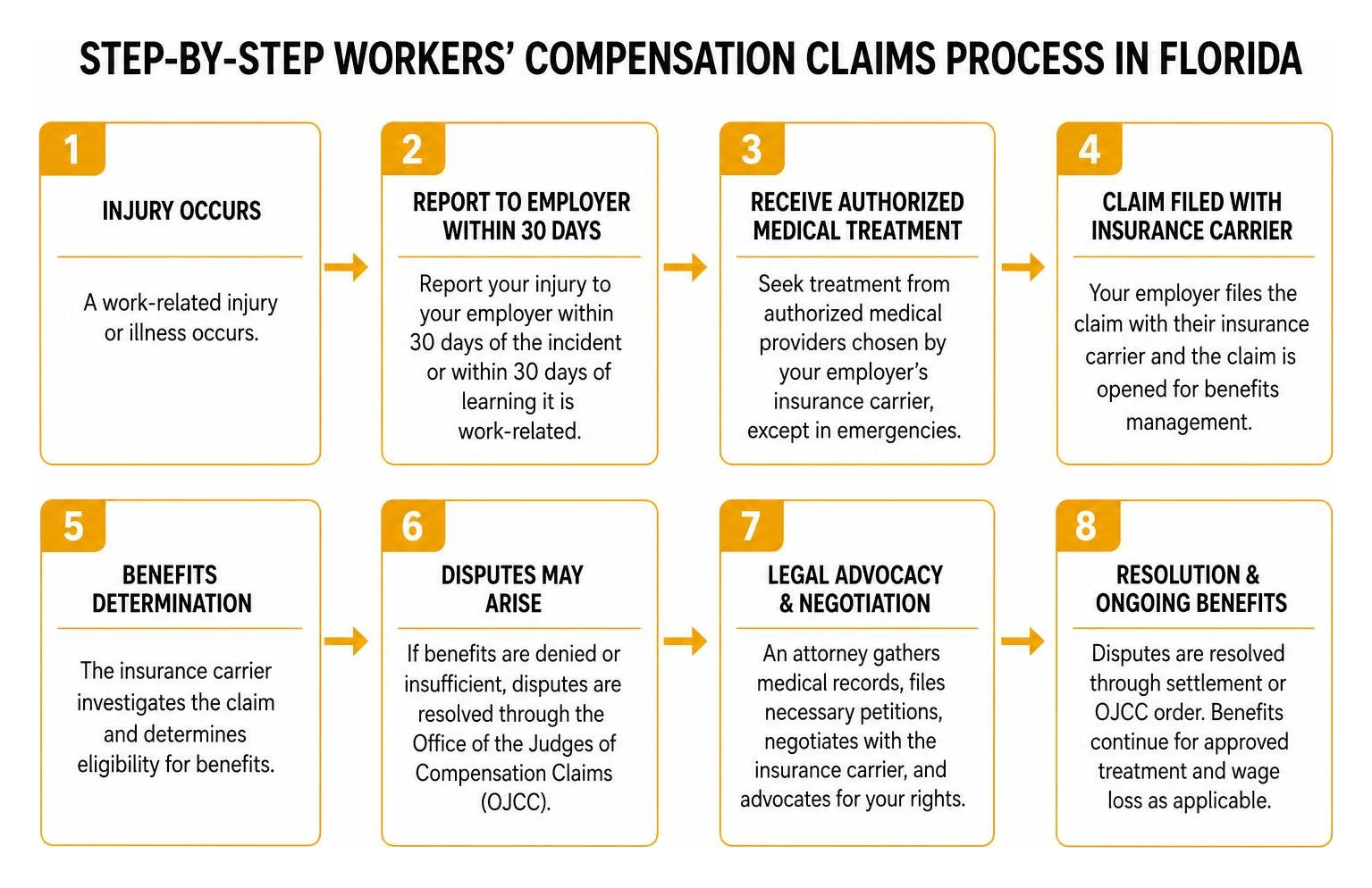
To protect your rights, keep these key milestones and statutory rules in mind:
- 30-Day Reporting Deadline: Under Florida law, you must report your workplace injury to your employer within 30 days of the incident or within 30 days of learning that your injury is work-related.
- Authorized Medical Providers: Florida operates under an employer/carrier-directed medical model. You must receive treatment from an authorized physician chosen by your employer’s insurance carrier, except in genuine emergencies.
- One-Time Change of Physician: Under Florida Statute § 440.13, you are entitled to request a one-time change of treating physician during your claim. If the insurance carrier fails to provide an alternate doctor within 14 calendar days of your written request, you gain the right to select your own physician.
- Wage Replacement (TTD/TPD): If you cannot work or are placed on light duty with reduced earnings, you may receive Temporary Total Disability (TTD) or Temporary Partial Disability (TPD) benefits. TTD typically provides 66⅔% of your average weekly wage (AWW), subject to statutory caps.
- Maximum Medical Improvement (MMI): Once your authorized doctor determines your condition has stabilized and is unlikely to improve further, you reach MMI. At this stage, you receive an impairment rating that determines any remaining permanent impairment benefits.
- Two-Year Statute of Limitations: You have two years from the initial date of injury to file a formal claim for benefits. Receiving authorized medical care or indemnity payments extends this deadline by one year from the date of the last benefit provided.
| Benefit Type | Eligibility Trigger | Standard Compensation Amount | Duration Limit |
|---|---|---|---|
| Medical Benefits | Work-related injury requiring care | 100% of authorized, medically necessary treatment | Lifetime (as long as care is received every 12 months) |
| Temporary Total Disability (TTD) | Complete inability to work per doctor orders | 66⅔% of your Average Weekly Wage (AWW) | Up to 104 weeks |
| Temporary Partial Disability (TPD) | Light-duty clearance with earnings under 80% of pre-injury wage | Up to 64% of lost wage differential | Up to 104 weeks combined with TTD |
| Permanent Impairment Benefits (PIB) | Reaching MMI with an assigned impairment rating | Variable weekly payment based on impairment percentage | Set weeks based on rating percentage |
| Permanent Total Disability (PTD) | Catastrophic, permanent inability to engage in employment | 66⅔% of AWW with annual cost-of-living adjustments | Payable until age 75 (or lifetime under certain criteria) |
Critical Stages Where Legal Advocacy Secures Benefits
While minor claims may proceed smoothly, disputes frequently arise during recovery. Navigating formal benefit disputes requires decisive legal intervention at several critical junctures:
- Initial Claim Denials: If the carrier denies your injury entirely, an attorney gathers evidence, issues discovery, and files a formal Petition for Benefits with the OJCC.
- Treatment Authorizations and Delays: Insurance companies often delay approving MRI scans, physical therapy, or specialist consultations. A lawyer files targeted motions to enforce your medical rights.
- Independent Medical Examinations (IMEs): When authorized doctors provide conflicting opinions, securing an independent medical examination helps clarify your treatment needs and impairment rating.
- State Mediation: Florida law mandates formal mediation before an OJCC judge hears a disputed claim. We represent you during these settlement conferences to negotiate favorable resolutions.
- Final Compensation Hearings: If the carrier refuses a reasonable settlement, your attorney presents medical evidence, takes expert depositions, and advocates directly before the Judge of Compensation Claims.
Workplace Injuries Common to Palm Beach County Industries
Palm Beach County is home to a diverse economy spanning construction, healthcare, hospitality, logistics, and municipal services. Each sector presents distinct occupational hazards:
- Construction Accidents: High-rise and residential construction sites frequently involve falls from scaffolding, structural collapses, and equipment injuries that require extensive orthopedic care.
- Healthcare and Nursing Hazards: Hospital and clinical staff regularly experience back strains from patient lifting, repetitive motion trauma, and needle stick exposures.
- Hospitality and Service Injuries: Hotel, resort, and restaurant workers across Palm Beach County often suffer burns, severe slip-and-falls, and chronic joint damage from extended physical labor.
- Warehouse and Transportation Mishaps: Forklift collisions, falling freight, and delivery vehicle accidents can cause severe spinal trauma and traumatic brain injuries (TBIs).
Hiring, Fees, and Representation for Injured Workers
Many injured employees hesitate to seek legal help because they worry about costs. In Florida workers’ compensation cases, attorneys operate under a contingency fee model regulated by state statute.
Under this model, you pay no upfront fees or hourly retainers. Your lawyer is compensated only if they successfully recover benefits or negotiate a lump-sum settlement on your behalf. Statutory fee calculations are typically structured as:
- 20% of the first $5,000 of benefits secured
- 15% of the next $5,000 of benefits secured
- 10% of any remaining benefits secured over $10,000
If an insurer wrongfully denies your benefits and a judge orders them to pay, the insurance company may be required to pay your attorney fees directly. Furthermore, Florida law strictly protects workers from retaliation; under Florida Statute § 440.205, an employer cannot fire, intimidate, or discriminate against you for filing a workers’ comp claim.
What to Look for in a Workers Comp Attorney West Palm
Selecting the right legal advocate is crucial for your physical and financial recovery. When evaluating counsel, consider these core qualifications:
- Deep OJCC and Trial Experience: Choose an attorney with extensive experience handling hearings before the Judges of Compensation Claims.
- Local Court Knowledge: Securing dedicated local injury representation ensures your legal team understands Palm Beach County employers, defense firms, and local medical providers.
- Transparent Communication: Your attorney should clearly explain every step of the process, keep you informed of updates, and provide direct access to your legal team.
- Negotiation Track Record: An experienced attorney knows how to accurately calculate the lifetime value of future medical care and indemnity benefits during settlement talks.
Additional Workers’ Compensation Benefits
Beyond basic medical visits and lost wages, Florida’s workers’ comp system provides several additional benefits that an attorney can help you secure:
- Vocational Rehabilitation: If your injury prevents you from returning to your former trade, the Florida Division of Workers’ Compensation offers vocational counseling, retraining, and education programs to help you re-enter the workforce.
- Medical Mileage Reimbursement: You are entitled to reimbursement for travel expenses to and from authorized doctor visits, physical therapy appointments, and pharmacies.
- Catastrophic and Permanent Disability Support: For severe injuries—such as amputations, total blindness, or severe neurological trauma—claimants are entitled to extended, maximum-rate disability indemnity payments.
Frequently Asked Questions About Florida Workers’ Comp
Taking the time to review answers to common claim concerns can help you protect your rights from day one.
How long do I have to report an on-the-job injury in Florida?
You must notify your employer within 30 days of the accident or within 30 days of when a medical provider confirms your injury is work-related. Always report the incident in writing and keep a personal copy of the signed injury report.
Can I be fired or retaliated against for filing a workers’ comp claim?
No. Florida Statute § 440.205 makes it unlawful for any employer to discharge, threaten, or coerce an employee for filing a valid workers’ compensation claim. If your employer retaliates against you, you may have grounds for a separate civil action.
How are workers’ compensation attorneys paid in West Palm Beach?
Workers’ compensation attorneys represent injured workers on a contingency basis. You pay nothing out of pocket. Attorney fees are paid as a statutory percentage of the benefits or settlement secured on your behalf, ensuring everyone has access to quality legal counsel regardless of their current financial situation.
Conclusion
A workplace injury can disrupt your health, livelihood, and family stability. Navigating insurance adjusters, authorized medical networks, and strict legal deadlines should not stand between you and the care you need.
At Panzer Law, P.A., we provide dedicated, personalized legal advocacy to help injured workers secure their full medical and wage benefits across South Florida. If you were hurt on the job, reach out for a free consultation today to learn how we can protect your rights and guide your recovery.
