

How to Find a Workers’ Compensation Lawyer in Florida
If your benefits are delayed or denied, look for a Florida workers’ comp lawyer who handles injured workers’ claims, explains fees clearly, and has experience with medical and wage disputes. Ask for a consultation, then bring your injury report, denial letter, medical records, and pay stubs. Report your injury to your employer as soon as possible; Florida generally requires notice within 30 days. Legal filing deadlines can also apply, so do not wait for the insurer to change its mind.
Florida workers’ compensation usually pays benefits for work-related injuries without requiring you to prove your employer was at fault. But you may still need help getting approved care or the wage benefits you are owed. According to the U.S. Bureau of Labor Statistics, private industry employers reported millions of nonfatal workplace injuries and illnesses in recent years, underscoring how often workers face these disputes.
I’m Gil Panzer, owner and attorney at Panzer Law, P.A., and I’ve spent more than three decades working on legal matters, including workers’ compensation claims, medical care, and settlements. As a workers’ compensation lawyer Florida workers can turn to, I wrote this guide to help you understand your options and choose counsel with confidence.
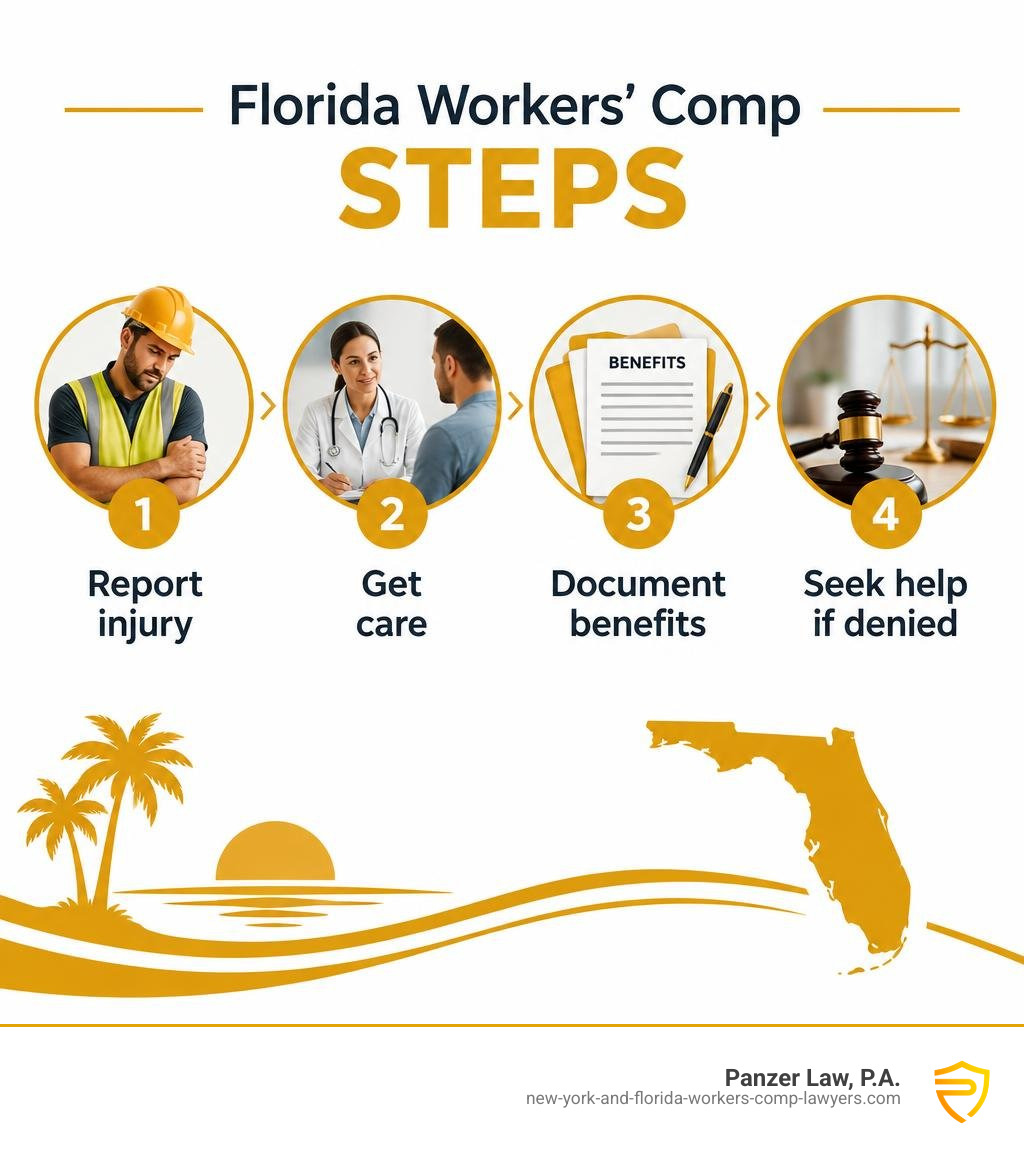
Simple workers’ compensation lawyer florida glossary:
- best workers comp lawyers in florida
- Florida workers’ compensation lawyer
- workers compensation lawyer in florida
Understanding Florida Workers’ Compensation Laws and Benefits
Workplace injuries happen in the blink of an eye. Across the country, employers report roughly 2.5 million nonfatal workplace injuries every single year. When an accident happens on the job in Florida, the state’s workers’ compensation system steps in under Chapter 440 of the Florida Statutes.
The system is designed as a no-fault program. You do not have to prove that your boss was negligent, spilled water on the warehouse floor, or forgot to service a ladder. Even if you made an honest mistake and tripped over your own work boots, you are generally covered. In exchange for this automatic safety net, workers give up their right to sue their employer directly for everyday negligence.
Most non-construction employers in Florida with four or more employees must carry workers’ compensation coverage, while construction businesses must provide it if they have one or more workers. When a valid injury occurs, the insurance policy should cover all necessary medical care and replace a portion of your lost wages.
| Benefit Classification | Typical Payment Rate | Maximum Statutory Duration | Primary Eligibility Criteria |
|---|---|---|---|
| Temporary Total Disability (TTD) | 66 2/3% of Average Weekly Wage (up to 80% for specific severe injuries) | Up to 104 weeks | Authorized doctor states you cannot perform any work during recovery |
| Temporary Partial Disability (TPD) | Up to 80% of the difference between 80% of pre-injury earnings and post-injury light-duty earnings | Up to 104 weeks (combined with TTD) | Authorized doctor releases you to light duty, but you earn less than 80% of pre-injury wage |
| Permanent Impairment Benefits (PIB) | Based on assigned impairment percentage rating | Varies based on Impairment Rating percentage | You reach Maximum Medical Improvement (MMI) with lasting physical restrictions |
| Permanent Total Disability (PTD) | 66 2/3% of Average Weekly Wage | Payable until age 75 (or life in select catastrophic cases) | Severe, catastrophic injury preventing you from performing even sedentary work |
Covered Workplace Injuries and Occupational Illnesses
Florida workers’ compensation laws cover a broad spectrum of medical conditions, provided the injury arose out of and occurred within the scope of your employment duties.
- Acute Traumatic Injuries: Sudden accidents such as falls from scaffolding, slips on slick flooring, heavy equipment impacts, and commercial motor vehicle crashes.
- Repetitive Stress and Motion Injuries: Cumulative wear and tear that builds over weeks or months, such as carpal tunnel syndrome, tendonitis, or chronic bursitis from repetitive assembly or data entry tasks.
- Back, Neck, and Spine Conditions: Herniated discs, fractured vertebrae, lumbar strains, and nerve impingement caused by heavy lifting or sudden twisting.
- Occupational Diseases: Illnesses resulting from workplace exposure to toxic industrial chemicals, mold, asbestos, fumes, or biological agents.
- First Responder PTSD: Mental health trauma sustained by law enforcement officers, firefighters, and emergency personnel under specific statutory guidelines.
- Catastrophic Physical Injuries: Traumatic brain injuries (TBI), severe spinal cord trauma causing paralysis, full amputations, and extensive third-degree burns.
Medical Care, Wage Replacement, and Disability Classifications
Medical coverage is a core pillar of your benefits. The insurance carrier is required to pay for all medically necessary treatments, hospital visits, diagnostic imaging, physical therapy, prescription medications, and travel mileage to and from doctor appointments. However, you cannot simply go to your personal family physician. You must treat with medical providers officially authorized by the insurance company.
For wage replacement, Florida calculates your Average Weekly Wage (AWW) using your gross earnings from the 13 weeks preceding your injury. Your base benefit check is typically 66 2/3% of that average, subject to a state maximum cap. You can protect your benefits with top rated Florida workers’ comp attorneys who ensure the insurer does not omit bonuses, overtime, or concurrent wages from your calculation.
Deadlines, Medical Disputes, and Navigating Denials

The workers’ comp process runs on strict statutory clocks. If you miss a deadline, the insurance company will quickly move to dismiss your claim, regardless of how badly you are hurt.
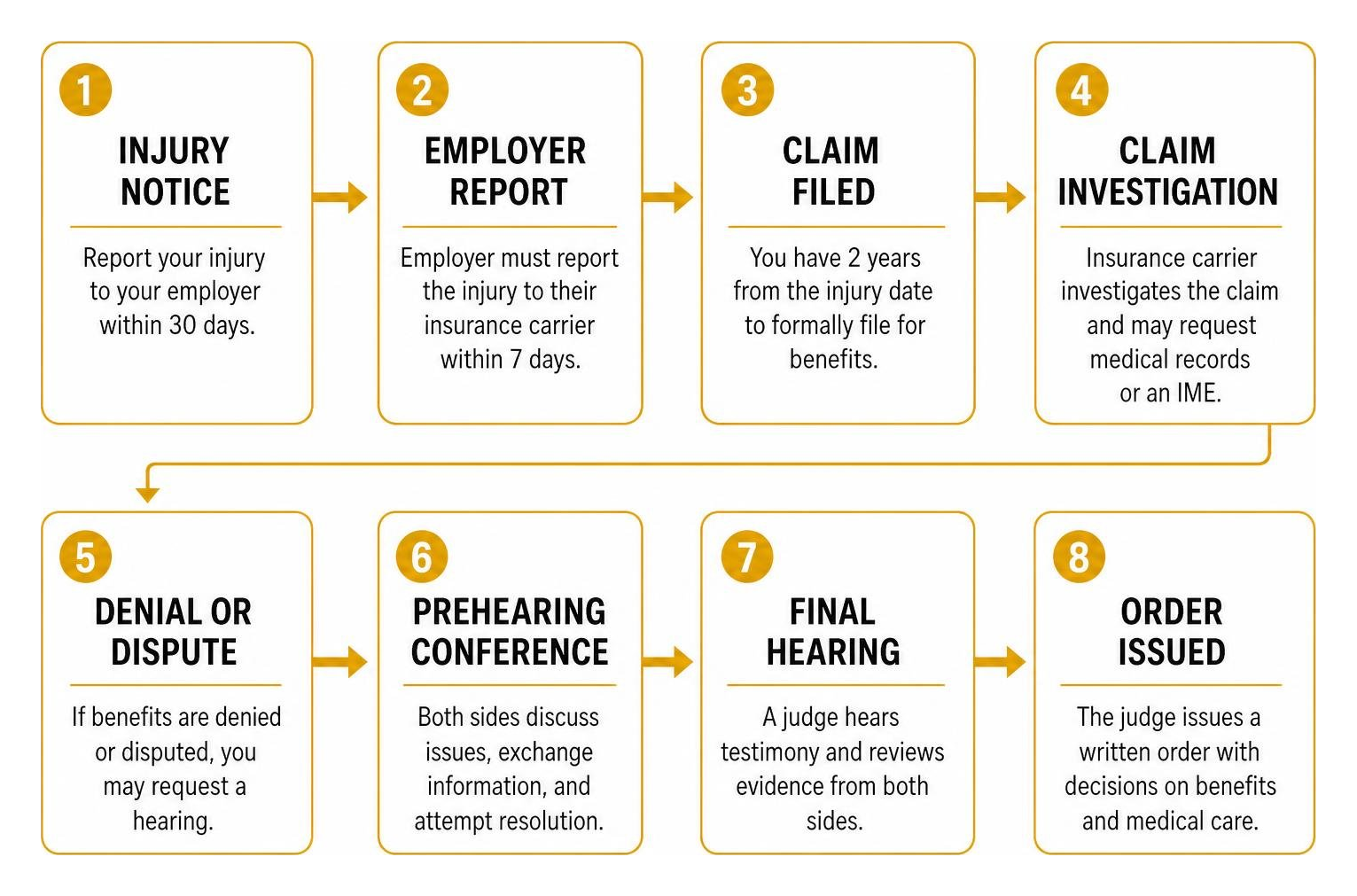
Under Florida law, you must report your workplace accident to your employer within 30 days of the date it happened (or within 30 days of when a doctor first informs you that an occupational disease is work-related). Once you notify your employer, they must report the injury to their insurance carrier within seven days.
You also face a two-year statute of limitations to formally file for benefits. After the initial claim is established, you must receive authorized medical treatment or indemnity payments at least once every 365 days to keep the statute of limitations open for future medical care. For a detailed breakdown of these procedural requirements, review our Florida workers’ comp lawyer claim representation guide.
The Role of Authorized Treating Physicians and Independent Medical Examinations (IME)
Your Authorized Treating Physician (ATP) holds tremendous power over your case. They decide whether you are placed on total disability, released to light duty with weight restrictions, or cleared for full duty without limitations. They also determine when you reach Maximum Medical Improvement (MMI) and calculate your permanent impairment rating.
What happens if the insurance company’s authorized doctor downplays your pain or insists you are completely fine when you can barely stand? Florida law grants you a statutory right to a one-time change of physician.
When you request this change in writing, the carrier has 14 days to provide a new doctor. If they fail to authorize a new physician within that 14-day window, you acquire the legal right to select your own doctor, and the insurer must pay for it.
If a deep medical disagreement persists, either party can invoke Florida Statute Section 440.13 to schedule an Independent Medical Examination (IME). An IME allows an outside physician to examine you, review your diagnostic tests, and issue an independent report that can be used as evidence before a judge.
Consulting a Workers’ Compensation Lawyer Florida for Denied Claims
Insurance carriers routinely deny legitimate claims using standard defense tactics:
- Alleging the accident happened outside work hours or off premises
- Claiming an undeclared pre-existing condition is the “major contributing cause” (MCC) of your symptoms
- Blaming an alleged lack of timely 30-day notice
- Accusing you of misconduct or claiming a positive drug screen caused the accident
When you receive a formal Notice of Denial, you must file a Petition for Benefits (PFB) with the Office of the Judges of Compensation Claims (OJCC). Once the petition is filed, the state schedules a mandatory mediation conference. Mediation is an informal, confidential settlement conference led by a state mediator where both sides try to resolve the dispute. If mediation fails, the case proceeds to a formal final hearing before a Judge of Compensation Claims (JCC), which functions just like a trial. You can find a Florida workers’ comp lawyer for your claim to prepare your medical testimony, take doctor depositions, and present your case.
Why You Need a Workers’ Compensation Lawyer Florida Claimants Trust

Insurance adjusters are well-trained professionals whose job is to resolve claims as economically as possible for their employer. When you represent yourself, you are going up against an experienced legal and claims department while trying to heal from severe injuries.
Hiring counsel balances the playing field immediately. At Panzer Law, P.A., we operate on a true contingency fee model: you pay no upfront costs, no hourly retainers, and zero attorney fees unless we recover benefits or a cash settlement for you. Florida statutes strictly regulate these attorney fees, which are calculated as a percentage of the benefits secured.
Having dedicated representation makes a significant difference across South Florida’s busy legal circuits. Whether you require a Miami workers’ compensation lawyer to handle a complex industrial dispute, a West Palm Beach workers’ compensation lawyer for a healthcare facility injury, or a Boca Raton workers’ compensation lawyer to appeal an improper denial, our team provides focused advocacy tailored to local judges and defense firms throughout Palm Beach County and Miami-Dade County.
Workers’ Comp Exclusivity and When You Can Sue Your Employer
Under the exclusive remedy doctrine, you generally cannot file a personal injury lawsuit against your direct employer for a standard work accident. However, critical exceptions exist under Florida law:
- Uninsured Employers: If your employer was legally mandated to carry workers’ compensation insurance but failed to maintain an active policy, you can sue them directly in civil court for full damages, including pain and suffering.
- Intentional Torts: If your employer engaged in conduct virtually certain to cause injury or death—such as deliberately disabling safety guards on industrial machinery—the exclusivity shield can be pierced.
- Third-Party Liability Claims: If a negligent third party (someone other than your direct employer or co-worker) caused your injury, you can pursue a concurrent personal injury lawsuit alongside your workers’ comp claim. Examples include being struck by a reckless driver while driving a company vehicle or being injured by a defective machine manufactured by an outside vendor.
How to Choose the Best Workers’ Compensation Lawyer Florida Has to Offer
When evaluating law firms, look for credentials that demonstrate authentic focus:
- Specialized Experience: Workers’ compensation in Florida is governed by an entirely separate administrative court system. Ensure the attorney focuses heavily on workers’ compensation rather than treating it as an occasional side practice.
- Board Certification: Less than 2 percent of all attorneys practicing in Florida are Board Certified in Workers’ Compensation by The Florida Bar. Certification indicates advanced peer reviews, extensive trial experience, and proven mastery of the field.
- Transparent Communication: You should have direct access to your legal team, with clear explanations of fee structures, settlement timelines, and medical options.
Frequently Asked Questions About Florida Workers’ Comp
Can My Employer Fire Me for Filing a Workers’ Comp Claim in Florida?
No. Florida Statute Section 440.205 explicitly states: “No employer shall discharge, threaten to discharge, intimidate, or coerce any employee by reason of such employee’s valid claim for compensation or attempt to claim compensation under the Workers’ Compensation Law.” If your employer retaliates against you, you may have grounds for a separate civil lawsuit for lost wages and statutory damages.
Are Workers’ Compensation Benefits Taxable in Florida?
Under federal law (IRS Code Section 104(a)(1)), workers’ compensation wage replacement checks and lump-sum settlements are fully exempt from federal income taxes. Furthermore, Florida has no state personal income tax, meaning you keep 100% of your benefit checks without state or federal tax withholdings. The only rare exception occurs if you receive concurrent Social Security Disability Insurance (SSDI) benefits that trigger a statutory offset.
How Long Can I Receive Temporary Disability Benefits in Florida?
In Florida, temporary wage replacement benefits (Temporary Total Disability and Temporary Partial Disability combined) are capped at a maximum of 104 weeks (two years). Once you exhaust those 104 weeks, or when your treating physician determines you have reached Maximum Medical Improvement (MMI), you transition to Permanent Impairment Benefits or explore a lump-sum settlement.
Conclusion
A serious workplace injury can jeopardize your physical health, your family’s financial stability, and your peace of mind. You do not have to fight insurance adjusters, navigate medical authorizations, and interpret complicated statutory deadlines alone.
At Panzer Law, P.A., we represent injured employees across Miami, Boca Raton, West Palm Beach, Palm Beach County, and Miami-Dade County. We take on the insurance carriers so you can focus entirely on your physical recovery. If you have questions about an active claim or an unfair denial, reach out to an experienced Florida workers’ compensation lawyer today for a free, confidential case evaluation. With our strict no-recovery, no-fee guarantee, you risk nothing to get the answers, medical care, and financial compensation you rightfully deserve.
