
Immediate Steps and Critical Deadlines After an On-the-Job Incident
When an unexpected injury happens on the job, the actions you take in the first minutes, hours, and days directly influence your medical outcome and your legal standing. Workers often assume their employer or the insurance company will automatically handle everything fairly. While many employers aim to do right by their staff, workers’ compensation insurance carriers operate as businesses designed to minimize claim payouts.
To safeguard your health and your livelihood, review our practical guide to filing workers’ comp claims alongside these essential steps.
Immediate Actions to Protect Your Injury Claim
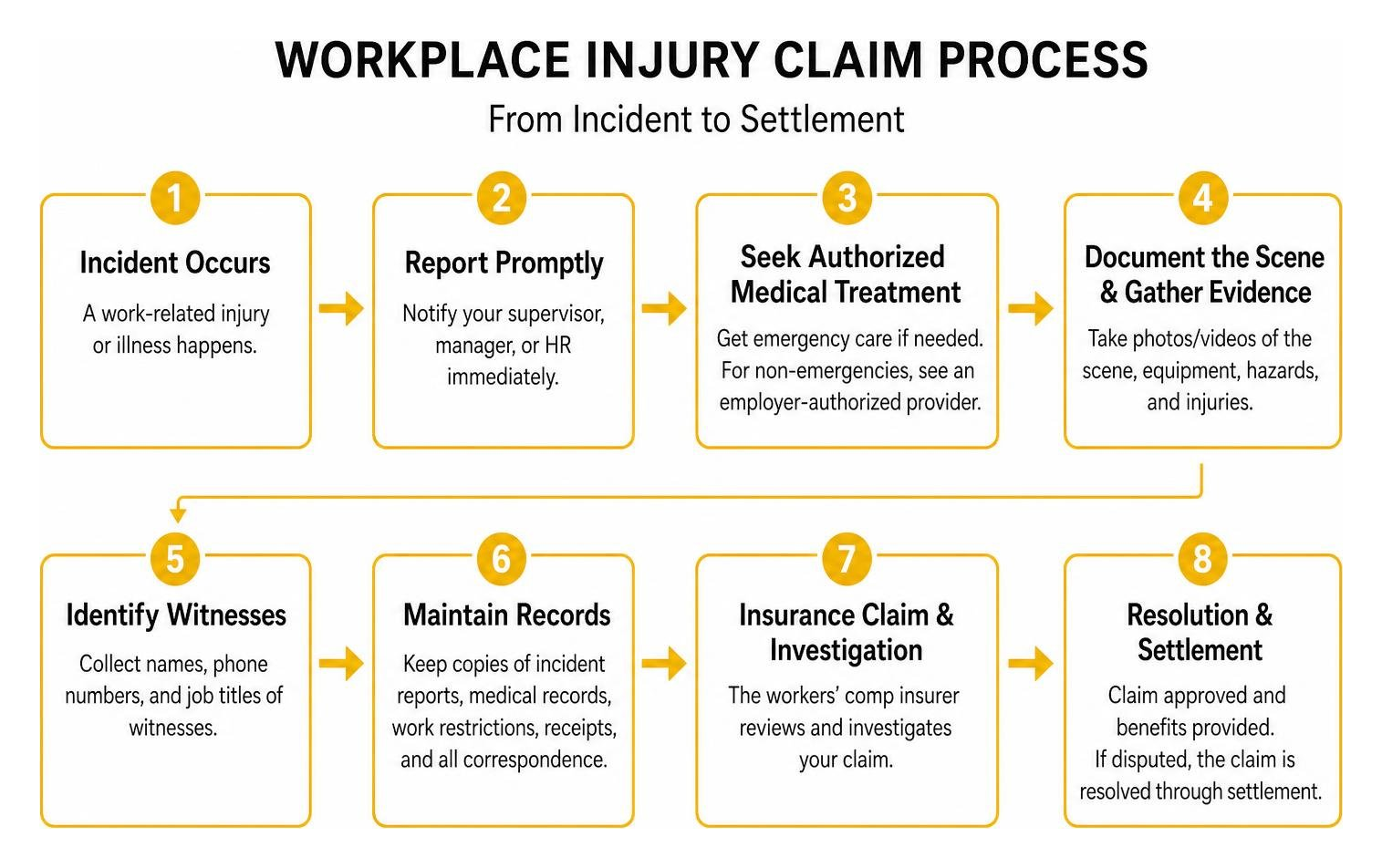
Taking swift, deliberate action creates the documented foundation needed to prove your claim. Following a workplace accident, make sure to execute these core steps:
- Report the Incident Promptly: Notify your supervisor, manager, or human resources department immediately. Even if an injury seems minor at first—such as a mild twinge in your lower back or a small cut—failing to report it right away gives insurers a reason to argue the injury occurred outside of work.
- Seek Authorized Medical Treatment: In an emergency, go to the nearest emergency room or urgent care center. For non-emergency care, request medical attention from an employer-authorized medical provider to ensure your treatment remains covered under statutory guidelines.
- Gather Scene Evidence: If you are physically able, take clear photographs and videos of the accident scene, the tools or equipment involved, any hazardous conditions (such as liquid spills or broken scaffolding), and your visible injuries.
- Identify Witnesses: Collect the full names, phone numbers, and job titles of coworkers or third-party contractors who saw the incident or were nearby right after it happened.
- Maintain Complete Records: Keep copies of all incident reports, work restrictions provided by treating physicians, prescription receipts, and written correspondence between you, your employer, and the insurance claims adjuster.
Key Deadlines and Procedural Pitfalls to Avoid
Workers’ compensation claims are bound by strict statutory timelines. Missing a filing deadline can result in the complete forfeiture of your right to medical care and lost-wage compensation.
- Notice Windows: In Florida, you must formally report your workplace accident to your employer within 30 days of its occurrence (or within 30 days of discovering a work-related occupational illness).
- Statute of Limitations: You generally have two years from the date of the injury to file a formal Petition for Benefits if the insurance carrier denies your claim or cuts off benefits.
- Strict Administrative Response Windows: If an insurer issues a formal denial or notices of benefit reduction, procedural appeal deadlines often require immediate action. Missing an administrative window leaves an improper denial permanently unchallenged.
Studies published in peer-reviewed journals such as Accident Analysis & Prevention consistently demonstrate that systematic documentation and prompt incident reporting significantly reduce post-accident complications and clarify injury causation.
Why You Need a Specialized Lawyer for Accident at Work Cases
Workers’ compensation is a distinct legal arena governed by complex statutes, specialized administrative judges, and technical medical definitions. A general practice attorney who handles wills on Monday, divorces on Wednesday, and traffic tickets on Friday rarely possesses the deep procedural familiarity required to challenge seasoned insurance defense firms.
Just as you would not consult a family doctor for open-heart surgery, hiring an experienced lawyer who concentrates daily on occupational claims ensures that every aspect of your case is handled with precision. When you need local representation in South Florida, exploring resources on finding local workmans comp lawyers will help you partner with an advocate tailored to your needs.
Qualifications to Look for in a Lawyer for Accident at Work
When evaluating legal representation, prioritize attorneys who demonstrate verified credentials, dedicated workers’ compensation experience, and clear communication standards:
- Dedicated Focus: Choose an attorney who focuses primarily on workers’ compensation and workplace liability rather than general, unrelated civil matters.
- Proven Trial and Hearing Experience: Your attorney should be well-versed in handling formal administrative hearings, taking doctor depositions, and overcoming aggressive defense strategies.
- Transparent Fee Arrangements: Reputable workers’ compensation attorneys work on a contingency basis, meaning no upfront fees, no out-of-pocket costs, and no fee owed unless money is recovered for you.
- Industry Recognitions: Look for reputable peer recognitions, high client ratings, and memberships in organizations such as the Million Dollar Advocates Forum.
- Clear, Accessible Communication: You deserve an advocate who explains complex statutory procedures in plain language without hiding behind dense legal jargon.
Comparing Workers’ Compensation Laws by Jurisdiction
Workers’ compensation frameworks differ widely across state lines and international borders. While the fundamental premise is to provide medical relief and wage protection without proving fault, local regulations shape everything from benefit caps to dispute resolution pathways.
| Jurisdiction | Primary Governing Body / System | Statutory Reporting Deadline | Average Weekly Wage (AWW) Calculation Basis | Permanent Disability Determinations | Third-Party Civil Suit Availability |
|---|---|---|---|---|---|
| Florida (Our Practice) | Florida Division of Workers’ Compensation / OJCC | 30 Days | 13 weeks prior to date of accident | Florida Impairment Guides / Statutory PTD Criteria | Yes (against negligent non-employers) |
| Florida — injury notice | Florida Division of Workers’ Compensation; notice goes to the employer | Generally within 30 days of the accident | Wages for the 13 weeks before the accident | Florida Impairment Guides / statutory permanent total disability criteria | A separate claim may be available against a negligent third party |
| Florida — disputed benefits | Office of the Judges of Compensation Claims (OJCC) | Generally 30 days for injury notice; a Petition for Benefits has a separate filing deadline | Wages for the 13 weeks before the accident | Florida Impairment Guides / statutory permanent total disability criteria | A separate claim may be available against a negligent third party |
| Florida — benefit calculation review | Florida Division of Workers’ Compensation / Office of the Judges of Compensation Claims | Generally 30 days for injury notice; claim filing has a separate deadline | Wages for the 13 weeks before the accident | Florida Impairment Guides / statutory permanent total disability criteria | A separate claim may be available against a negligent third party |
| United Kingdom | Civil Tort System / Department for Work and Pensions (DWP) | 3 Years (Standard limitation period) | Actual past net loss of earnings & future losses (Quantum) | Medical expert reports assessing general & special damages | Standard route (fault-based employer liability) |
Workers’ Compensation vs. Third-Party Personal Injury Lawsuits

A frequent point of confusion for injured workers is the difference between an administrative workers’ compensation claim and a civil personal injury lawsuit. Under Florida’s exclusive remedy doctrine, an employee generally cannot sue their direct employer or direct coworkers for negligence in exchange for receiving guaranteed, no-fault workers’ comp benefits.
However, the exclusive remedy rule protects only your direct employer. If an independent third party caused or contributed to your accident, you can pursue both a workers’ compensation claim and a separate third-party personal injury lawsuit.
Maximizing Compensation Through Third-Party Claims
Workers’ compensation covers authorized medical bills and a statutory percentage of your lost wages, but it does not provide compensation for pain and suffering, emotional distress, or loss of enjoyment of life. A third-party personal injury claim bridges this gap by targeting fully recoverable economic and non-economic damages.
Common third-party liability scenarios include:
- Subcontractor and General Contractor Negligence: On construction sites, an employee of one trade contractor injured by the negligence of a separate subcontractor can sue that third party directly.
- Defective Machinery and Equipment: If you suffer an injury due to a malfunctioning table saw, defective forklift, or failing safety harness, the manufacturer or distributor may be held strictly liable through a product liability lawsuit.
- Premises Liability: If your job requires off-site work (e.g., delivery drivers, field technicians) and you slip on an unmaintained walkway or suffer an injury due to hazardous property conditions, the property owner can be held liable.
- On-the-Job Motor Vehicle Accidents: If you are driving for work duties in Miami, Boca Raton, or West Palm Beach and another driver hits you, you can file a workers’ compensation claim while also pursuing a personal injury lawsuit against the at-fault driver.
How a Workplace Injury Lawyer Investigates Liability and Prepares for Trial
Uncovering third-party liability requires prompt, independent investigative work. Insurance carriers and site managers often correct hazardous conditions immediately following a serious accident, potentially erasing key evidence.
When we take on a workplace injury case, our investigative protocol includes:
- OSHA and Safety Audits: Requesting and analyzing federal safety violation records, prior employer citations, and historical logs.
- Accident Reconstruction: Collaborating with forensic engineers and safety specialists to inspect machinery, calculate force dynamics, and pinpoint safety failures.
- Deposing Witnesses and Subcontractors: Questioning eyewitnesses, equipment maintenance managers, and site safety supervisors under oath.
- Vocational and Economic Assessments: Enlisting vocational rehabilitation consultants and forensic economists to quantify total lifetime wage-earning loss and ongoing care requirements.
Common Workplace Injuries, Claim Pitfalls, and Settlement Strategies
Workplace injuries range from single traumatic events to conditions that develop gradually over years of repetitive labor or hazardous exposure. Understanding your medical diagnosis and preserving continuous documentation are essential for negotiating maximum claim value. For an in-depth look at our approach to local cases, review our Florida workers comp claim representation guide.
Commonly Litigated Injuries and Industrial Diseases
- Spinal Cord and Back Trauma: Herniated discs, fractured vertebrae, and nerve impingement from falls from scaffolding, ladders, or heavy lifting.
- Traumatic Brain Injuries (TBIs): Concussions and severe head injuries caused by falling construction debris, equipment collapses, or vehicle collisions.
- Crush and Amputation Injuries: Severe trauma involving industrial machinery, press rollers, forklifts, and conveyer assemblies.
- Repetitive Stress and Motion Disorders: Carpal tunnel syndrome, torn rotator cuffs, and chronic tendon damage caused by continuous, daily physical exertion.
- Occupational and Industrial Diseases: Respiratory illnesses from silica or toxic fumes, severe hearing loss, and conditions like hand-arm vibration syndrome (HAVS) from extended power-tool operation.
Critical Mistakes That Jeopardize Claim Value
Workers frequently undermine their own claims by making avoidable procedural missteps. To protect your rights, avoid these pitfalls:
- Failing to Report Within 30 Days: Never assume informal conversations with coworkers serve as adequate notice. Ensure your written notification is submitted to management within the statutory 30-day window.
- Inaccurate Average Weekly Wage (AWW) Calculations: Workers’ comp wage benefits depend directly on your calculated AWW. Adjusters routinely omit overtime, bonuses, second-job earnings, and health insurance fringe benefits, lowering your weekly checks.
- Missing the Maximum Medical Improvement (MMI) Pivot: Reaching MMI means your condition has stabilized and cannot improve further with active treatment. Insurers often attempt to terminate temporary disability benefits right at this transition without assessing your permanent impairment rating (PIR) or permanent disability status.
- Accepting Premature or Lowball Settlement Offers: Insurers may offer an immediate lump-sum settlement before the full scope of your future medical needs or permanent physical restrictions is clear. Signing a full release too early forfeits your right to future medical coverage.
Settlement Negotiations and Dispute Resolution
Securing a fair settlement requires leverage built on thorough medical documentation and calculated litigation readiness. Most disputed workers’ compensation cases are resolved through structured mediation or negotiated settlements rather than a final administrative trial.
During settlement negotiations, we calculate the complete present value of your future medical treatment, ongoing prescription needs, permanent impairment benefits, and lifetime wage loss. If the insurance carrier refuses to offer a fair settlement, we bring the dispute before the Judge of Compensation Claims (JCC) to compel the benefits you are owed.
Frequently Asked Questions About Workplace Injury Claims
For additional answers to common concerns, visit our dedicated frequently asked questions resource center.
What should I do if my employer disputes my workers’ compensation claim?
If your employer or their insurance carrier denies your claim, you should consult an experienced attorney immediately. Your attorney will file a formal Petition for Benefits with the state administrative division, subpoena company incident reports, depose supervisors, and obtain medical evaluations to overcome the denial through administrative dispute channels.
How do contingency fees work when hiring a workplace accident attorney?
Under our contingency fee structure, there are no upfront fees, retainers, or out-of-pocket expenses. We cover the costs of securing medical records, hiring accident reconstruction experts, and deposing witnesses. We only get paid if we successfully recover financial benefits or a lump-sum settlement for you.
What is the difference between workers’ comp benefits and personal injury damages?
Workers’ compensation is a statutory, no-fault system providing specific medical treatment and partial lost wages, but it excludes non-economic damages. Personal injury lawsuits require proving fault against a negligent third party, allowing you to recover full past and future lost earnings, pain and suffering, mental anguish, and complete loss of life enjoyment.
Protecting Your Rights After a Job Site Accident
A serious workplace injury can disrupt your financial security, your physical well-being, and your family’s peace of mind. Navigating the workers’ compensation system while managing medical appointments and missed paychecks is challenging—especially when insurance adjusters work to protect their company’s bottom line.
At Panzer Law, P.A., we represent injured workers throughout South Florida—including Boca Raton, Miami, West Palm Beach, Palm Beach County, and Miami-Dade County. We are dedicated to holding insurance carriers accountable, protecting your ongoing medical care, and pursuing every dollar of compensation available under the law.
Take control of your recovery today. Schedule a free consultation with a Florida workers’ compensation lawyer to discuss your case with our legal team at no out-of-pocket cost to you.
