

How a Workers’ Comp Lawyer Near You Can Help
A workers’ comp lawyer can help you challenge a denied claim, get access to medical care, check your lost-wage benefits, and review a settlement offer. If you were hurt at work in Florida, report the injury to your employer as soon as possible, generally within 30 days. Get medical care, keep copies of your records and any denial letter, and ask a lawyer to review your options before a deadline passes.
I’m Gil Panzer, owner and attorney at Panzer Law, P.A., and I’ve spent more than 30 years helping injured workers in Florida and New York with claims, medical care, and settlements. If you searched for a “workers comp lawyer near me,” here’s how to decide what help you need and what to do next.

Essential workers comp lawyer near me terms:
- best workers comp lawyers in florida
- Florida workers’ compensation lawyer
- workers compensation lawyer in florida
Understanding Workers’ Compensation Coverage and Available Benefits
When an unexpected injury happens on the job, your entire routine comes to a sudden halt. Between unexpected medical appointments and missed workdays, it is easy to feel overwhelmed. Fortunately, the law establishes clear safeguards to protect employees who get hurt while carrying out their occupational duties. While states across the country enforce varying statutory systems, our focus here centers on the specific protections provided under Florida law.
Workers’ compensation serves as a statutory no-fault system. This structure means you do not have to prove your employer was careless or negligent to receive financial and medical support. In exchange for guaranteed statutory benefits, employees generally give up the right to sue their employer directly in civil court. However, obtaining every dollar you are owed requires understanding how insurance requirements operate and what specific recovery categories are available.
Employer Coverage Mandates and Employee Rights
In Florida, business owners must follow strict rules regarding insurance coverage. The law applies specific coverage thresholds depending on the type of business:
- Non-Construction Businesses: Any private company employing four or more employees (including corporate officers and business owners) must carry workers’ compensation coverage.
- Construction Industry: Due to elevated safety risks, Florida law requires construction employers to provide coverage if they employ one or more workers. Even sole proprietors and independent subcontractors in construction must carry coverage or hold a valid, registered state exemption.
- Agricultural Operations: Agricultural businesses with six or more regular employees, or twelve or more seasonal workers who perform labor for more than 30 days, must secure coverage.
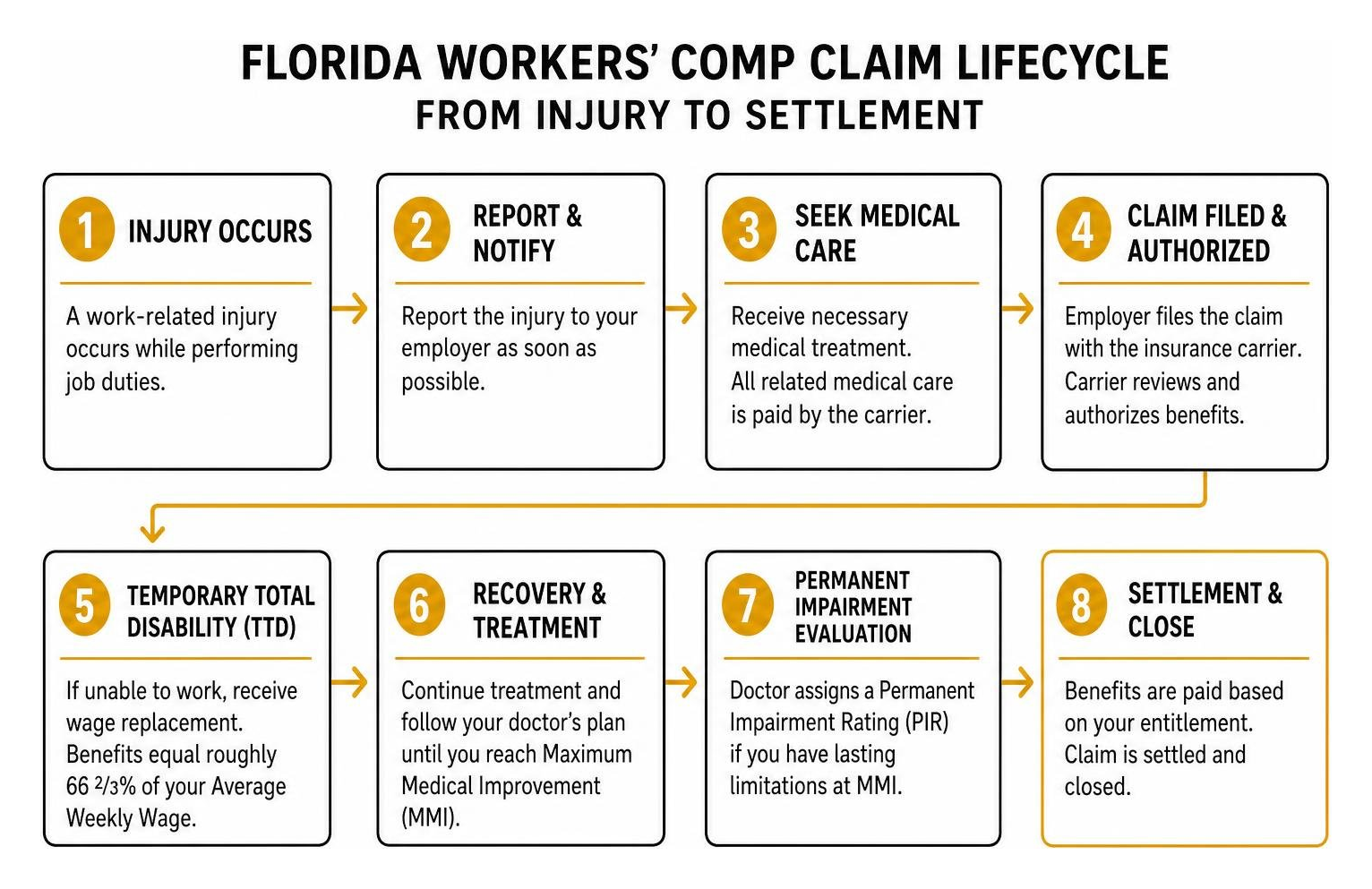
Under this system, covered employees have the legal right to immediate medical attention paid entirely by the carrier, along with partial wage replacement if a doctor orders time off work.
Types of Recoverable Benefits: Medical Care, Lost Wages, and Disability
When your claim is authorized, Florida law provides three main categories of benefits:
- Comprehensive Medical Care: The insurance company must cover all medically necessary care linked directly to your work injury. This includes initial emergency room treatment, specialist consultations, diagnostic imaging (MRIs, X-rays), surgical operations, prescription medications, physical therapy, and assistive medical devices.
- Lost Wage Replacement (Indemnity Benefits): If an authorized treating physician determines that you cannot work during your recovery, you are entitled to Temporary Total Disability (TTD) benefits. In Florida, these payments equal roughly 66 2/3% (two-thirds) of your Average Weekly Wage (AWW), calculated from your earnings over the 13 weeks prior to the accident.
- For injuries occurring on or after January 1, 2026, Florida’s maximum weekly workers’ compensation benefit is capped at $1,358 per week, with a statutory minimum weekly payment of $20.
- Permanent Impairment and Disability: Once your medical condition stabilizes and reaches Maximum Medical Improvement (MMI), an authorized doctor evaluates whether you have sustained lasting physical limitations. You are assigned a permanent impairment rating (PIR), which determines the duration and payout of Permanent Impairment Benefits (IB).
- Vocational Retraining: If severe permanent limitations prevent you from returning to your prior occupation, the state provides vocational counseling and re-education programs to help you re-enter the workforce.
Specific Accidents vs. Cumulative Trauma and Repetitive Stress Injuries
Work injuries are not always the result of a single, catastrophic accident. Many debilitating conditions develop gradually over months or years of physical labor.
| Feature | Specific Traumatic Accidents | Cumulative Trauma & Repetitive Stress |
|---|---|---|
| Origin | A sudden, identifiable incident (e.g., falling from scaffolding, slipping on wet warehouse floors, machinery impact). | Gradual wear and tear resulting from prolonged, repeated physical motion (e.g., carpal tunnel, degenerative disc disease). |
| Onset of Symptoms | Immediate pain, visible trauma, or rapid physical limitation. | Slowly worsening stiffness, aching, numbness, or loss of mobility over time. |
| Notice Requirement | Within 30 days of the exact date the accident took place. | Within 30 days of the date a medical professional diagnoses the condition as work-related or when you reasonably should have known. |
| Evidence Burden | Straightforward incident reports, on-site witness statements, and immediate emergency room documentation. | Detailed medical histories, occupational ergonomic evaluations, and treating physician causality assessments showing the job was the major contributing cause. |
Proving that repetitive motion at work served as the major contributing cause requires organized medical records. Insurance adjusters frequently attempt to blame cumulative trauma on outside hobbies or natural aging, making early documentation critical.
Critical Steps: Reporting Injuries and Handling Denied Claims

What you do immediately following an accident directly affects the outcome of your claim. Even a valid, severe injury can face administrative delays or formal denial if strict procedural deadlines are missed. When navigating these situations, injured workers frequently turn to established legal resources or find local workmans comp lawyers near you to protect their statutory rights from the beginning.
Strict Reporting Deadlines and Mandatory Claim Timelines
To protect your legal standing under Florida law, keep these deadlines in mind:
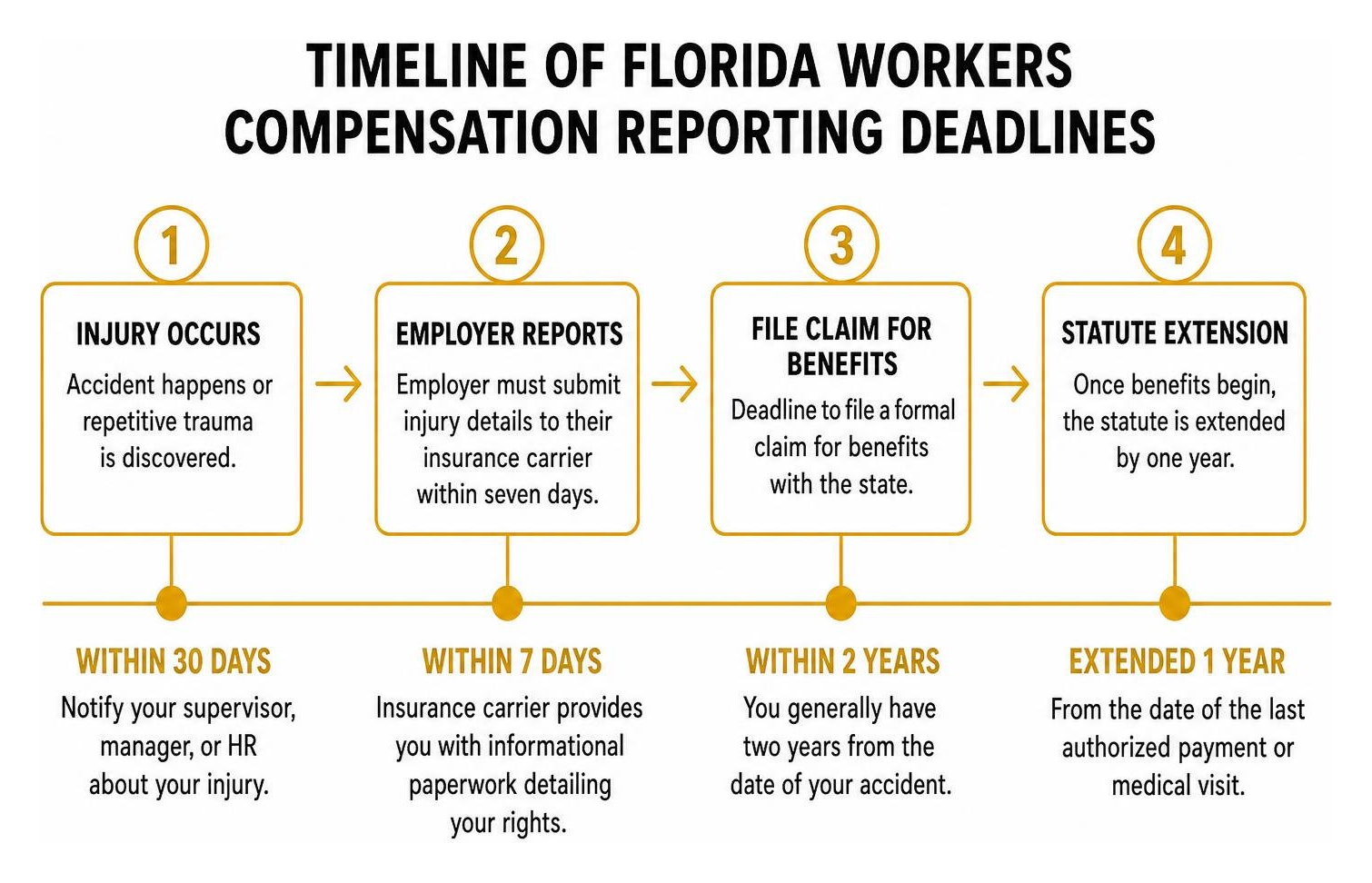
- The 30-Day Employer Notice Rule: You must formally notify your supervisor, manager, or HR department about your injury within 30 days of the accident (or within 30 days of discovering a repetitive trauma injury). Failing to give notice within this statutory window can result in a permanent denial of benefits.
- Medical Reporting (First Report of Injury): Once reported, your employer must submit the injury details to their insurance carrier within seven days. The carrier then provides you with informational paperwork detailing your statutory rights.
- The Two-Year Statute of Limitations: You generally have two years from the date of your accident to file a formal claim for benefits with the state. Once benefits begin, receiving authorized medical treatment or wage indemnity extends the statute of limitations by one year from the date of the last authorized payment or medical visit.
What to Do If Your Workers’ Compensation Claim Is Denied
Insurance carriers frequently look for reasons to reduce their financial exposure. If you receive a formal “Notice of Denial,” your claim is not necessarily over.
Common reasons carriers deny valid claims include:
- Disputing whether the accident occurred within the course and scope of your employment.
- Claiming you missed the mandatory 30-day reporting deadline.
- Alleging that a preexisting health condition is the primary cause of your symptoms.
- Disagreements regarding medical records or diagnostic tests.
When a carrier issues a denial, we resolve the issue by filing a formal Petition for Benefits (PFB) with the Florida Office of the Judges of Compensation Claims (OJCC). This formal legal filing identifies the exact benefits withheld—such as unpaid indemnity checks, diagnostic testing, or specialized orthopedic care.
Once the petition is entered, Florida law mandates that the parties attend a state mediation conference. Mediation provides an informal, confidential setting where a neutral mediator helps resolve the dispute. If the carrier refuses to act fairly, your case proceeds to an evidentiary final hearing before a Judge of Compensation Claims, where formal testimony, depositions, and medical evidence are presented.
Legal Protections for Undocumented Workers and Retaliation Claims
A common misconception is that immigration status prevents an individual from collecting workers’ compensation. Under Florida law, every employee is entitled to workers’ compensation benefits, regardless of legal documentation or citizenship status. If you are injured while performing your job duties, your employer’s insurance carrier is legally required to pay for your medical recovery and statutory wage benefits.
Furthermore, Florida Statute § 440.205 makes it unlawful for any employer to discharge, threaten to discharge, intimidate, or coerce an employee because they filed a valid workers’ comp claim. If an employer fires or demotes you simply because you exercised your statutory rights after an injury, they expose themselves to separate civil liability for illegal workplace retaliation.
Why You Need a Workers Comp Lawyer Near Me After a Work Injury
Dealing with adjusters, scheduling authorized medical appointments, and calculating average wages can be confusing while you are trying to heal. Retaining dedicated counsel balances the playing field against corporate insurers. At Panzer Law, P.A., our team brings decades of direct litigation experience to every case. Working with a dedicated advocate like workers comp attorney Gilbert Russell Panzer Jr gives you a clear strategy tailored to your recovery goals.
Key Factors That Influence Settlement Values
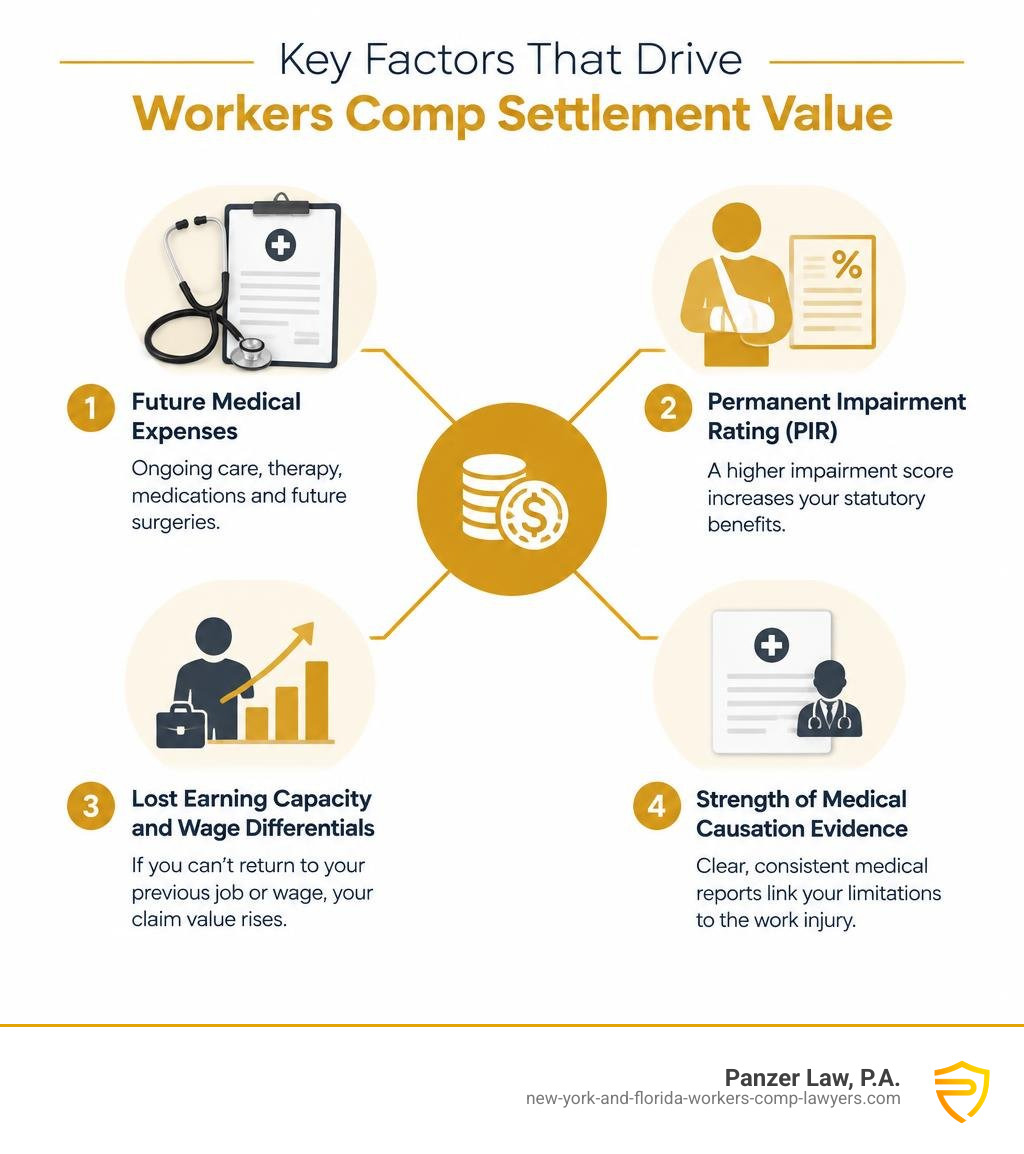
Workers’ compensation settlements in Florida typically involve a negotiated lump-sum payout that permanently resolves your claim. The monetary value of your settlement depends on several clear factors:
- Future Medical Expenses: If your injury requires ongoing prescription management, physical therapy, pain injections, or future orthopedic surgery, the projected cost of that future care forms the foundation of your settlement valuation.
- Permanent Impairment Rating (PIR): A higher impairment score calculated at MMI increases the statutory indemnity benefits owed to you.
- Lost Earning Capacity and Wage Differentials: If your injuries leave you with permanent physical restrictions that prevent you from returning to your prior trade or earning your previous wage, your claim value rises.
- Strength of Medical Causation Evidence: Clear, consistent medical reports from treating physicians linking your physical limitations directly to your workplace accident strengthen your negotiating leverage.
How to Choose the Best Workers Comp Lawyer Near Me
Selecting the right legal team is a major decision for your family’s financial stability. When searching for a dedicated legal advocate, consult our practical guide to top-rated representation and keep these practical criteria in mind:
- Focused Experience: Choose a firm that concentrates specifically on workers’ compensation rather than a general practice attorney who only occasionally handles workplace injury claims.
- Local Community Knowledge: A firm with offices in Miami, West Palm Beach, and Boca Raton understands the local medical networks, regional judges, and defense counsel strategies across Miami-Dade County and Palm Beach County.
- Trial and Deposition Readiness: Look for an attorney who prepares every case for formal hearings rather than immediately accepting low settlement offers.
- Direct, Transparent Communication: You deserve an attorney who explains complex statutory procedures clearly and provides honest updates regarding your claim’s progress.
Cost Breakdown: How a Workers Comp Lawyer Near Me Charges for Legal Representation
Injured workers often worry about the cost of hiring an attorney while their regular paycheck is on hold. Workers’ compensation representation operates on a contingency fee model:
- Zero Upfront Retainers: You never pay out-of-pocket legal fees, retainers, or consultation charges.
- Statutory Fee Guidelines: In Florida, workers’ compensation attorney fees are regulated by state statute (Florida Statute § 440.34). Fees represent a percentage of the benefits recovered or the final settlement amount approved by the judge.
- No Recovery, No Fee: If we do not secure an insurance recovery or monetary settlement for your case, you owe us nothing in attorney fees.
Frequently Asked Questions About Workplace Injuries
To help you better understand your legal options, we have compiled clear answers to common questions regarding Florida workers’ compensation laws. For additional details, you can also review our complete frequently asked questions resource.
Can I Be Fired for Filing a Workers’ Compensation Claim?
No. Florida law protects employees who assert their right to benefits. Under Florida Statute § 440.205, employers cannot terminate, demote, or harass you simply for filing a workers’ comp claim. While Florida is an “at-will” employment state, using an on-the-job injury as grounds for termination is illegal. If your employer retaliates against you, you may have grounds for a wrongful termination lawsuit in civil court.
What Is the Maximum Weekly Benefit for Injured Workers in 2026?
For injuries taking place on or after January 1, 2026, the maximum weekly temporary total disability compensation benefit in Florida is $1,358 per week. The state updates this statutory ceiling annually to reflect changes in the statewide average weekly wage. If your average weekly earnings exceed this cap, your temporary indemnity checks will be limited to this maximum statutory figure.
Can I See My Own Doctor After a Work-Related Accident?
Except for immediate emergency room care after an accident, you cannot choose your own personal physician for workers’ comp treatment. You must be evaluated by a healthcare provider formally authorized by your employer’s insurance carrier.
However, Florida law grants injured workers the statutory right to request a one-time change of physician during their treatment. If you are dissatisfied with your authorized doctor, you can request an alternate physician in writing. If the carrier does not provide an alternate doctor within 14 days of your written notice, you gain the right to select your own physician at the carrier’s expense.
Conclusion
A work injury should not derail your health or your family’s financial security. The workers’ compensation process involves complex rules, strict filing deadlines, and aggressive insurance adjusters focused on minimizing payouts. Having an experienced legal advocate on your side ensures your medical care is fully authorized and your settlement reflects the true impact of your injury.
At Panzer Law, P.A., we represent injured workers throughout South Florida—including Boca Raton, Miami, West Palm Beach, Palm Beach County, and Miami-Dade County. We handle every aspect of your claim, from securing authorized medical appointments to negotiating your final settlement, so you can focus on healing.
If you were injured on the job, contact a dedicated Florida workers’ compensation lawyer at Panzer Law, P.A. today. Reach out directly through our contact us page for a free, confidential case evaluation with no fees unless we recover benefits for you.
