

Introduction
If you got hurt at work, take these immediate steps: report the injury to your supervisor in writing, seek treatment from an authorized workers’ compensation medical provider, and document the accident scene and your symptoms. Acting quickly helps protect your access to wage-loss benefits and paid medical care under Florida’s workers’ compensation system.
When an unexpected accident occurs on the job, the sudden confusion can feel overwhelming. Whether you suffered a slip and fall on a wet warehouse floor in Miami, strained your back lifting heavy materials in West Palm Beach, or experienced equipment failure at a Boca Raton construction site, knowing your rights is critical. Workplace injuries can disrupt your physical well-being, your financial stability, and your peace of mind all at once.
Navigating Florida’s statutory workers’ compensation system requires adherence to strict emergency protocols and statutory reporting deadlines. Missing a filing window or visiting an unauthorized doctor can jeopardize your access to wage-loss benefits and paid medical care. In this comprehensive guide, we walk you through the essential steps every injured employee must take to protect their physical health and legal rights.
Immediate Action Plan When You Got Hurt at Work
Acting swiftly and deliberately immediately after an accident helps protect your health and your workers’ compensation claim. When an incident occurs, shock and adrenaline can mask severe pain, leading many workers to downplay their injuries.
Taking immediate control of the situation ensures that medical personnel evaluate your physical state properly and that your employer cannot dispute the origin of your injury.
Step 1: Report the Incident and Protect Your Claim
The very first action you must take after stabilizing severe injuries is to give supervisor notification. Never assume that a coworker mentioning the accident to management fulfills your legal obligation. Provide a written notice describing exactly what happened, when it occurred, and where the incident took place.
Under Florida law, you must report the accident within 30 days of the incident, or within 30 days of discovering a work-related medical condition. However, waiting even a few days gives insurance adjusters an excuse to question whether the injury truly happened at work. To understand the broader filing mechanics, review a practical guide to filing workers’ comp claims.
Step 2: Seek Immediate Authorized Medical Attention
If your condition involves life-threatening trauma, go directly to the nearest emergency room. For non-emergency situations, you must request treatment through your employer’s workers’ compensation insurance network.
Under Florida’s workers’ compensation statutes, the insurance carrier selects your authorized treating physician. If you seek treatment from your personal primary care doctor without prior carrier authorization, the insurer will likely refuse to pay those medical bills. Always inform the healthcare provider that your visit is strictly due to an on-the-job injury so they can document the correct billing codes and workers’ compensation case records.
Step 3: Document Everything Right After You Got Hurt at Work
Documentation forms the backbone of a successful workers’ compensation claim. Create a dedicated folder for all paperwork, digital communications, and notes related to the incident.
Make sure to collect and record the following information:
- Witness statements: Request contact details and brief written summaries from any coworkers or bystanders who saw the incident.
- Accident scene photographs: Take clear photos of the hazard (e.g., wet floors, broken machinery, defective stairs, or poor lighting).
- Injury photos: Document visible bruising, lacerations, swelling, or surgical sites over time.
- Symptom tracking logs: Keep a daily journal detailing your pain levels, mobility restrictions, and emotional well-being.
Navigating the Workers’ Compensation Claim Process and Forms
Filing a formal claim involves specific administrative channels and state compliance standards. Once you notify your employer, they are legally required to send notice of the incident to their workers’ compensation insurance carrier.
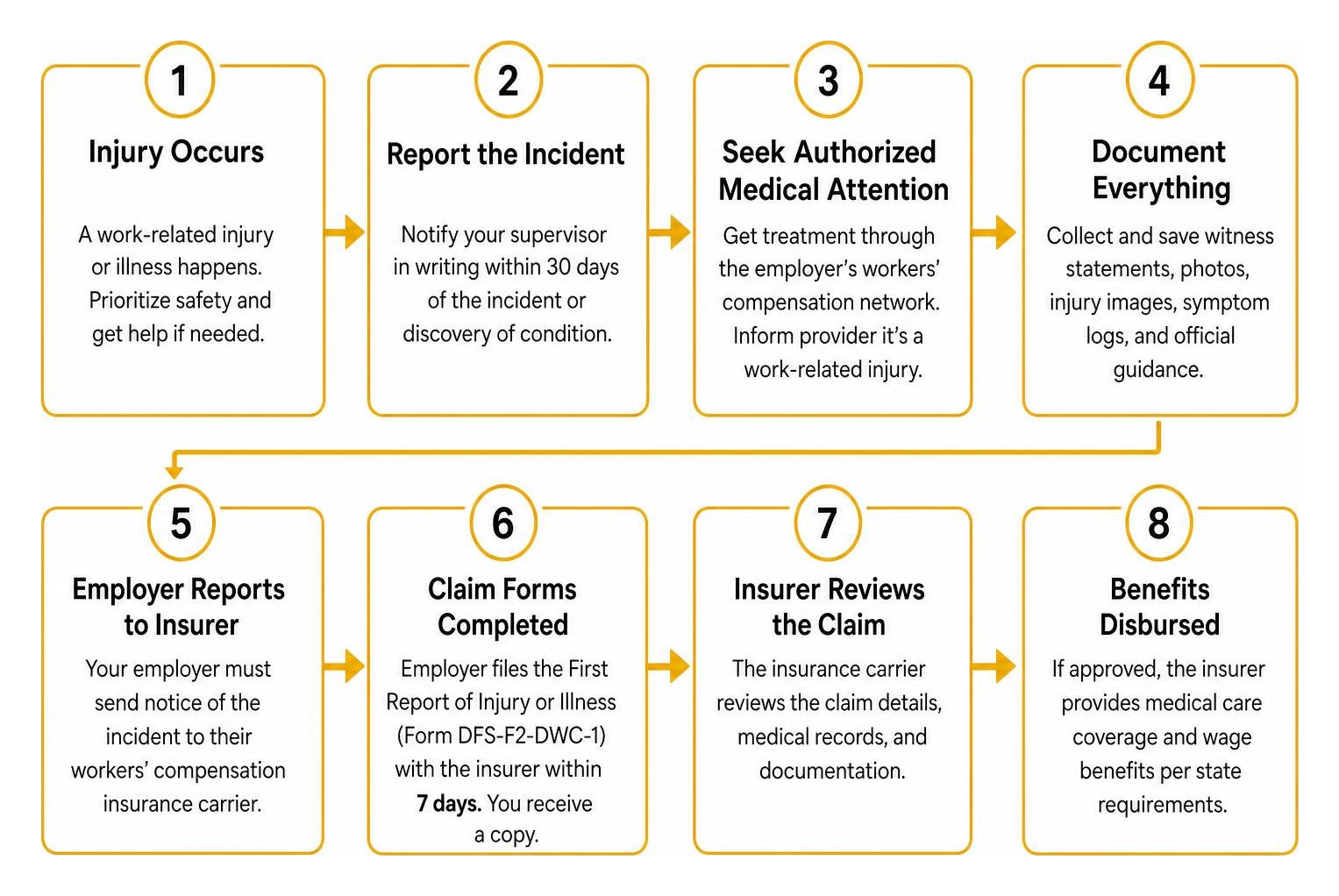
Official Injury Reporting Forms and State Documentation
Your employer must complete and submit the First Report of Injury or Illness (Form DFS-F2-DWC-1) to their insurance carrier within seven days of receiving notice from you. You are entitled to a copy of this completed document.
Review the form carefully to ensure your employer recorded your injury details, personal information, and wage records accurately.
| State/Document Standard | Initial Employee Notice Deadline | Employer Carrier Filing Deadline | Core Claim Form |
|---|---|---|---|
| Florida | 30 Days from incident | 7 Days from notice | Form DFS-F2-DWC-1 |
| Standard Comparison Model | 15–30 Days typical | 10 Days typical | DWC-041 / Standard First Report |
Understanding Insurer Deadlines and Investigation Windows
Once the insurance company receives the First Report of Injury, they assign a claims adjuster to investigate the case. The carrier evaluates medical causation, prior medical history, and employment status.
During this investigation period, the carrier must either accept the claim, pay benefits under a reservation of rights, or issue a formal notice of denial. Navigating these interactions requires caution; adjusters often attempt to record statements to identify contradictions. To prepare for carrier communications, consult our Florida workers’ comp lawyer claim representation guide.
Protecting Your Legal Rights and Overcoming Claim Disputes
Insurance companies operate as for-profit businesses aiming to minimize claim payouts. Workers frequently face procedural roadblocks designed to delay or defeat their rightful benefits.

Common Errors to Avoid If You Got Hurt at Work
Avoiding simple administrative mistakes can save your claim from denial:
- Failing to report immediately: Waiting weeks invites skepticism from claims examiners.
- Providing vague injury descriptions: Stating “my body hurts” instead of identifying specific body parts (e.g., lower back, right knee, left wrist) can exclude unlisted body parts from future coverage.
- Skipping doctor appointments: Missing physical therapy or specialist visits gives the insurer grounds to argue that your injury has resolved.
- Ignoring medical restrictions: Performing physical work at home or on light duty that exceeds your physician’s written restrictions can lead to charges of fraud or immediate claim termination.
Handling Retaliation and Employer Pushback
Under Florida law (Florida Statutes § 440.205), employers are prohibited from firing, threatening, or coercing employees for filing or attempting to file a valid workers’ compensation claim. Despite these protections, subtle forms of pushback can occur, such as undesirable shift reassignments or hostile work environments.
Securing Your Wage-Loss and Medical Benefits
Workers’ compensation provides two primary categories of relief: comprehensive medical care and indemnity (wage-loss) compensation. To maximize your financial recovery, you can protect your benefits with the top rated Florida workers’ comp attorneys who understand how to calculate complex compensation formulas.
Temporary and Permanent Disability Payments
Wage-loss checks depend on your Average Weekly Wage (AWW), calculated using the gross earnings from the 13 weeks preceding your injury date:
- Temporary Total Disability (TTD): Paid at approximately 66 2/3% of your AWW if your authorized doctor removes you from work completely.
- Temporary Partial Disability (TPD): Paid when you can work with restrictions but earn less than 80% of your pre-injury income.
- Permanent Impairment Benefits: Paid once you reach Maximum Medical Improvement (MMI) and an authorized doctor assigns a permanent physical impairment rating.
In Florida, there is a statutory seven-day waiting period. If your disability extends beyond 21 days, compensation for that initial seven-day period is paid retroactively.
Returning to Work and Modified Duty
If your treating physician determines you can perform light-duty tasks, your employer may extend an offer of modified employment matching those restrictions. You must make a good-faith effort to perform this work. Refusing a valid light-duty assignment that complies with your medical restrictions can lead the insurance carrier to suspend your temporary partial disability benefits.
Frequently Asked Questions About Workplace Injuries
Understanding your options helps you manage the claims process with confidence. Here are answers to common questions, with more details available on our frequently asked questions page.
How long do I have to report an injury to my employer?
Under Florida law, you have a strict deadline of 30 days from the date of the accident (or within 30 days of when a doctor first diagnoses a work-related condition) to report the incident to your supervisor. Failure to report within this window can forfeit your right to benefits.
Can I choose my own doctor after being hurt on the job?
In Florida workers’ compensation cases, the insurance carrier selects and authorizes the treating medical providers. You cannot use your personal health insurance or see your family physician unless you pay out of pocket or face an emergency life-threatening situation. However, Florida law allows you a one-time change of physician during your treatment upon written request.
What should I do if my workers’ comp claim is denied?
If your claim is denied, the carrier must provide a formal Notice of Denial explaining their reasons. You have the right to challenge this denial by filing a formal Petition for Benefits with the Florida Office of the Judges of Compensation Claims (OJCC), proceeding through mandatory mediation, and presenting your case at a final evidentiary hearing.
Conclusion
Suffering an injury on the job brings physical discomfort and financial stress. Knowing what steps to take—from notifying your employer to securing authorized medical care and tracking lost wages—helps protect both your health and your legal rights.
At Panzer Law, P.A., we represent injured workers throughout South Florida, including Boca Raton, Miami, West Palm Beach, Palm Beach County, and Miami-Dade County. We operate on a strict no-recovery, no-fee model, meaning you pay zero legal fees or costs unless we secure financial compensation for your case. Contact an experienced Florida workers’ compensation lawyer today for a free consultation to review your claim and secure the full benefits you deserve.
