

How a Workers’ Compensation Settlements Lawyer Helps You Negotiate
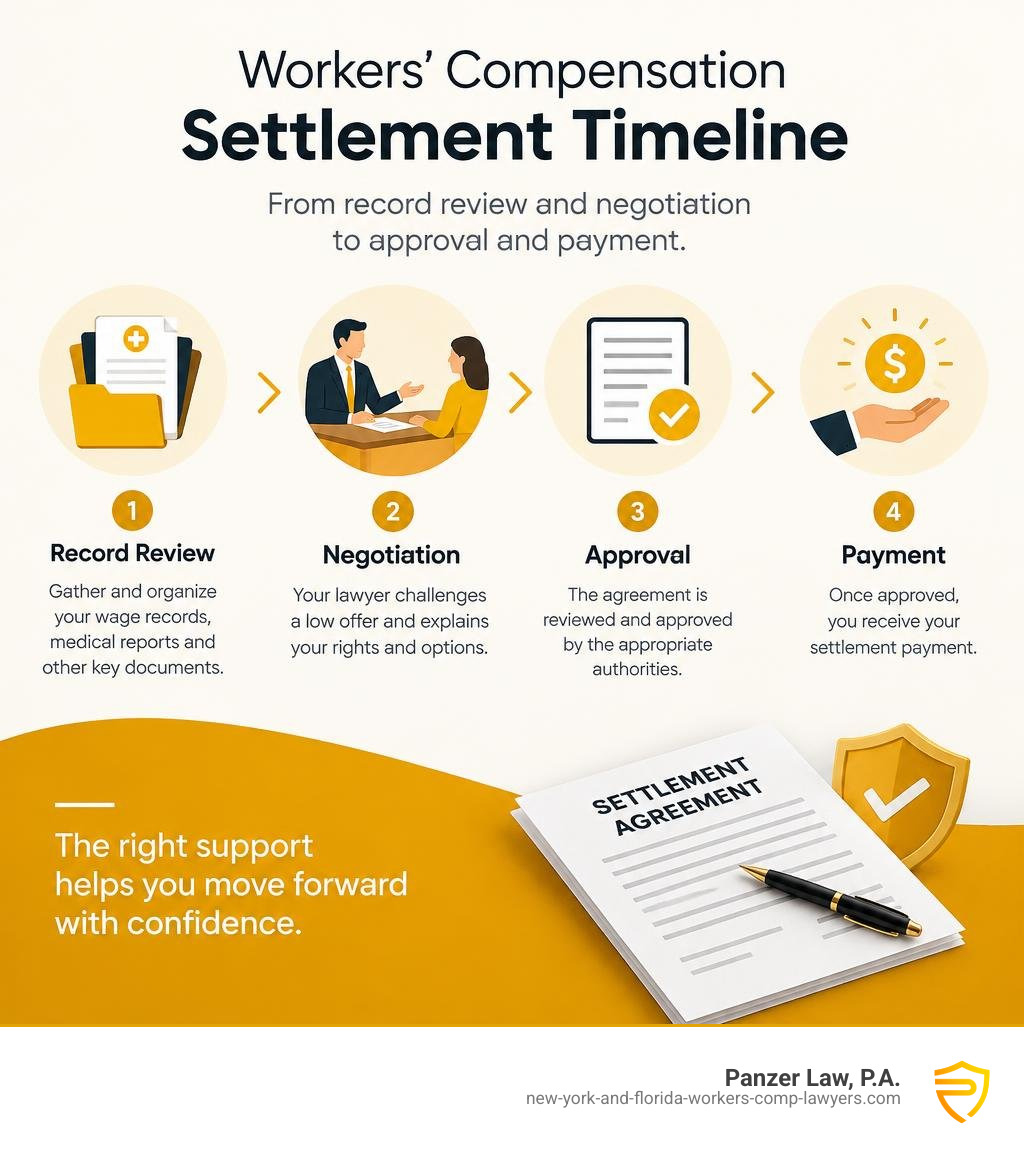
Before you accept a lump-sum offer, ask a workers’ compensation lawyer to review what you are giving up. Gather your wage records, medical reports, unpaid bills, and any estimate of future care. A lawyer can use those records to challenge a low offer and explain whether the agreement would end your right to future medical or wage benefits.
This matters especially if your Florida claim has been denied or delayed. A payout may help now, but a settlement can be hard to change if your condition gets worse.
I’m Gil Panzer, a workers compensation settlements lawyer at Panzer Law, P.A., with over 30 years of legal experience representing injured workers in Florida and New York. I help clients address benefit disputes, medical care, and settlement decisions so they can understand the terms before signing.
Understanding Workers’ Comp Settlements: Types, Benefits, and Valuation
A workers’ compensation settlement is a voluntary agreement between an injured employee and the employer’s workers’ comp insurance carrier. In exchange for an agreed financial sum, the injured worker releases the insurer from specific ongoing obligations. Depending on how the agreement is structured, you might settle only your lost wages (indemnity benefits), your medical coverage, or both through a “full and final release.”
Workers’ compensation encompasses several core benefit categories designed to keep families afloat after a workplace accident:
- Medical Benefits: Full coverage for authorized doctors, hospital visits, surgeries, prescription drugs, physical therapy, and diagnostic tests.
- Temporary Total Disability (TTD): Wage replacement benefits paid while you are completely unable to work during your recovery period. In Florida, this generally amounts to two-thirds (66.67%) of your pre-injury average weekly wage, subject to state statutory maximums.
- Temporary Partial Disability (TPD): Reduced wage-loss benefits paid if you can return to light-duty work but earn less than 80% of your pre-injury wage.
- Permanent Partial Disability / Impairment Benefits (IB): Monetary benefits determined once you reach maximum medical improvement, calculated using a statutory schedule based on your permanent functional loss.
- Permanent Total Disability (PTD): Ongoing indemnity benefits provided to individuals with catastrophic injuries who cannot return to any sedentary employment within a reasonable radius.
When finalizing a resolution, you can estimate your workers comp settlement amount by looking at both historical wage losses and prospective medical expenses.
Settlements typically take one of two forms: a lump-sum distribution or a structured annuity. Here is how they compare:
| Feature | Lump-Sum Payout | Structured Settlement Annuity |
|---|---|---|
| Payment Structure | Single, one-time payment of all agreed funds | Regular periodic disbursements (monthly, annually) |
| Financial Control | Immediate access to entire settlement for investments or debt | Steady, predictable income stream over an extended period |
| Management Risk | You assume all responsibility for budgeting future medical costs | Protects against overspending or market volatility |
| Insurer Involvement | Carrier’s liability is extinguished immediately upon funding | Carrier funds an annuity contract via a secure life insurer |
| Best Suited For | Moderate injuries, cleared medical care, or self-managed care | Catastrophic injuries requiring decades of ongoing treatment |
How a Workers Compensation Settlements Lawyer Calculates Claim Value
Valuing a workers’ compensation claim requires far more than adding up past medical bills. Because workers’ compensation law limits recovery to statutory benefits—excluding damages like pain and suffering—our calculation focuses heavily on future liability exposure.
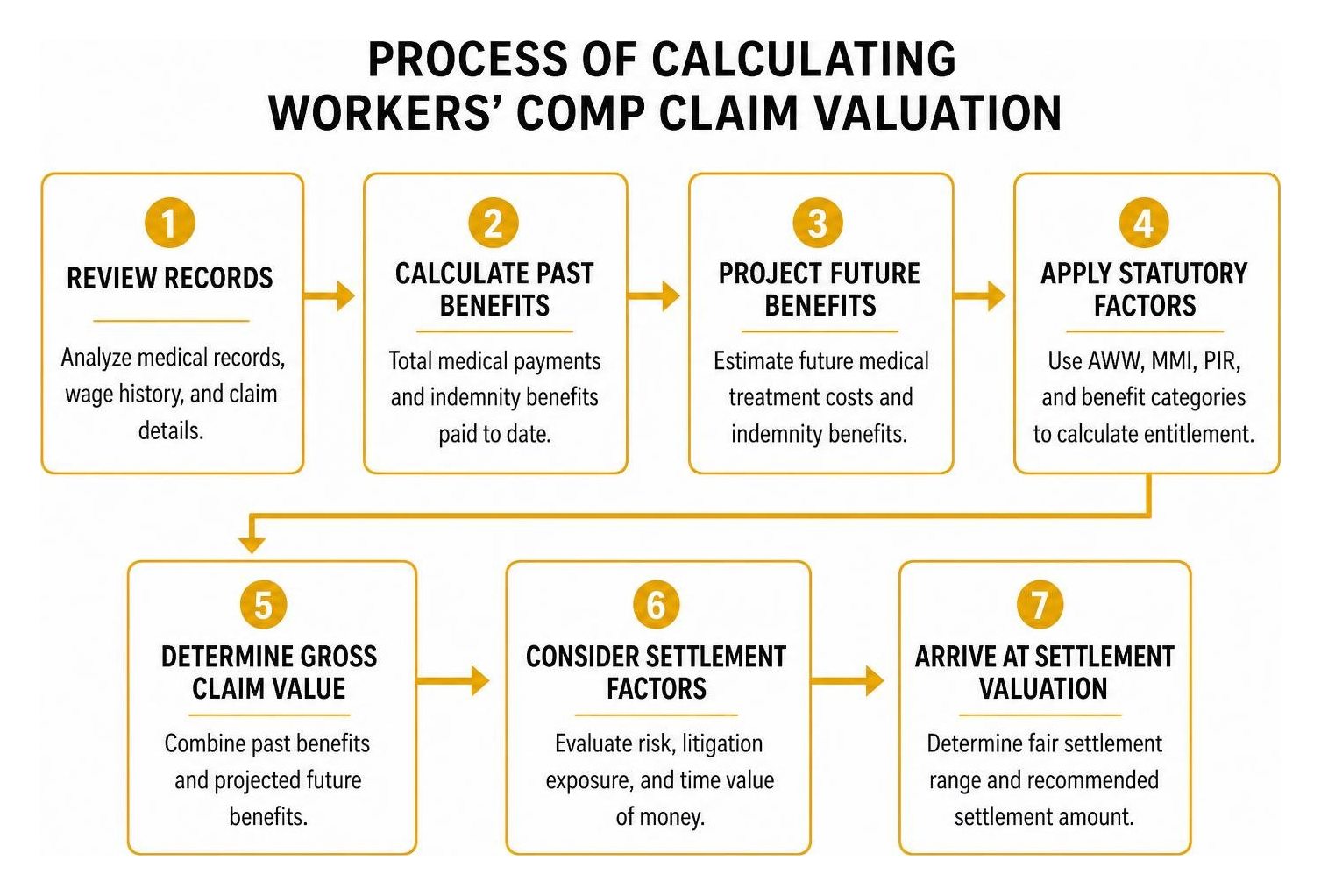
Several pivotal factors dictate the ultimate value of your settlement:
- Maximum Medical Improvement (MMI): The date on which an authorized treating physician determines your condition has stabilized and no further significant functional recovery is expected.
- Permanent Impairment Rating (PIR): A percentage score assigned by your doctor reflecting permanent bodily impairment. A higher rating directly translates to additional weeks of statutory impairment benefits.
- Average Weekly Wage (AWW): Calculated from your earnings across the 13 weeks preceding your accident. If your employer improperly excluded overtime, bonuses, or concurrent employment wages, your baseline rate will be artificially low.
- Future Medical Care and Life Expectancy: Using actuarial life tables and expert medical opinions, we calculate the lifetime cost of doctor visits, prescription medications, injections, surgical revisions, and assistive devices.
- Vocational Retraining Needs: If your permanent physical restrictions prevent you from returning to your past occupation, the costs of vocational rehabilitation, educational retraining, or total wage loss contribute significantly to claim value.
Workers’ Comp vs. Personal Injury and Tax Implications
Workplace injury claims operate under a no-fault statutory model. You do not need to prove your employer was negligent to receive medical and wage benefits; conversely, you are barred from suing your employer for general damages like emotional distress or pain and suffering.
However, if a negligent third party caused your injury—such as a reckless driver striking you while making deliveries in Miami, or a defective scaffolding manufacturer on a construction site in West Palm Beach—you may pursue a personal injury lawsuit alongside your workers’ comp claim.
From a tax perspective, workers’ compensation settlements enjoy substantial protections. Under IRS guidance on workers’ compensation, compensation received for personal physical injuries or sickness under workers’ compensation acts is fully exempt from federal and state income taxes.
However, if you are a Medicare beneficiary or reasonably expect to enroll in Medicare within 30 months of settlement, the federal government requires you to protect Medicare’s financial interests. This is handled through a Medicare Set-Aside (MSA), an allocated portion of your settlement dedicated solely to paying future injury-related medical treatments that Medicare would otherwise cover.
When to Hire a Workers Compensation Settlements Lawyer for Your Claim

Although minor injuries with quick returns to work can sometimes be resolved directly with an adjuster, serious or disputed claims demand professional legal representation. You should consult an attorney if you encounter:
- Catastrophic Injuries: Traumatic brain injuries, spinal cord damage, crush injuries, or severe burns requiring lifelong care.
- Disputed Impairment Ratings: Insurance doctors frequently assign low impairment ratings to minimize payout obligations.
- Pre-Existing Condition Defenses: Insurers frequently blame workplace trauma on degenerative arthritis or prior sports injuries.
- Pressure to Settle Early: If an adjuster offers a fast check before you have reached MMI, they are trying to close the file before the true extent of your future medical costs is known.
Working with an experienced advocate helps protect your benefits against predatory insurance tactics. In Florida, strict statutory deadlines govern claims: under Chapter 440 of the Florida Statutes, you must report an injury to your employer within 30 days and formally petition for benefits within the two-year statute of limitations. Retaining a dedicated Florida workers’ compensation lawyer ensures your procedural rights remain secure across Palm Beach County, Miami-Dade County, and surrounding communities.
How a Workers Compensation Settlements Lawyer Handles Denials and Delays
Insurance carriers are for-profit enterprises that routinely delay indemnity checks, deny specialty referrals, or issue outright claim denials. When a carrier refuses to authorize care, they often send you to an Independent Medical Examination (IME)—a physician chosen and paid by the insurer who often provides an opinion favorable to the defense.
To counter these tactics, our legal team takes immediate procedural action:
We file a formal Petition for Benefits (PFB) with the Florida Office of the Judges of Compensation Claims (OJCC). This legally compels the insurer to articulate its defenses. We depose adjusting agents, cross-examine defense medical examiners, and present testimony from treating physicians. Our understanding of courtroom litigation creates genuine leverage, often forcing insurance carriers to offer realistic settlement sums rather than risk a formal trial judgment.
Step-by-Step: How to Negotiate and Finalize a Lump-Sum Settlement

Negotiating a lump-sum agreement is an evidence-driven, structured legal process:
- Developing the Demand Package: Once you reach MMI, we assemble all diagnostic imaging, physician narrative reports, wage documentation, and future medical cost projections into an extensive settlement proposal.
- Engaging in Discovery and Negotiations: We exchange discovery records with insurance defense counsel, addressing contested defenses and negotiating counteroffers.
- Formal State Mediation: If informal discussions stall, the parties attend state mediation. A neutral mediator works with both sides to bridge financial gaps and construct a binding resolution.
- Drafting the Settlement Documents: Counsel drafts the Joint Petition, Settlement Stipulation, and general release documents, ensuring no hidden clauses compromise your Social Security disability benefits or pension rights.
- Judicial Approval Hearing: In Florida, a Judge of Compensation Claims (JCC) must review the settlement documents. The judge ensures child support liens are satisfied, attorney fees comply with statutory guidelines, and, if you were previously unrepresented, the agreement is legally fair.
Consulting a top-rated workers’ comp lawyer gives you confidence that every contractual clause serves your long-term health and financial stability.
Common Negotiation Mistakes Injured Workers Make
Unrepresented workers often fall into avoidable traps that leave substantial funds on the table:
- Settling Prior to Reaching MMI: Agreeing to a lump-sum while still undergoing diagnostic tests can leave you personally responsible for unforeseen future surgeries.
- Ignoring Outstanding Health Liens: Failing to identify and satisfy outstanding child support arrearages, hospital liens, or health insurance subrogation claims can result in post-settlement lawsuits against your payout.
- Underestimating Prescription Costs: Modern specialized medications, pain management regimens, and anti-inflammatory therapies can cost tens of thousands of dollars over a lifetime.
- Relying on Adjuster Promises: Verbal assurances made during phone conversations hold no legal weight. If a benefit or exception is not explicitly written into the settlement contract, it does not exist.
Settlement Timelines and Modification Rights
Reaching a settlement can take anywhere from a few months in straightforward cases to over a year in complex, highly contested catastrophic claims. Once both parties sign a full and final Joint Petition and the Judge of Compensation Claims enters an order approving the agreement, the contract is legally binding.
Under Florida law, workers’ compensation settlements are virtually permanent. You cannot reopen or modify a finalized lump-sum settlement simply because your physical condition deteriorates or your medical procedures cost more than anticipated. A settlement can only be overturned under narrow legal exceptions, such as proven intentional fraud or mutual mistake of fundamental fact. This strict standard of finality underscores why every detail must be verified before signing.
Frequently Asked Questions About Workers’ Comp Settlements
How long does it take to receive payout funds after signing a settlement?
After the parties sign the closing paperwork, the documents are submitted to the Judge of Compensation Claims for formal review and entry of the approval order. Once the judge signs the order, Florida law generally requires the insurance carrier to disburse payment within 30 days. If the carrier fails to issue your funds within the statutory timeframe, they may be assessed late penalties and statutory interest. You can find more details about state payout procedures in our workers’ comp FAQ.
What is a Medicare Set-Aside and when is it required?
A Medicare Set-Aside (MSA) is a designated financial allocation within your settlement that pays for future injury-related medical care that Medicare would cover. An MSA is required if you are currently enrolled in Medicare and your total settlement exceeds $25,000, or if you reasonably anticipate enrolling in Medicare within 30 months and your settlement exceeds $250,000. These funds can be self-administered or managed by a professional trust administrator, ensuring Medicare’s interests remain protected without jeopardizing your general benefits.
Can a workers’ comp settlement be reopened if my condition worsens later?
In almost all cases, no. A standard workers’ compensation lump-sum settlement contains a “full and final release” clause, meaning you permanently surrender your right to demand additional medical treatments or wage replacement benefits from that employer and insurer for that specific injury. Unless you can prove deliberate fraud, coercion, or total mutual mistake, the court will not reopen your claim.
Conclusion
Resolving an on-the-job injury through a lump-sum agreement provides financial independence and lets you manage your medical choices without constant insurance adjuster approvals. However, trading lifelong statutory rights for a one-time check requires careful preparation, thorough medical valuation, and skilled negotiation.
At Panzer Law, P.A., we operate on a contingency-fee basis: you pay no attorney fees or out-of-pocket costs unless we successfully recover money for you. Whether you were injured in Boca Raton, Miami, or West Palm Beach, our dedicated legal team is ready to evaluate your claim and fight for the settlement you deserve.
Contact Workers Comp Law Firm Panzer Law today for a free, no-obligation case evaluation.
