

How a West Palm Beach Workers Comp Attorney Can Help
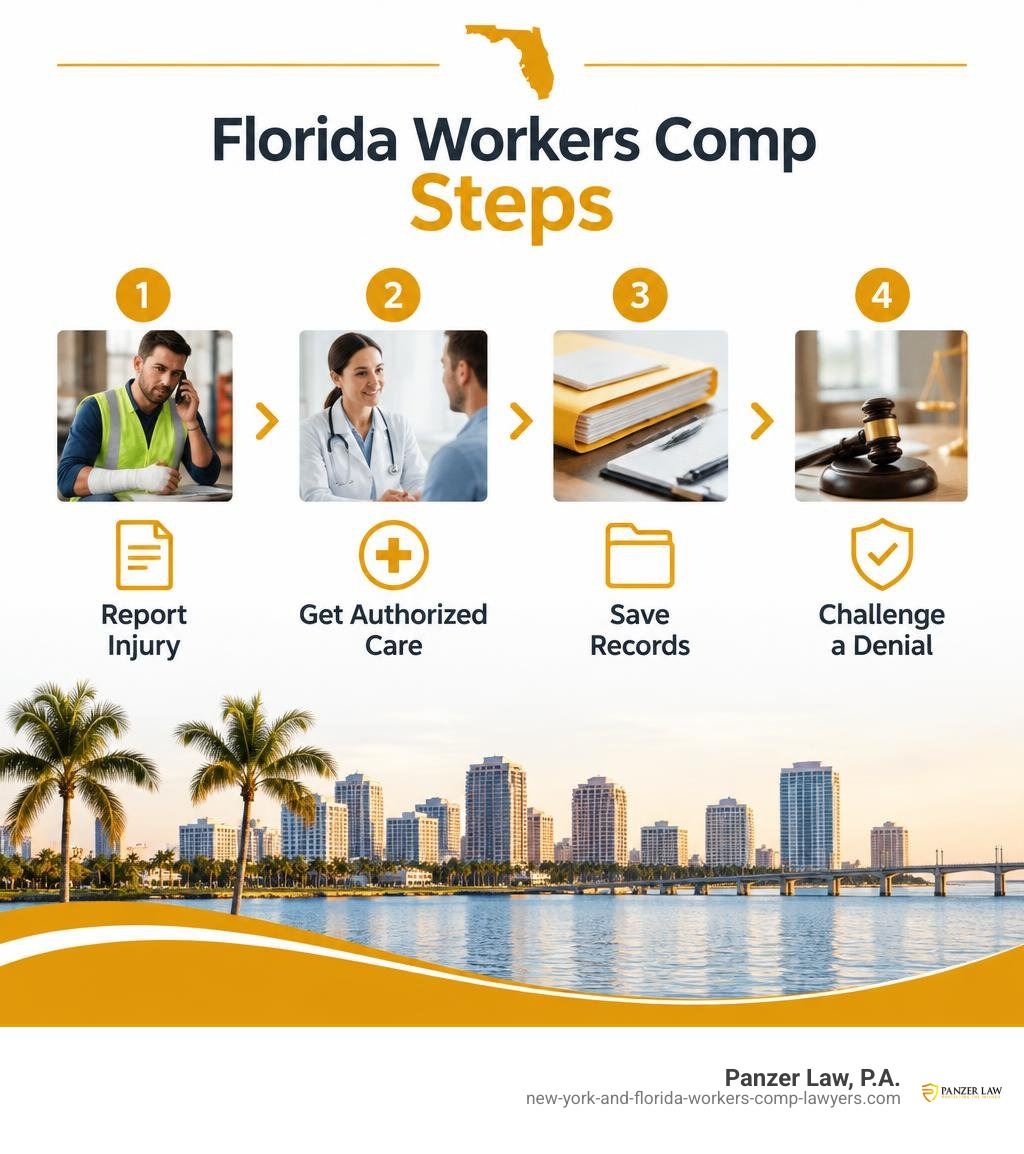
Report your injury to your employer as soon as possible. In Florida, you generally have 30 days to give notice. Ask how to get authorized medical care, and keep copies of your accident report, work restrictions, and messages from the insurer. If treatment or wage benefits are delayed or denied, a West Palm Beach workers comp attorney can help you challenge the decision and protect your claim.
I’m Gil Panzer, owner of Panzer Law, P.A. and a West Palm Beach workers comp attorney serving injured workers in Florida. For more than three decades, I’ve worked on workers’ compensation claims involving medical care, benefits, and settlements; the steps below show where to start.
Quick west palm beach workers comp attorney terms:
- Florida workers’ compensation lawyer
- workers compensation lawyer in florida
- workman’s comp. lawyers near me
Understanding Florida Workers’ Compensation Laws and Eligibility
Navigating Florida’s workers’ compensation system can feel overwhelming when you are dealing with physical pain, lost income, and aggressive insurance adjusters. Governed by Florida Statutes Chapter 440, the system is designed to provide medical care and wage replacement to employees injured on the job.

The foundational principle of these laws is the no-fault doctrine. Under this framework, you do not have to prove that your employer’s negligence caused your accident to qualify for benefits. Even if a slip or momentary lapse in judgment contributed to your injury, you remain entitled to coverage. However, the trade-off is the “exclusive remedy” rule: in exchange for guaranteed no-fault benefits, you generally cannot sue your employer in civil court for general damages such as pain and suffering. Understanding statutory regulations across Florida is crucial to ensuring your workplace rights are fully protected.
Florida No-Fault System and Employer Coverage Requirements
In Palm Beach County, whether an employer is mandated to carry workers’ compensation coverage depends primarily on their industry and workforce size:
- Non-Construction Businesses: Any private employer with four or more employees (part-time or full-time) must maintain an active workers’ compensation policy.
- Construction Industry: Due to elevated workplace hazards, construction employers must carry coverage if they have one or more employees, including the business owner and corporate officers.
- Agricultural Sector: Agricultural employers must carry coverage if they employ six or more regular workers, or 12 or more seasonal workers who work more than 30 days during a season.
Corporate officers in non-construction industries may choose to file a notice of election to be exempt from coverage. However, employers cannot force rank-and-file employees to sign away their rights. If an employer fails to carry required insurance, they face severe administrative stop-work orders, steep state penalties, and direct civil liability if an employee suffers an injury.
Employee Eligibility and Misclassification Challenges
To receive benefits, you must meet the statutory definition of an “employee.” Full-time, part-time, seasonal, and temporary workers all qualify under Florida law. Undocumented workers are also fully entitled to workers’ compensation benefits for medical care and lost wages if injured on the job.
A frequent obstacle we encounter in South Florida is 1099 independent contractor misclassification. Employers sometimes label workers as independent contractors to avoid paying payroll taxes and purchasing workers’ compensation insurance. Florida courts and the Division of Workers’ Compensation look beyond job titles at the economic reality of the relationship:
- Does the employer dictate your work hours and methods?
- Does the company supply your equipment and tools?
- Are you paid on an hourly or salary schedule rather than a fixed project fee?
If your employer exercises substantial control over your daily duties, you are likely an employee under Florida law, regardless of whether you signed an independent contractor agreement.
Covered Workplace Injuries, Exclusions, and Critical Deadlines
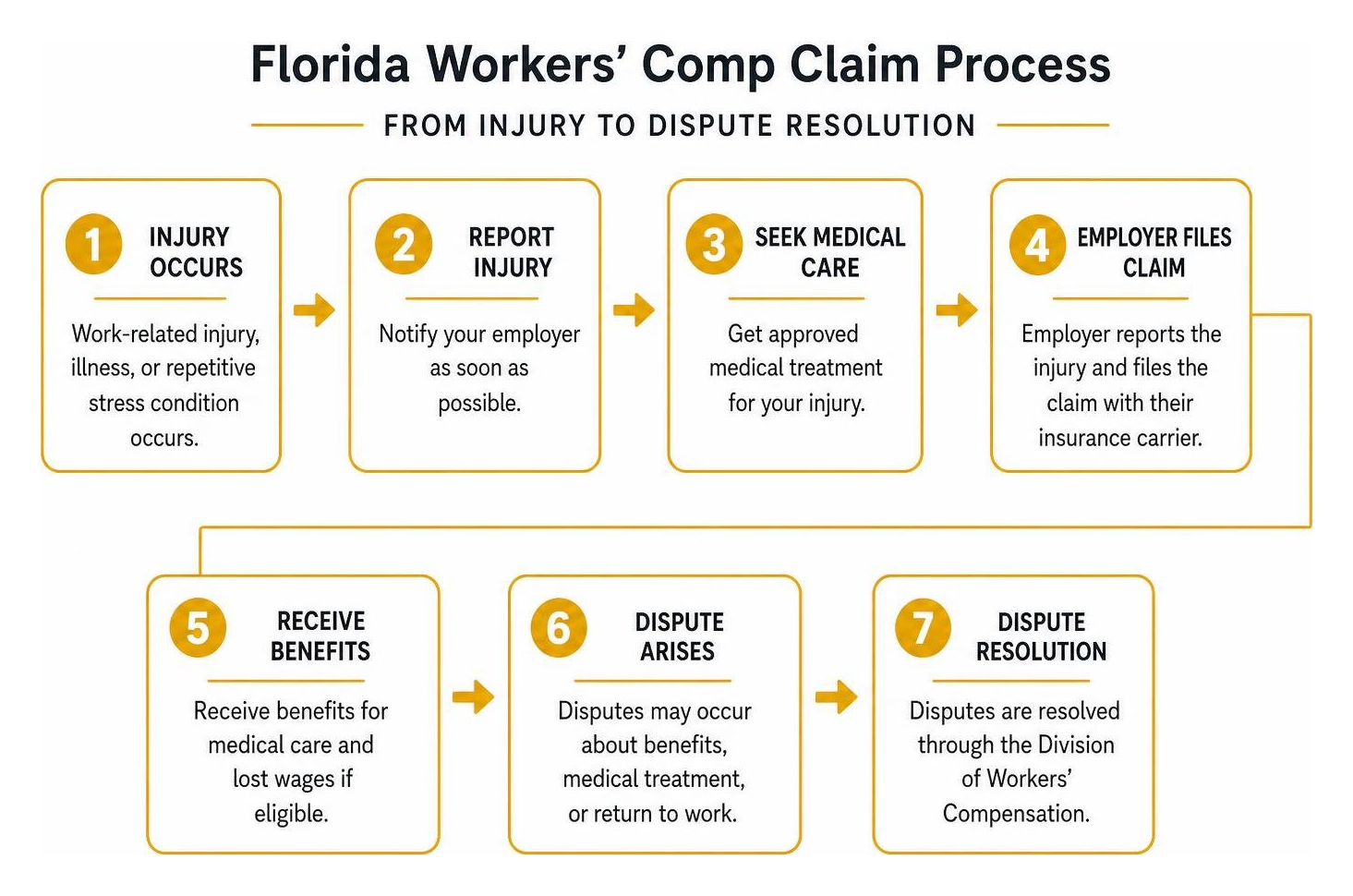
Workers’ compensation covers sudden traumatic injuries, repetitive stress conditions, and occupational diseases resulting from employment hazards.
Common Job Injuries and Statutory Exclusions
We frequently represent injured workers in Palm Beach County suffering from:
- Traumatic orthopedic trauma (herniated discs, torn ligaments, compound fractures) caused by falls or heavy lifting.
- Repetitive motion disorders, such as carpal tunnel syndrome or degenerative joint strain.
- Severe crush injuries, lacerations, or mechanical amputations caused by high-powered machinery or industrial automotive components like those supplied by COMP Cams.
- Head trauma and concussions from falling debris or striking heavy objects.
- Occupational respiratory illnesses resulting from chemical fumes, dust, or toxic exposure.
Under Florida law, your work duties must be the Major Contributing Cause (MCC)—meaning more than 50% responsible—for your injury or disability compared to all other pre-existing factors.
Statutory Exclusions: Insurers frequently try to deny claims based on specific statutory defenses, including:
- Intoxication: Injuries primarily caused by alcohol or drug impairment are not compensable.
- Intentional Self-Harm: Deliberate self-inflicted injuries are excluded.
- Horseplay: Injuries resulting from aggressive, unauthorized horseplay outside normal work activities are excluded.
- Going-and-Coming Rule: Standard commutes to and from work are generally excluded, unless you were traveling between job sites or running a special work errand for your employer.
Critical Notice and Statute of Limitations Deadlines
Missing a procedural deadline can permanently bar an otherwise valid injury claim:
- The 30-Day Reporting Deadline: You must report your injury to your employer within 30 days of the accident, or within 30 days of when a doctor first informs you that your medical condition is work-related.
- The Two-Year Statute of Limitations: You must formally file a Petition for Benefits within two years of the initial accident date.
- The One-Year Tolling Rule: After the initial two-year period, the statute of limitations is extended (tolled) for one year from the date your employer or insurer last provided you with authorized medical care or indemnity payments.
Available Benefits and Immediate Steps Following an Accident
Florida law outlines specific indemnity and healthcare benefits designed to keep you financially afloat while recovering from an occupational accident.

Medical Care, Wage Replacement, and Rehabilitation
Under an accepted claim, your employer’s insurance company is required to cover all reasonable and necessary medical treatment related to the workplace accident:
- Medical Treatment: Doctor visits, emergency care, physical therapy, prescription medications, diagnostic testing (MRIs, X-rays), and surgical procedures with zero co-pays.
- Travel Reimbursement: Mileage expenses for travel to and from authorized medical appointments and pharmacies.
- One-Time Change of Physician: You have the absolute statutory right under Florida Statute § 440.13(2)(f) to request a one-time change of your authorized treating physician. The insurer must authorize a new doctor within 14 calendar days; if they fail to do so in writing, you gain the right to select your own replacement doctor.
Wage replacement (indemnity) benefits are determined by your Average Weekly Wage (AWW), calculated using your gross earnings from the 13 weeks prior to the accident:
- Temporary Total Disability (TTD): If your authorized physician places you entirely off work, you receive 66 2/3% of your pre-injury AWW (up to 80% for certain catastrophic injuries), capped at the state maximum weekly rate.
- Temporary Partial Disability (TPD): If you are released to light-duty work with physical restrictions and your employer cannot accommodate you at full pay (or you earn less than 80% of your pre-injury wage), TPD pays up to 64% of the difference. Temporary disability benefits are capped at a statutory maximum of 104 weeks.
- Permanent Total Disability (PTD): If you suffer catastrophic injuries that permanently prevent you from engaging in even sedentary employment within a 50-mile radius, you are entitled to continuous weekly wage benefits until age 75 (or for life in severe cases).
- Impairment Benefits: Once you reach Maximum Medical Improvement (MMI), your doctor assigns an Impairment Rating (PIR) for any residual permanent impairment, entitling you to additional weekly compensation.
Step-by-Step Actions to Take After a Workplace Injury
Taking prompt, careful steps after an injury protects your health and your legal rights:
- Step 1: Notify Your Employer Immediately. Report your accident in writing to a manager or supervisor, detailing the exact date, time, location, and nature of your injury.
- Step 2: Seek Authorized Medical Treatment. Except in life-threatening emergencies, only seek treatment from doctors authorized by your employer’s workers’ comp insurance carrier.
- Step 3: Document the Scene and Gather Evidence. Take photos of where the incident occurred, identify malfunctioning equipment, and collect names and phone numbers of any witnesses.
- Step 4: Maintain Detailed Records. Save every work status slip, medical record, physical therapy note, prescription receipt, and written communication with the insurance adjuster.
- Step 5: Follow All Medical Directives. Attend every scheduled appointment and strictly adhere to your assigned physical restrictions both on and off the job.
Navigating Claim Denials, Appeals, and Third-Party Lawsuits
When insurance companies prioritize their bottom line over your recovery, claims are often delayed, disputed, or outright denied.
Challenging Denied Claims Through the OJCC
If the insurer issues a formal Notice of Denial or refuses to authorize necessary medical care, we file a Petition for Benefits (PFB) with the Florida Office of the Judges of Compensation Claims (OJCC).
The dispute resolution process involves several key stages:
- Response Period: The insurance carrier has 14 days after the PFB is filed to either grant the requested benefits or file a formal legal response stating their defenses.
- State Mediation: A formal, mandatory mediation conference is scheduled within 130 days of filing. A neutral state mediator works with both parties to resolve the dispute or negotiate a global lump-sum settlement.
- Pre-Trial and Discovery: If mediation does not resolve the issue, we conduct depositions of insurance adjusters, supervisors, and medical experts.
- Final Evidentiary Hearing: A Judge of Compensation Claims (JCC) presides over a formal trial, evaluates evidence and medical testimony, and issues a binding legal ruling.
Whether your claim originates in West Palm Beach or nearby jurisdictions like Miami, navigating the OJCC requires an understanding of regional claims handling and administrative court procedures.
Workers’ Comp Claims vs. Third-Party Personal Injury Lawsuits
While workers’ comp bars direct lawsuits against your employer, you can pursue a separate civil personal injury lawsuit if a negligent third party contributed to your injury.
| Feature | Florida Workers’ Compensation Claim | Third-Party Personal Injury Lawsuit |
|---|---|---|
| Fault Requirement | No-fault system (no need to prove negligence) | Requires proof of third-party negligence |
| Pain and Suffering | Not recoverable under state statute | Fully recoverable |
| Wage Loss Recovery | 66 2/3% of Average Weekly Wage (capped) | 100% of past and future lost earnings |
| Medical Expenses | 100% of authorized, related medical care | Past and estimated future medical bills |
| Target Defendant | Employer’s workers’ compensation carrier | At-fault third party (individual or corporation) |
Common third-party liability scenarios include:
- Motor Vehicle Collisions: A negligent driver crashes into your vehicle while you are making work deliveries or traveling between job sites.
- Defective Machinery: A defective part or poorly designed tool malfunctions on a job site.
- Property Hazards: A third-party commercial property manager fails to repair dangerous premises where you are assigned to work.
- Negligent Subcontractors: An employee of another subcontractor causes an accident on a multi-contractor construction site.
- Distribution Accidents: You are injured by third-party delivery contractors while loading or handling inventory for retail home furnishing distributors such as West Elm.
Why You Need a West Palm Beach Workers Comp Attorney for Your Claim
Insurance companies employ experienced adjusters and defense lawyers whose primary objective is to minimize claim payouts. Attempting to manage complex legal filings while recovering from an injury puts you at a significant disadvantage.
When to Hire a West Palm Beach Workers Comp Attorney
You should consult a lawyer immediately if:
- Your initial claim has been denied or delayed.
- The insurance adjuster refuses to authorize specialist consultations, physical therapy, or surgery.
- You have been assigned an artificially low impairment rating or are being pressured to return to full-duty work before you have healed.
- You are experiencing workplace retaliation, demotion, or threats of termination for asserting your statutory rights.
- You are ready to discuss settling your workers’ comp claim for a lump sum.
For a deeper look into the legal process, explore our Florida workers comp lawyer claim representation guide or read about how to find a Florida workers comp lawyer for your claim.
Contingency Fees and How a West Palm Beach Workers Comp Attorney Protects You
Under Florida Statute § 440.34, attorney fees in workers’ compensation cases are strictly regulated to protect injured workers:
- Contingency Fee Basis: You pay no upfront retainers or out-of-pocket legal expenses.
- Statutory Sliding Scale: Attorney fees from lump-sum settlements are generally set at 20% of the first $5,000 in benefits secured, 15% of the next $5,000, 10% of the remaining amount up to $100,000, and 5% of any recovery exceeding $100,000.
- Carrier-Paid Fees: If the insurance company wrongfully denies a specific medical benefit or indemnity payment and we prevail before the Judge of Compensation Claims, the insurance carrier is often ordered to pay our legal fees directly, over and above your benefits.
Frequently Asked Questions About Palm Beach County Work Injury Claims
How long do I have to report an on-the-job injury in Palm Beach County?
You have 30 days from the date of the accident (or the date a doctor confirms your condition is work-related) to notify your employer. We strongly recommend reporting the incident in writing immediately to eliminate any factual disputes regarding notice.
Can my employer fire me for filing a workers’ comp claim in Florida?
No. Under Florida Statute § 440.205, it is illegal for an employer to discharge, threaten to discharge, intimidate, or coerce an employee for claiming workers’ compensation benefits. If you face retaliatory termination, you may pursue separate legal damages in civil court.
Can I choose my own doctor for my workers’ compensation medical care?
Under Florida’s system, your employer’s insurance carrier selects your initial treating physician. However, you are entitled to request a one-time change of physician during your treatment. If the insurer fails to respond to your written request within 14 calendar days, you gain the legal right to select your own authorized doctor.
Conclusion
A serious workplace injury can disrupt your livelihood and leave you facing complex legal battles with insurance carriers. You do not have to handle these challenges on your own.
At Panzer Law, P.A., we have dedicated more than three decades to advocating for injured workers across Palm Beach County and South Florida. We handle every aspect of your claim—from securing authorized medical treatment and calculating average weekly wages to litigating disputed benefits and negotiating maximum lump-sum settlements. We operate on a contingency basis, meaning you pay no out-of-pocket costs and no legal fees unless we secure a recovery for you.
If you or a loved one has suffered an on-the-job injury, reach out to an experienced West Palm Beach Workers Compensation Lawyer at Panzer Law, P.A. today for a free, confidential case evaluation.
