

How a Workers Comp Settlement Calculator Estimates Your Claim Value
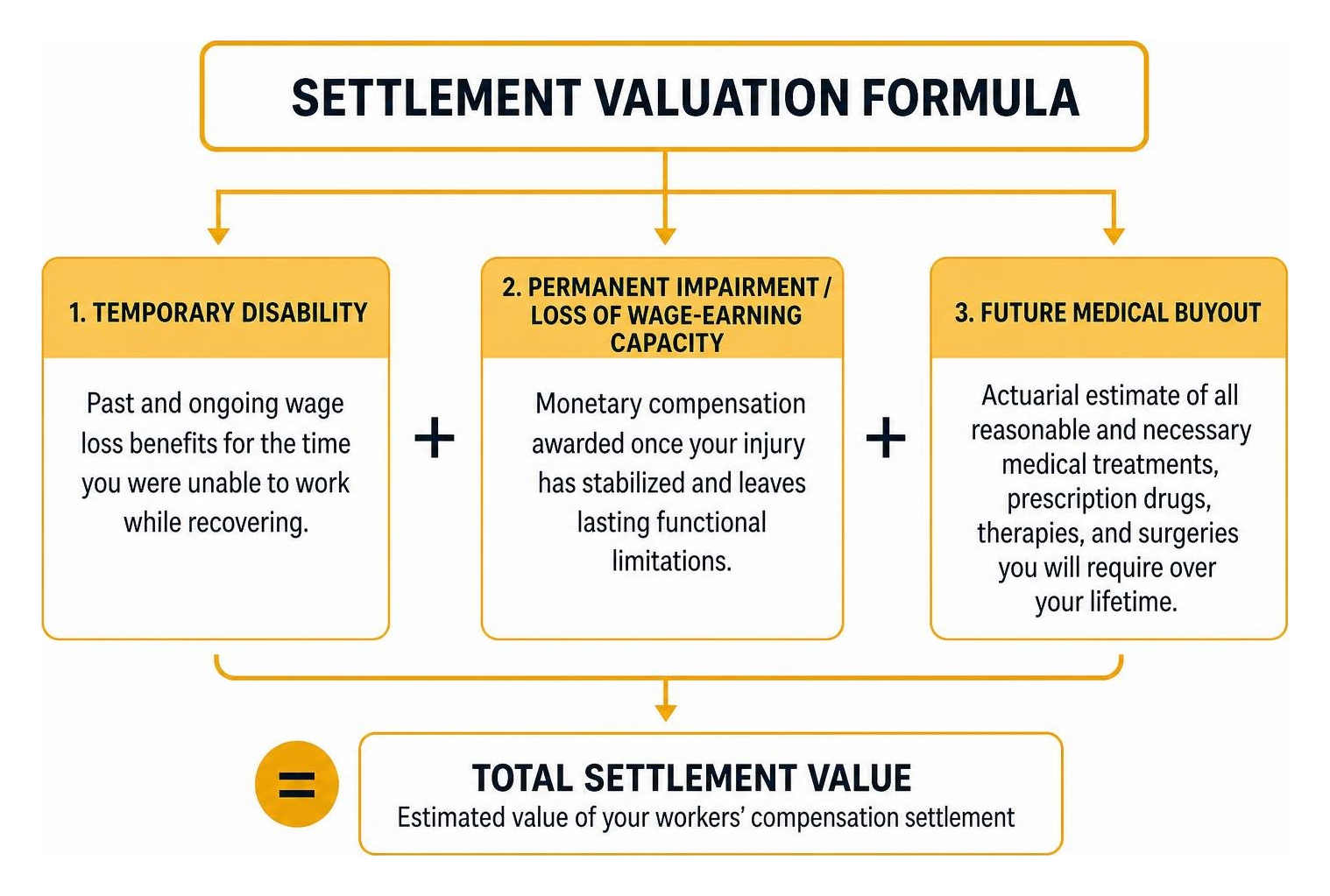
Estimating a workers’ compensation payout is not a guessing game. Insurance adjusters and judges rely on specific statutory frameworks to establish baseline claim reserves. A standard calculator evaluates your claim using what many in the legal field call the “three-legged stool” formula:
- Past and Ongoing Wage Loss (Temporary Disability): Benefits owed for the time you were completely or partially unable to work while recovering.
- Permanent Impairment / Loss of Wage-Earning Capacity: Monetary compensation awarded once your injury has stabilized and leaves lasting functional limitations.
- Future Medical Buyout: An actuarial estimate of all reasonable and necessary medical treatments, prescription drugs, therapies, and surgeries you will require over your lifetime.
When you begin the claims process, understanding how these components interact is vital. If you are just starting out, reviewing our guide to filing workers comp claims will ensure you establish proper documentation from day one.
Average Weekly Wage and Statutory Compensation Rates
Every workers’ compensation calculation begins with your Average Weekly Wage (AWW). Under standard rules, your AWW represents your gross pre-tax earnings—including overtime, bonuses, shift differentials, and certain concurrent employment earnings—averaged over the 13 to 52 weeks preceding your injury.
From your AWW, the system establishes your statutory compensation rate:
- In most standard jurisdictions, your weekly benefit rate equals 66.67% (two-thirds) of your pre-injury AWW.
- If you earn $1,200 per week, your base compensation rate is approximately $800 per week.
- However, statutory maximums apply. If your state caps weekly benefits below your two-thirds calculation, your payout is capped at that statutory limit regardless of how much you earned.
Scheduled vs. Unscheduled Permanent Partial Disability (PPD)
When an injury causes permanent damage, statutory systems categorize the impairment as either a scheduled or an unscheduled injury:
- Scheduled Injuries: Involve specific extremities or body parts (such as an arm, leg, hand, finger, or eye). Statutes assign a set number of maximum benefit weeks to each body part. Payouts are calculated by multiplying the assigned weeks by your impairment percentage and your statutory weekly compensation rate.
- Unscheduled Injuries: Involve general, systemic areas such as the spine, neck, brain, pelvis, or internal organs. These are evaluated as a Whole Person Impairment (WPI) percentage, which considers your total physical loss and reduced wage-earning capacity.
| Injury Category | Body Part / System | Statutory Valuation Basis | Valuation Formula Drivers |
|---|---|---|---|
| Scheduled | Arm / Shoulder | Fixed statutory weeks (e.g., 200–312 weeks) | Scheduled Weeks × % Impairment × Weekly Comp Rate |
| Scheduled | Hand / Fingers | Fixed statutory weeks (e.g., 100–244 weeks) | Scheduled Weeks × % Impairment × Weekly Comp Rate |
| Scheduled | Leg / Knee | Fixed statutory weeks (e.g., 180–288 weeks) | Scheduled Weeks × % Impairment × Weekly Comp Rate |
| Scheduled | Eye / Vision Loss | Fixed statutory weeks (e.g., 100–160 weeks) | Scheduled Weeks × % Loss of Sight × Weekly Comp Rate |
| Unscheduled | Spine / Neck / Back | Whole Person Impairment (WPI) | WPI % × Max Statutory Weeks × Loss of Earning Capacity |
| Unscheduled | Traumatic Brain / Pelvis | Whole Person Impairment (WPI) | Lifetime Wage Loss + Lifetime Attendant Care Multiplier |
Key Data Inputs Required for an Accurate Workers Comp Settlement Calculator
To generate an accurate estimate, any digital tool requires precise inputs. Using broad estimates produces misleading figures that insurance adjusters will quickly dismantle. When utilizing authorized tools like Florida state benefit calculators, ensure you have:
- Gross Pre-Injury Earnings: Complete pay stubs demonstrating 13 to 52 weeks of wages, including tips and overtime.
- Impairment Rating Percentage: The exact physical impairment rating assigned by a physician upon reaching medical stability.
- Accrued and Remaining Benefit Weeks: An accounting of all Temporary Total Disability (TTD) or Temporary Partial Disability (TPD) weeks paid versus statutory maximum caps.
- Outstanding and Future Medical Costs: Clear estimates of future prescription medications, injection therapies, physical therapy regimens, and potential surgeries.
Key Variables That Dictate Your Total Settlement Payout
Two workers with identical job titles and identical injuries can receive vastly different settlement amounts based on several crucial variables. The severity of the injury and the invasiveness of treatment heavily influence how insurers calculate reserves. For example, conservative care such as physical therapy carries lower multipliers, whereas claims involving complex surgical intervention—such as determining spinal cord injury settlement values—frequently reach the highest valuation tiers due to lifelong medical requirements.
Maximum Medical Improvement and Independent Medical Examinations
Maximum Medical Improvement (MMI) occurs when your treating medical providers determine that your condition has stabilized and no further curative improvement is expected. Settling your claim before reaching MMI is risky because you cannot accurately predict future medical expenses or the full extent of permanent impairment.
Once you reach MMI, your treating physician assigns a permanent impairment rating. However, insurance carriers frequently request an Independent Medical Examination (IME). Despite the neutral title, IME doctors hired by insurers often provide ratings that are 30% to 50% lower than those assigned by your authorized treating physician.
For instance, if an authorized doctor assigns a 15% Whole Person Impairment for a spinal injury, an insurer’s IME physician might rate it at 5%. For a worker whose compensation rate yields $3,335 per impairment point, this single 10-point dispute represents a $33,350 swing in settlement indemnity value.
Future Medical Expenses, Prosthetics, and Medicare Set-Asides (MSA)
The largest portion of a significant settlement is often the buyout of future medical expenses. In complex and catastrophic injury claims, ongoing care costs quickly outpace wage loss benefits:
- Prosthetic Devices: Advanced myoelectric prosthetic limbs cost between $50,000 and $80,000 per unit and must be replaced every 4 to 5 years. Over a 20-year span, the true lifetime cost of prosthetics alone can easily exceed $200,000.
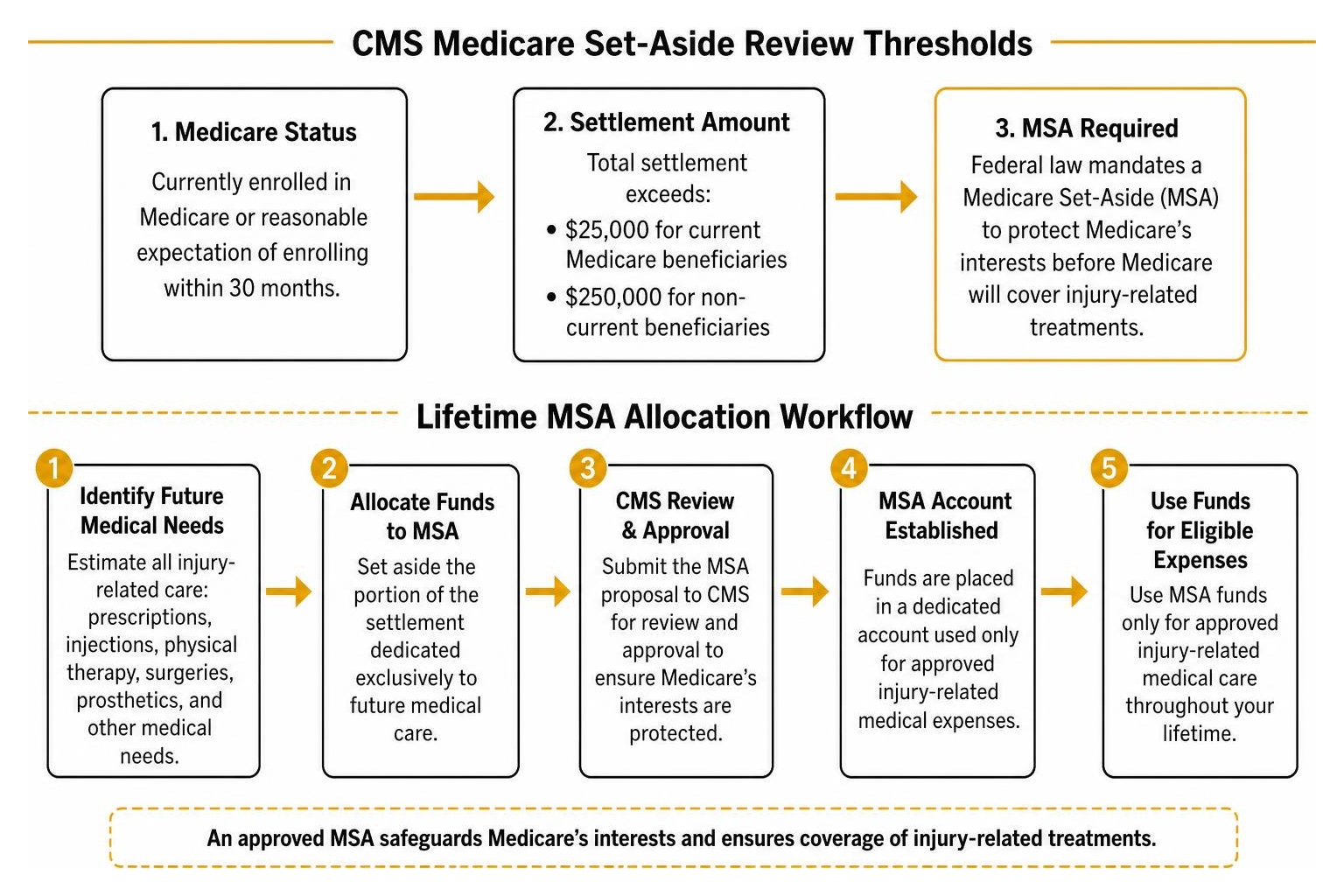
- Medicare Set-Asides (MSAs): If you are currently enrolled in Medicare, or have a reasonable expectation of enrolling within 30 months and your total settlement exceeds $250,000 (or $25,000 for current beneficiaries), federal law mandates that Medicare’s interests be protected. A formal MSA allocation must identify which portion of your settlement is dedicated exclusively to future injury-related medical care before Medicare will cover those treatments.
State Benefit Caps and Statutory Disability Schedules
Workers’ compensation is governed strictly by state law, creating massive jurisdictional variations across the country. In 2026, the national average weekly maximum TTD cap across all 51 jurisdictions sits at approximately $1,179 per week.
Benefit caps and disability schedules vary by state, so a national calculator must account for the rules applicable to your claim.
Settlement Structures, Employer E-Mod Impacts, and Negotiation Leverage
Once a claim’s gross value is established, both parties must negotiate the method of disbursement and evaluate the financial pressures driving the insurance carrier’s willingness to settle.
Lump Sum Compromise & Release vs. Structured Settlements
Workers’ compensation settlements generally follow one of two legal mechanisms:
- Lump Sum (Compromise and Release): You receive your entire net settlement proceeds in a single payment. In exchange, you release the employer and insurance carrier from all future liability, permanently closing both wage indemnity and medical benefits.
- Structured Settlement (Periodic Annuity / Stipulated Finding): You receive scheduled payments over months or years funded through an annuity. This provides guaranteed cash flow and can be structured to leave certain medical coverage open under strict parameters.
| Factor | Lump Sum (Compromise & Release) | Structured Settlement (Annuity / Stipulation) |
|---|---|---|
| Payment Timing | Single, immediate disbursement | Scheduled monthly or annual payments |
| Future Medical Liability | Fully closed; claimant manages own care | Can be structured to keep specific medical open |
| Investment Control | Full control by the injured worker | Locked into fixed, guaranteed annuity yield |
| Present Value Impact | Subject to 2%–5% present value discount | Earns compound interest over time tax-free |
| Best Suited For | Workers wanting complete independence | Long-term catastrophic care and budgeting protection |
Employer Experience Modification Rates and Claim Costs
A major factor influencing an insurer’s settlement posture is the employer’s Experience Modification Factor (E-Mod). Administered by rating bureaus like the NCCI, an E-Mod represents an employer’s safety record compared to industry peers.
When an employee suffers a lost-time compensable injury, it increases the employer’s E-Mod, directly inflating their workers’ compensation premiums for the next three rolling policy years. For example, a $75,000 lost-time claim on a $1.2M payroll can increase an employer’s E-Mod by +0.25, creating an insurance premium surcharge of $8,400 per year for three consecutive years. That raises the employer’s true cost from $75,000 to $100,200 ($75,000 + $25,200). Employers often push their carriers to settle and close open claims quickly to stabilize these escalating multi-year premium adjustments.
Evaluating Your Negotiation Strength and Overlooked Claim Components

Many unrepresented workers unknowingly leave 30% to 50% of their claim’s true value on the table because insurance adjusters never volunteer hidden settlement components. When building negotiation leverage, make sure your demand accounts for:
- Medical Travel Reimbursement: Accumulated round-trip mileage and tolls to all authorized doctors, physical therapists, and diagnostic facilities.
- Home Health Attendant Care: Compensation for family members or professionals who assist you with activities of daily living (bathing, dressing, meal preparation).
- Future Replacement Hardware and Revision Surgeries: Anticipated hardware removals, spinal fusion revisions, or joint replacement updates over your statistical life expectancy.
- Vocational Rehabilitation / Retraining Allocations: Compensation for educational retraining if your physical restrictions prevent you from returning to your past line of work.
Legal, Financial, and Tax Realities of Workplace Injury Settlements
Securing a favorable settlement figure is only half the battle; understanding how tax laws and federal offsets interact with your award is equally essential to protecting your net recovery. To learn more about how statutory representation works, read our Florida workers comp claim representation guide.
IRS Tax Treatment Under IRC Section 104(a)(1) and SSDI Offsets
Under Internal Revenue Code (IRC) Section 104(a)(1), workers’ compensation settlement proceeds received for personal physical injuries or physical sickness are 100% exempt from federal and state income taxes. You do not pay income tax on lump-sum indemnity or medical buyout proceeds.
However, complex interactions arise if you concurrently receive Social Security Disability Insurance (SSDI):
- Federal law dictates that the combined total of your SSDI benefits and workers’ compensation payments cannot exceed 80% of your pre-injury average current earnings.
- If your settlement exceeds this threshold, the Social Security Administration will reduce (offset) your monthly SSDI payments.
- The Legal Solution: An experienced workers’ comp attorney drafts specific “life-expectancy amortization language” into the settlement closing documents. This spreads the lump sum across your remaining statistical life expectancy, significantly minimizing or completely eliminating the SSDI monthly offset.
Costly Settlement Mistakes and Premature Closures
Insurance carriers use several predictable tactics to settle claims for pennies on the dollar. Avoid these critical mistakes:
- Settling Before Reaching MMI: Agreeing to a release before diagnostic tests and treatment options are exhausted leaves you personally liable for unforeseen surgeries.
- Accepting Verbal Offers: Verbal agreements are not legally binding; adjusters can modify terms or drop authorized coverage until formal settlement contracts are executed.
- Ignoring Medical Liens: Outstanding health insurance, hospital, or child support liens must be resolved during negotiations, or creditors can claim your settlement funds post-closure.
- Overlooking Long-Term Revision Costs: Failing to account for future hardware failures or degenerative changes above and below spinal fusion sites.
Why a Workers Comp Settlement Calculator Cannot Replace Legal Strategy
While an online calculator provides a helpful mathematical baseline, it cannot evaluate disputed causation, counter defense IME medical opinions, or cross-examine insurance-hired doctors. Studies consistently demonstrate that claimants who hire experienced legal counsel receive 20% to 40% higher net settlements than those who negotiate directly with insurance carriers.
At our workers comp law firm Panzer Law, we operate strictly on a contingency fee basis. You pay nothing out of pocket, and there are no legal fees or costs unless we successfully secure a recovery on your behalf.
Frequently Asked Questions About Workers’ Compensation Settlements
We answer several common questions below. For additional details, browse our full frequently asked questions resource center.
How long does it take to negotiate and receive a settlement payout?
Most workers’ compensation claims resolve within 12 to 18 months from the date of injury. Straightforward soft-tissue claims with minimal disputes may resolve in 6 to 9 months, while complex surgical claims or disputed cases can take 2 to 3 years. Once terms are finalized, state administrative approval and disbursement typically take between 30 and 60 days.
Can I reopen my workers’ comp claim after settling?
In the vast majority of cases, no. If you settle your case via a full Lump Sum Compromise and Release, the settlement is final and permanently closes your rights. You cannot ask for additional money or medical care, even if your condition deteriorates or requires unexpected surgery later. Only rare Stipulated Awards that explicitly keep medical benefits open allow future claims within specific statutory windows.
How do Florida benefit caps and temporary disability duration limits affect settlement value?
In Florida, statutory limits play a direct role in how settlements are valued:
- 104-Week Temporary Benefit Cap: Florida law strictly limits Temporary Total Disability (TTD) and Temporary Partial Disability (TPD) indemnity benefits to a combined maximum of 104 weeks. Once this cap is exhausted, wage-loss checks stop unless you prove permanent total disability or transition to permanent impairment benefits.
- Statutory Attorney Fees (F.S. 440.34): Florida law regulates attorney fees using a statutory sliding scale: 20% of the first $5,000 recovered, 15% of the next $5,000, and 10% of the remaining balance, ensuring claimants retain the overwhelming majority of their settlement proceeds.
Conclusion
An online workers’ comp settlement calculator provides an initial reference point, but your true claim value depends on accurate wage assessments, precise impairment ratings, and comprehensive lifetime medical projections. Insurance carriers protect their bottom line by minimizing your payouts—you deserve an advocate who protects yours.
At Panzer Law, P.A., we serve injured workers across Palm Beach County, Miami-Dade County, and throughout South Florida, with offices in Boca Raton, Miami, and West Palm Beach. We provide free case evaluations and operate under a strict no-recovery, no-fee guarantee.
Contact our experienced Florida workers’ compensation lawyers today to ensure your legal rights and financial future are fully protected.
