

How to File a Workers’ Comp Claim After a Work Injury
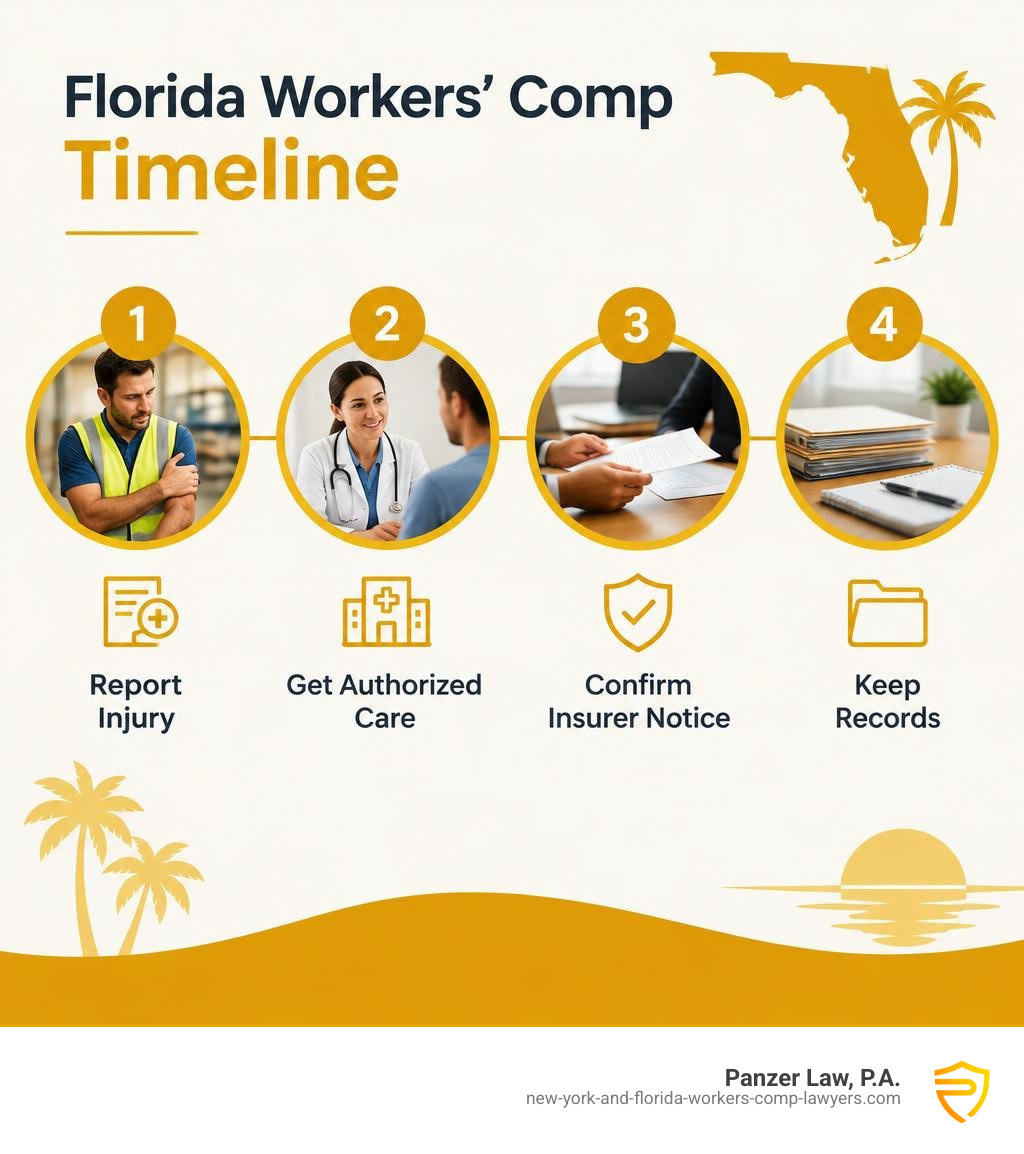
If you’re hurt or become ill because of your job in Florida, tell your employer as soon as possible. Florida generally requires notice within 30 days. Ask where to get authorized medical care, make sure your employer reports the injury to its insurer, and keep copies of your reports, medical records, and missed-work notes. Most Florida employees with work-related injuries or illnesses can seek benefits for medical care and lost wages.
Don’t wait for a claim decision to follow up on treatment. If care or payments stall, contact the insurer and ask for an explanation in writing. This guide covers the filing steps and five mistakes that can make a claim harder to resolve.
I’m Gil Panzer, owner and attorney at Panzer Law, P.A., and I’ve spent over 30 years helping injured workers with filing a workers comp claim. My work focuses on access to medical care and benefit disputes in Florida and New York.
Step-by-Step Guide to Filing a Workers Comp Claim
When a workplace accident happens, knowing what to do next can mean the difference between getting your medical bills paid promptly and facing months of unpaid time off. Understanding a practical guide to filing workers comp claims helps demystify the legal landscape so you can protect your rights from day one.

The claims process revolves around clear notification, thorough medical records, and statutory compliance. Here is how to navigate the essential steps smoothly:
Step 1: Reporting the Injury and Filing a Workers Comp Claim Form
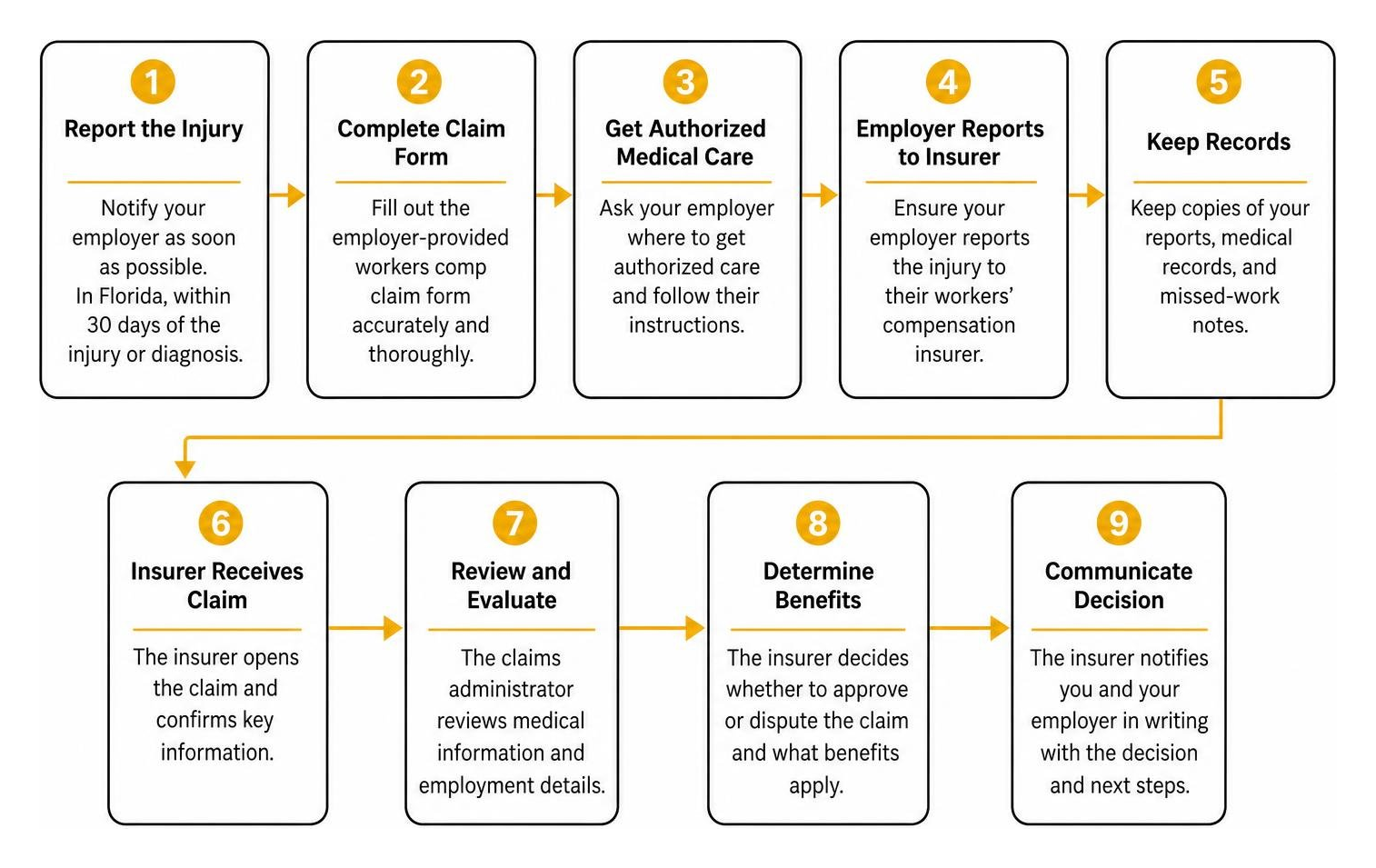
Your very first action must be reporting the accident to your supervisor or human resources department. In Florida, you must notify your employer within 30 days of the injury date or within 30 days from when a doctor informs you that your condition is work-related. Waiting beyond this timeframe gives the insurance carrier grounds to deny your claim entirely.
Once notified, your employer should provide an official claim form.
When you hand in your completed documentation, always do so in person with a signed acknowledgment or send it via certified mail with a return receipt requested. This receipt serves as irrefutable proof that you delivered your notice within the statutory window.
Step 2: Selecting Authorized Medical Providers and Receiving Treatment
Workers’ compensation does not work like standard health insurance where you can simply pick any doctor from your personal network. To have your treatment covered, you must visit an authorized treating physician approved by your employer’s insurance carrier or designated Medical Provider Network (MPN) / Health Care Organization (HCO).
If you require emergency treatment immediately after an accident, visit the nearest emergency room and inform the intake staff right away that your injury happened at work. Under certain statutory frameworks, claims administrators authorize up to $10,000 in early medical care while investigating a claim to ensure an injured worker does not go without vital diagnostics.
Step 3: Employer Responsibilities and Insurance Carrier Response
After you submit your injury report, your employer has legal obligations to fulfill. They must report your injury to their insurance carrier within seven days of receiving notice. The insurer then opens a file and assigns a claims adjuster.
The insurance carrier is bound by strict deadlines:
- Initial Status Notice: The claims administrator must notify you within 14 days regarding whether your claim is accepted, denied, or undergoing further investigation.
- The 90-Day Rule: If the insurance company does not explicitly deny your claim within 90 days of receiving your formal written notice, your injury is generally presumed to be covered under workers’ compensation law.
| Party | Core Responsibilities | Key Timelines |
|---|---|---|
| Employer | Provide claim forms, report injury to carrier, coordinate initial authorized medical evaluation | Within 1 business day for claim forms; report to insurer within 7 days |
| Insurance Carrier | Investigate accident, authorize medical treatments, issue wage replacement benefits | 14 days to provide status letter; 90 days maximum to accept or deny liability |
| Injured Worker | Notify employer, attend all authorized doctor visits, submit work status notes | Report within 30 days of incident; follow doctor work restrictions |
Essential Benefits Available Through Workers’ Compensation
Under state law, workers’ compensation is designed as a no-fault safety net. In exchange for relinquishing the right to sue your employer directly for negligence, you are entitled to statutory benefits. Our Florida workers comp lawyer claim representation guide outlines how these entitlements break down across medical and indemnity categories:
- Comprehensive Medical Care: 100% coverage for authorized doctor visits, surgeries, medications, and physical therapy.
- Temporary Total Disability (TTD): Wage replacement while you are completely unable to work during recovery.
- Temporary Partial Disability (TPD): Partial wage replacement if you return on light-duty earning less than your pre-injury income.
- Permanent Impairment Benefits (IB): Compensation awarded if you suffer a lasting physical impairment after reaching Maximum Medical Improvement (MMI).
- Travel Reimbursement: Compensation for mileage accrued traveling to and from authorized medical appointments.
- Vocational Rehabilitation Support: Educational retraining benefits if you cannot return to your prior trade.
- Death Benefits: Financial support for surviving dependents, along with statutory funeral expenses.
Medical Care and Wage Replacement Calculations
Your medical benefits cover all reasonable and medically necessary curative care recommended by your authorized doctor. This includes diagnostic imaging (like MRIs and X-rays), prescription medications, assistive medical devices, and specialized physical therapy.
For lost wages, temporary disability payments are calculated at approximately two-thirds (66 2/3%) of your average weekly wage (AWW) earned during the 13 weeks prior to the injury, up to state maximum caps. If you suffer severe injuries—such as paralysis, blindness, or severe neurological damage—your temporary compensation rate may increase up to 80% of your average weekly earnings for a statutory period.
Vocational Rehabilitation and Death Benefits
If your workplace injury prevents you from returning to your former job even after completing medical care, you may be eligible for vocational re-education. These programs provide training vouchers and job placement assistance so you can transition into a sustainable career.
In catastrophic cases where an employee passes away as a result of a workplace accident, surviving dependents are entitled to statutory death benefits. These benefits include substantial financial support payments for surviving spouses and dependent children, alongside covered burial costs as explained in official county guides such as the Workers-Comp-Booklet.pdf.
5 Critical Mistakes to Avoid When Filing Your Claim

Even a legitimate injury claim can be denied over simple procedural mistakes. Avoiding these five critical errors will safeguard your financial and physical recovery.
Mistake 1 & 2: Missing Deadlines and Delaying When Filing a Workers Comp Claim
The most frequent reason legitimate claims get rejected is tardiness. Failing to report your accident to your employer within 30 days almost always results in a complete forfeiture of benefits.
Additionally, you must adhere to the overall statute of limitations: formal petitions for benefits must generally be filed within two years of the injury date (or within one year of the last authorized medical treatment or indemnity payment). Procrastination gives insurance adjusters room to argue that your injury happened outside of work or was caused by an unrelated incident.
Mistake 3 & 4: Incomplete Injury Documentation and Unauthorized Doctor Visits
When completing an injury report, you must document every single part of your body that was hurt. If you slipped and injured both your lower back and your knee, but only wrote “back pain” on the initial report, the insurance carrier may refuse to cover treatment for your knee down the road.
Equally damaging is seeking treatment from your personal physician without prior authorization. Unless it is an immediate life-threatening emergency, unauthorized doctor visits will not be paid for by workers’ compensation, and the medical reports from unauthorized physicians may be excluded as evidence in your claim.
Mistake 5: Navigating Denials and Disputes Without Professional Advocacy
Insurance companies are profit-driven entities equipped with teams of adjusters and defense lawyers looking to reduce claim payouts. Trying to challenge a complex claim denial or unfair impairment rating on your own puts you at a severe disadvantage.
Working with experienced advocates—such as when you find local workmans comp lawyers near you—levels the playing field. Professional legal representation ensures that medical disputes, independent medical exams, and administrative settlement conferences are managed with your best interests at heart.
Frequently Asked Questions About Workplace Injury Claims
What happens if my employer refuses to provide a claim form?
If your employer ignores your injury report or refuses to provide official forms, you can contact the state Division of Workers’ Compensation directly or reach out to an Information & Assistance officer. You can also report the claim directly to your employer’s workers’ compensation insurance company. If you need answers to common procedural hurdles, check out our frequently asked questions page for further insights.
How can an injured worker change their treating physician?
Under Florida law, an injured worker is entitled to a one-time change of physician during the course of their treatment. Once you submit a written request for a change of doctor to the insurance carrier, the adjuster has 14 days to provide an alternate authorized physician. If the carrier fails to authorize a new doctor within that 14-day window, you acquire the legal right to select your own treating physician within the same specialty.
What legal steps should I take if my claim is denied?
If your claim is denied or your benefits are terminated prematurely, you must file a formal Petition for Benefits with the Office of the Judges of Compensation Claims (OJCC). This initiates a structured dispute resolution process involving mandatory mediation conferences and, if necessary, a final evidentiary hearing before an administrative law judge. You can explore our dedicated workers compensation resources to learn how petitions and settlement negotiations proceed.
Conclusion
Filing a workers’ compensation claim does not have to be an overwhelming process. By reporting your accident immediately, seeking care through authorized medical providers, documenting every injury thoroughly, and respecting statutory deadlines, you protect your access to vital healthcare and wage replacement benefits.
At Panzer Law, P.A., we stand beside injured workers across Boca Raton, Miami, West Palm Beach, Palm Beach County, and Miami-Dade County. We handle every detail of your claim—from initial medical authorizations to high-stakes settlement negotiations—under our no-recovery, no-fee guarantee. You pay nothing out of pocket unless we successfully recover compensation for you.
If you were injured on the job and need help asserting your legal rights, schedule your free consultation with Panzer Law, P.A. today.
