

How Hurt at Work Compensation and Wage Loss Are Calculated
When an unexpected injury pulls you away from your job, your household budget faces immediate pressure. Under state workers’ compensation systems, wage-loss benefits are designed to replace a substantial portion of your lost earnings while you recover. These payments are not taxable under standard federal and state guidelines, which helps cushion the drop between your regular gross pay and your disability check.
Wage-loss payments operate on specific statutory formulas rather than flat rates. In most instances, your cash benefit equals roughly two-thirds (66.67%) of your pre-injury gross earnings, subject to statutory minimums and maximums adjusted annually. As detailed in resources covering workers’ compensation in 2026, state benefit caps mean higher-earning employees may not receive a full two-thirds of their normal income.
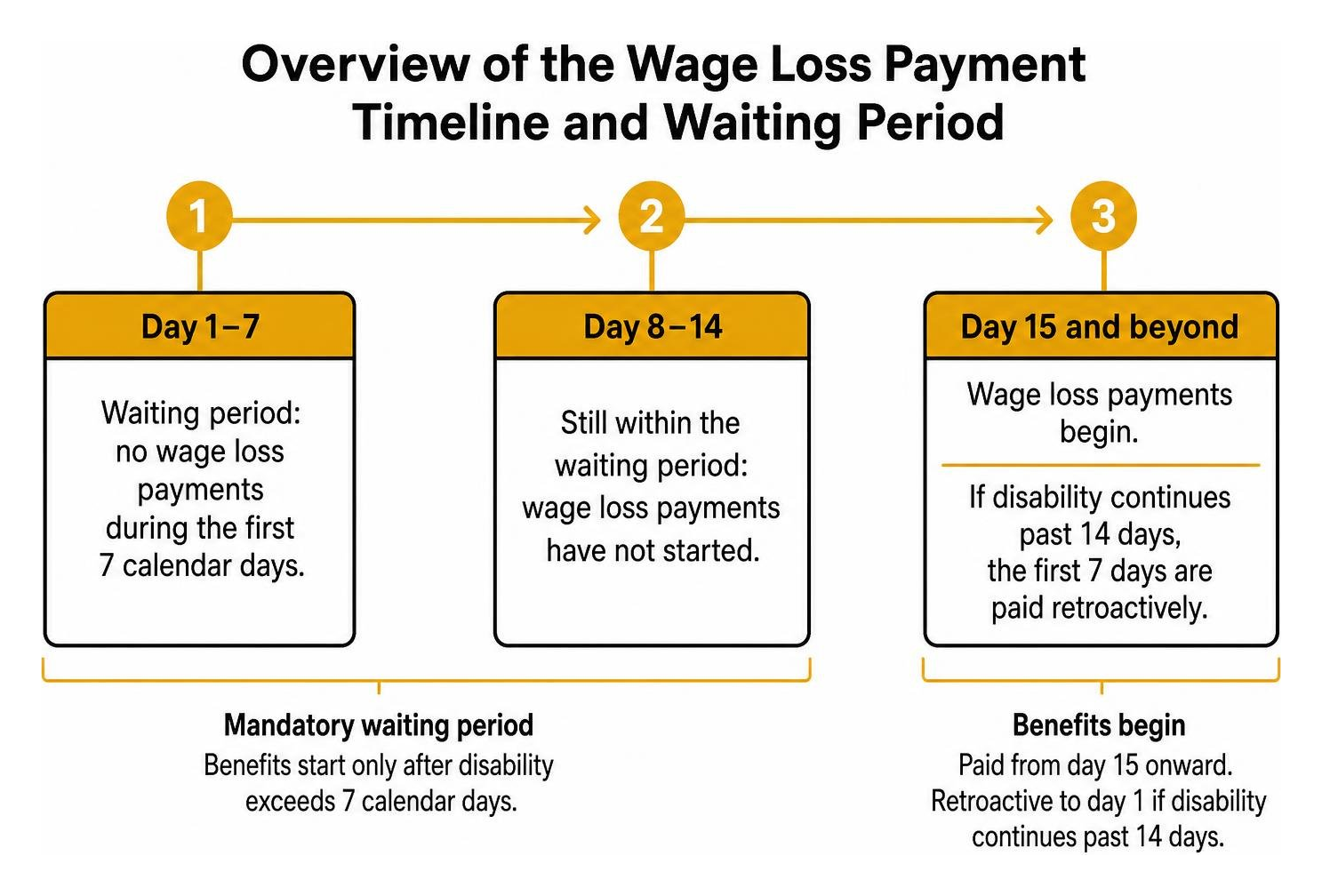
Every claim also involves a mandatory waiting period before cash benefits start. In Florida and New York, you must be disabled from work for more than seven calendar days before indemnity checks begin. If your work-related disability extends past 14 consecutive days, the system pays you retroactively for those first seven days. Understanding these initial timing rules helps you plan your personal finances and avoid unnecessary panic during the first few weeks after an injury.
Calculating Average Weekly Wage and Benefit Caps for Hurt at Work Compensation
The bedrock of your cash benefit is your Average Weekly Wage (AWW). Calculating your AWW requires a comprehensive review of your gross earnings—typically over the 13 consecutive weeks immediately preceding the date of your accident.
To determine your true AWW, the insurance carrier must include more than just your base hourly rate:
- Regular gross wages and paid overtime
- Production bonuses, sales commissions, and shift differentials
- The fair market value of non-monetary perks provided by your employer (such as housing or meals) if they cease after your injury
- Wages from a secondary job, provided you held that concurrent employment at the time of your accident
Once your AWW is established, the carrier multiplies it by 66.67% to find your compensation rate. For 2026, state-specific caps establish the absolute ceiling on weekly checks. In Florida, the maximum weekly compensation rate for 2026 is capped at $1,358.00 per week, whereas New York caps benefits at $1,281.50 per week. If two-thirds of your gross pay exceeds your state’s maximum cap, your weekly benefit is automatically reduced to that ceiling.
Following practical claim filing steps ensures your payroll documentation is submitted correctly so the insurer does not understate your AWW.
Temporary vs Permanent Disability Classifications
Work injuries heal along unpredictable timelines. The law categorizes wage-loss benefits into distinct tiers based on your level of impairment and whether your condition is temporary or permanent.
Once your treating physician determines that your injury has stabilized and will not improve with further active care, you reach Maximum Medical Improvement (MMI). At MMI, temporary disability benefits end, and your doctor assigns an impairment rating that determines your eligibility for permanent disability payments or scheduled loss awards outlined in standard injured worker benefit guidelines.
| Disability Classification | Work Capability Status | Wage Replacement Rate | Duration Limits & Payment Structure |
|---|---|---|---|
| Temporary Total Disability (TTD) | Completely unable to work per authorized doctor | 66.67% of AWW (up to 80% for specific severe injuries) | Paid until cleared for work or reaching MMI; capped up to 104–260 weeks depending on state statutes |
| Temporary Partial Disability (TPD) | Released to light duty with wage loss | Percentage of difference between AWW and light-duty earnings | Payable while working reduced hours/wages until reaching MMI |
| Permanent Partial Disability (PPD) | Reached MMI but has lasting physical impairment | Determined by impairment rating or statutory schedule | Paid in weekly installments or negotiated lump-sum settlements |
| Permanent Total Disability (PTD) | Permanently unable to engage in any employment | 66.67% of AWW | Paid continuously until retirement age or for life in catastrophic injury cases |
Essential Medical Benefits and Care Coverage Under Workers’ Comp
A core component of workers’ compensation is complete coverage for reasonable and necessary medical treatment related to your workplace injury. Unlike private health insurance, there are no deductibles, co-pays, or surprise balance bills for authorized care.
Workers’ compensation medical coverage covers all aspects of your physical rehabilitation, including:
- Emergency room visits, ambulance transport, and trauma surgery
- Follow-up consultations with orthopedic specialists, neurologists, and surgeons
- Prescription medications, medical devices, braces, and assistive mobility equipment
- Physical therapy, chiropractic adjustments, and occupational therapy regimens
- Reimbursement for medical travel mileage to and from authorized medical appointments
Authorized Doctors, Medical Networks, and Utilization Review
In both Florida and New York, you cannot simply visit your family doctor and bill the workers’ compensation carrier. To have your medical bills covered, you must seek treatment from a healthcare provider authorized by the employer’s insurance company or selected through an established medical network.
Insurance companies manage treatment through a formal process called Utilization Review (UR). UR evaluates whether recommended surgeries, diagnostic tests (such as MRIs), or therapy sessions meet accepted evidence-based medical treatment guidelines, as referenced in standard employee DWC guidelines.
If the carrier’s adjuster denies a specific procedure recommended by your doctor, you have the right to request a second opinion or petition for an Independent Medical Examination (IME) to challenge the determination.
Returning to Work and Modified Duty Rights
When your treating doctor decides you have recovered enough to perform restricted tasks, they will issue a light-duty or modified-duty release. This document outlines specific physical limitations, such as lifting caps, restrictions on standing or bending, and maximum shift lengths.
If your employer offers a bona fide light-duty position matching those medical limitations, you are expected to accept it. Refusing a valid light-duty offer can lead the insurer to suspend your temporary wage-loss checks. However, if the modified position pays less than your pre-injury wage, you are entitled to Temporary Partial Disability (TPD) checks to bridge the earnings gap. Furthermore, state laws prohibit employers from retaliating, demoting, or terminating you simply because you filed a claim or requested accommodations for your medical restrictions.
Step-by-Step Process for Filing and Protecting Your Claim

Securing your benefits requires strict attention to procedural requirements. Insurance adjusters review initial claim files for delays or inconsistencies that could justify denying coverage.
To protect your rights from day one, follow these fundamental steps:
- Report the Incident in Writing: Inform your supervisor immediately, detailing the date, time, location, and precise mechanics of the accident.
- Seek Authorized Treatment: Request immediate medical attention from an employer-authorized clinic and state clearly that the injury occurred on the job.
- Preserve Evidence: Take photos of the accident scene, equipment involved, and visible injuries; collect contact details from any witnesses.
- Maintain a Personal File: Save copies of all incident reports, medical work-status notes, wage slips, and written communications from the insurance carrier.
- Seek Professional Guidance: Consulting a top rated workers comp lawyer early helps prevent procedural mistakes that adjusters use to reduce payouts.
Reporting Deadlines and Employer Notice Requirements
Time is critical after a workplace injury. In Florida, you must formally notify your employer of your work injury within 30 days of the accident (or within 30 days of when a doctor first diagnoses an occupational disease). In New York, the formal notice window is also 30 days.
Failing to give notice within the statutory window gives the insurer grounds to deny your claim entirely, regardless of how severe your injuries are. Once notified, the employer must file a First Report of Injury with the state regulatory agency and their insurance carrier within seven days. To formally protect your legal rights against procedural expiration, formal petitions for benefits must generally be filed within two years of the injury date, echoing administrative timelines found in state-level injury reporting guides.
Overcoming Denials, Appeals, and Dispute Resolution
Insurance carriers often deny claims to protect their bottom line. Common justifications include alleging the injury was pre-existing, claiming it occurred outside working hours, or arguing you missed a reporting deadline.
If your claim is denied, you will receive a formal Notice of Denial detailing the carrier’s reasons. You can contest this decision by filing a formal Petition for Benefits:
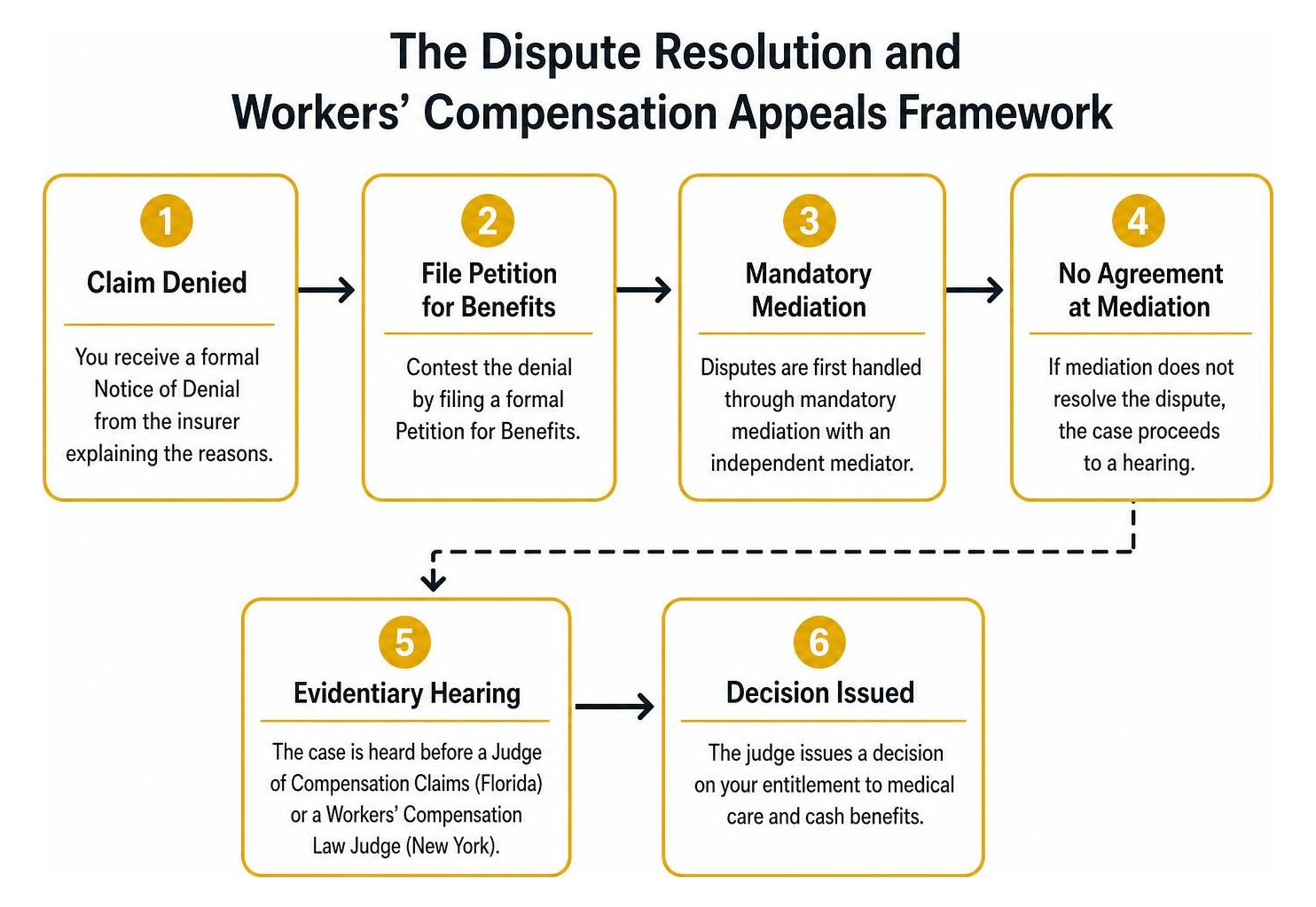
Disputes are first handled through mandatory mediation conferences, where an independent mediator works with both sides to resolve differences. If mediation does not produce an agreement, your case proceeds to an evidentiary hearing before a Judge of Compensation Claims (JCC) in Florida or a Workers’ Compensation Law Judge (WCLJ) in New York. You can protect your benefits by presenting medical records, diagnostic scans, and physician depositions to prove your entitlement to medical care and cash benefits.
Special Jurisdictions, Federal Claims, and Third-Party Lawsuits
While traditional workers’ compensation handles most job injuries, specific employment sectors and multi-party accidents operate under different legal frameworks. If you are injured in New York, working with a New York workers compensation lawyer ensures that state-specific scheduled loss of use awards and hearing board rules are handled correctly.
Understanding Third-Party Liability in Hurt at Work Compensation
Workers’ compensation is a “no-fault” exclusive remedy, meaning you generally cannot sue your direct employer or co-workers for ordinary negligence. However, if an outside entity contributed to your accident, you can file a separate third-party personal injury lawsuit alongside your workers’ compensation claim.
Common third-party liability scenarios include:
- Motor Vehicle Collisions: Being rear-ended by a negligent driver while making deliveries, traveling between job sites, or running company errands.
- Defective Machinery: Sustaining an injury caused by malfunctioning equipment, unguarded power tools, or defective heavy machinery, opening a product liability claim against the manufacturer.
- Subcontractor Negligence: Getting hurt on a multi-employer construction site due to hazards created by another subcontractor or property owner.
Unlike workers’ comp, a third-party claim allows you to recover non-economic damages, including 100% of your lost wages, future earning capacity loss, and compensation for pain and suffering. If your third-party claim resolves successfully, the workers’ comp insurer may assert a statutory subrogation lien to recover benefits it previously paid on your behalf.
Federal Rules and Multi-State Variations
Civilian federal employees—such as postal carriers, TSA agents, and VA hospital staff—are covered under the Federal Employees’ Compensation Act (FECA), administered by the U.S. Department of Labor’s Office of Workers’ Compensation Programs (OWCP). Federal workers initiate their claims directly through the online Employees’ Compensation Operations and Management Portal (ECOMP) using Form CA-1 for traumatic injuries or Form CA-2 for occupational diseases, without needing prior approval from their supervisors.
Similarly, maritime workers, longshoremen, and defense contractors fall under specialized federal statutes such as the Longshore and Harbor Workers’ Compensation Act (LHWCA) or the Defense Base Act, which maintain their own specific benefit schedules and administrative dispute processes.
Frequently Asked Questions About Workplace Injuries
Can I receive wage-loss benefits if my injury was partially my fault?
Yes. Workers’ compensation is a no-fault insurance system. You do not need to prove that your employer did anything wrong to receive medical care and wage-loss benefits, and benefits are payable even if your own momentary distraction or carelessness contributed to the accident.
There are narrow exceptions to this rule. Insurance carriers can deny benefits if they prove the injury was caused by intentional self-harm, horseplay outside the scope of employment, or active intoxication from alcohol or unprescribed controlled substances that directly caused the accident.
What is the deadline to notify my employer after getting hurt?
In Florida and New York, you must notify your employer within 30 days of the accident. If your condition is a repetitive trauma injury (like carpal tunnel) or an occupational disease, you have 30 days from the date a physician informs you that the condition is work-related.
Even with a 30-day window, you should report any incident immediately in writing. Waiting weeks to report an injury invites the insurance carrier to argue that the incident occurred over the weekend or outside of work duties.
Will accepting a settlement close my medical coverage permanently?
In most cases, yes. The majority of workers’ compensation settlements are resolved through a Compromise and Release agreement. In exchange for a lump-sum cash payout, you release the insurance carrier from all future obligations, including ongoing weekly disability checks and future medical care coverage for that injury.
If you require future medical treatments and qualify for Medicare (or expect to qualify within 30 months), federal regulations may require a Medicare Set-Aside (MSA) allocation within the settlement to protect Medicare’s interests. Never sign a final settlement release until an attorney reviews the terms to confirm you are receiving full financial value for your projected lifetime medical and wage needs.
Conclusion
Understanding how workers’ compensation operates helps you secure the full range of benefits provided by law. From establishing your accurate Average Weekly Wage and monitoring statutory benefit caps to obtaining authorization for necessary medical treatments, every step you take directly influences your physical and financial recovery.
At Panzer Law, P.A., we stand beside injured workers across Miami, Boca Raton, West Palm Beach, and throughout Florida and New York. We operate on a contingency basis, meaning there are never upfront costs or attorney fees unless we successfully recover compensation for your claim. If you need assistance navigating a dispute, evaluating a settlement offer, or managing a denied claim, speak with an experienced Florida workers compensation lawyer today for a free consultation.
