

What a Boca Raton Workers’ Compensation Attorney Can Do for You
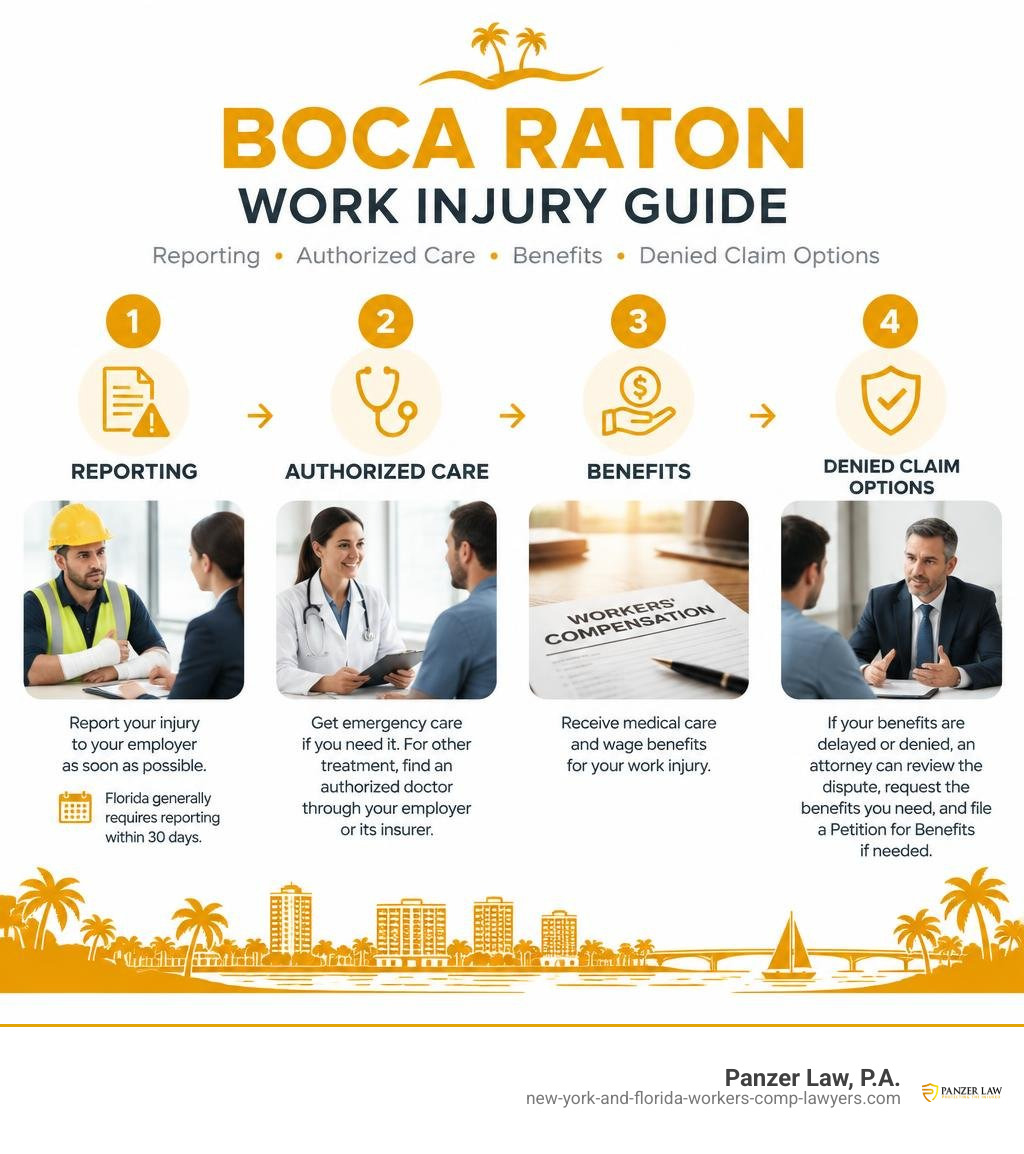
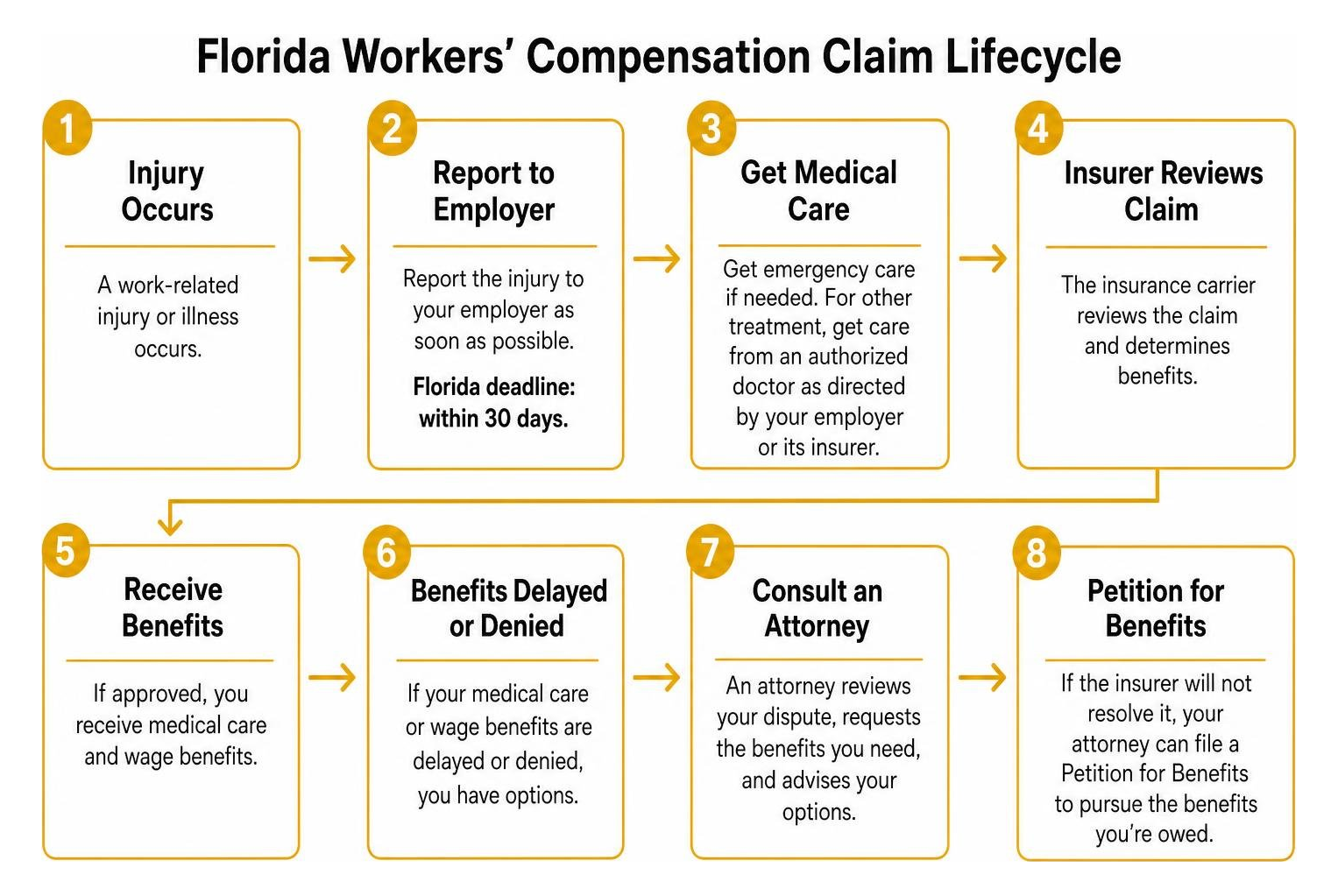
If you were hurt at work in Boca Raton, report the injury to your employer as soon as possible. Get emergency care if you need it. For other treatment, ask your employer or its insurer where to find an authorized doctor. Florida generally requires you to report the injury within 30 days.
If your medical care or wage benefits are delayed or denied, a workers’ compensation attorney can review the dispute, request the benefits you need, and file a Petition for Benefits if the insurer will not resolve it.
I’m Gil Panzer, owner and attorney at Panzer Law, P.A., with more than 30 years of legal experience helping injured workers in Florida and New York. If you need a Boca Raton workers compensation attorney, I can help you address denied benefits, seek medical care, and review your options.
Easy boca raton workers compensation attorney glossary:
- Florida workers’ compensation lawyer
- workers compensation lawyer in florida
- workman’s comp. lawyers near me
Understanding Florida Workers’ Compensation Rights in Boca Raton
When an accident occurs on the job in South Florida, state law establishes a no-fault administrative system designed to provide medical treatment and partial wage replacement. In exchange for these guaranteed statutory remedies, employees give up the right to sue their employers for standard workplace negligence.
Under Florida law, coverage mandates depend on the type of business:
- Non-construction businesses: Must carry workers’ compensation coverage if they employ four or more employees (including corporate officers).
- Construction businesses: Must maintain coverage if they employ one or more workers.
- Agricultural employers: Must carry coverage if they have five or more regular employees or twelve or more seasonal workers performing labor for at least 30 days.
Whether you work in a corporate office near Mizner Park, on a commercial construction site along Glades Road, or in a healthcare facility in Palm Beach County, these protections apply. When disputes arise regarding benefits or medical approvals, partnering with a knowledgeable Boca Raton workers’ compensation lawyer ensures your legal protections remain enforced.
When and Why You Need a Boca Raton Workers Compensation Attorney

The workers’ compensation system was conceived as a self-executing safety net. However, insurance carriers are for-profit corporations focused on managing their financial exposure. Adjusters often dispute claims by arguing that an injury is not work-related, that it resulted from a pre-existing degenerative condition, or that work activities were not the “major contributing cause” (MCC) of the medical condition.
Under the legal definition of an attorney, legal counsel acts as an advocate with the authority to manage procedural filings, take depositions, and challenge insurer decisions. When an insurer undercalculates your weekly checks or refuses to authorize specialized care, our team steps in to protect your financial stability. If you are experiencing resistance from an insurer, you can find a Florida workers’ comp lawyer to evaluate the dispute under our contingency fee model.
How a Boca Raton Workers Compensation Attorney Handles Denials and Petitions for Benefits
When an insurance carrier refuses to authorize medical treatment or pay indemnity benefits, the primary legal remedy is filing a formal Petition for Benefits (PFB) with the Florida Office of Judges of Compensation Claims (OJCC).
The dispute resolution process follows specific procedural steps:
- Filing the Petition for Benefits: Details the exact benefits, medical procedures, or indemnity payments being claimed.
- Response from Carrier: The insurance carrier has 14 days to either provide the requested benefits or file a formal denial stating its defense.
- State Mediation: A mandatory mediation conference is scheduled with a state-appointed mediator to resolve disputes amicably without formal trial costs.
- Final Merits Hearing: If mediation does not resolve the dispute, the case proceeds to an evidentiary hearing before a Judge of Compensation Claims (JCC), where medical records, expert depositions, and witness testimony are presented.
For a detailed walkthrough of this legal roadmap, review our Florida workers’ comp claim representation guide.
Requesting a Change of Authorized Treating Physician Under Florida Law
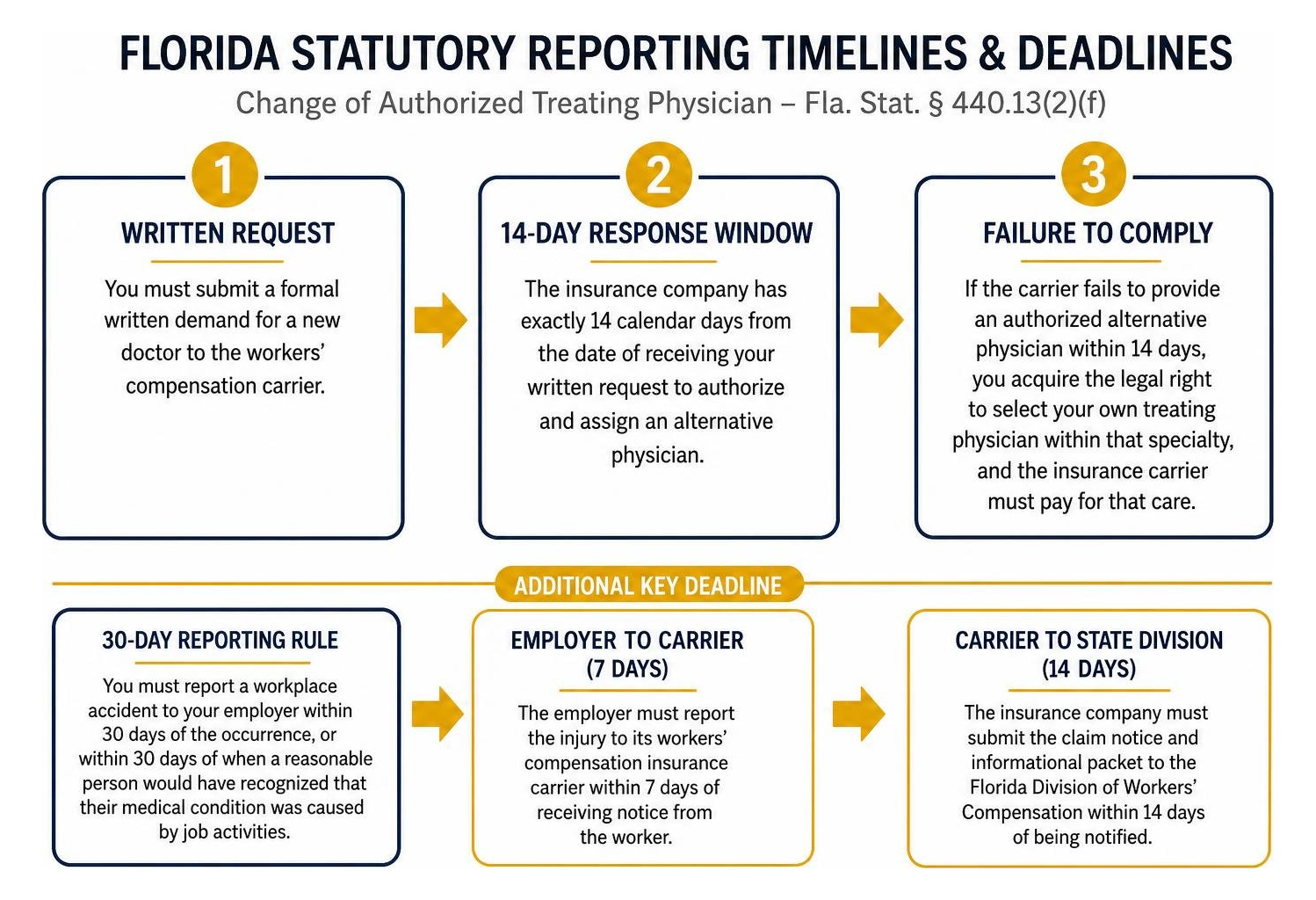
Under Florida Statute § 440.13(2)(f), an injured worker has an absolute one-time statutory right to request a change of authorized treating physician during the course of treatment. This right applies to any reason or no reason at all.
To exercise this right effectively, specific rules must be observed:
- Written Request: You must submit a formal written demand for a new doctor to the workers’ compensation carrier.
- 14-Day Response Window: The insurance company has exactly 14 calendar days from the date of receiving your written request to authorize and assign an alternative physician.
- Failure to Comply: If the carrier fails to provide an authorized alternative physician within 14 days, you acquire the legal right to select your own treating physician within that specialty, and the insurance carrier must pay for that care.
Exercising this right strategically can significantly alter the trajectory of your medical recovery and impairment ratings.
Critical Deadlines and Steps After a Workplace Injury in Palm Beach County
Taking deliberate action immediately following a job injury protects your health and your legal claim. If you suffer an injury in Boca Raton, Delray Beach, or elsewhere in Palm Beach County, following standard operational steps prevents common defense arguments:
- Report the Incident Immediately: Inform your direct supervisor, floor manager, or HR department in writing right away.
- Demand Authorized Medical Care: Clearly request medical evaluation through the employer’s designated workers’ compensation carrier.
- Document the Scene and Symptoms: Capture photographs of defective equipment, wet flooring, or lack of safety measures, and secure names of co-worker witnesses.
- Maintain Accurate Records: Keep copies of all medical slips, work-status notes (DWC-25 forms), prescriptions, and written notices sent to your employer.
If your claim originated in the Palm Beach County court district, retaining a West Palm Beach workers’ compensation lawyer familiar with regional OJCC judges and regional insurance defense firms is essential.
Florida 30-Day Reporting Rule and Employer Notice Timelines
Florida Statute § 440.185(1) establishes that an employee must report a workplace accident to their employer within 30 days of the occurrence, or within 30 days of when a reasonable person would have recognized that their medical condition was caused by job activities. Missing this strict window can result in a total forfeiture of benefits.
Once you report an injury, strict statutory timelines govern the employer and insurer:
- Employer to Carrier (7 Days): The employer must report the injury to its workers’ compensation insurance carrier within 7 days of receiving notice from the worker.
- Carrier to State Division (14 Days): The insurance company must submit the claim notice and informational packet to the Florida Division of Workers’ Compensation within 14 days of being notified.
Calculating Your Average Weekly Wage and Wage-Loss Benefits
Your wage-replacement benefits hinge entirely on your Average Weekly Wage (AWW). Under Florida law, the AWW is calculated using your gross earnings from the 13 consecutive weeks immediately preceding the date of the accident.
To determine the true AWW, all statutory earnings must be included:
- Base hourly wages or salaried compensation.
- Overtime earnings and production bonuses.
- Reported tips and gratuities (critical for service industry personnel in Boca Raton’s hospitality sector).
- Employer-provided fringe benefits, such as health insurance contributions or housing allowances, if the employer stops providing them after your injury.
The calculated AWW is then multiplied by 66.67% (or 0.6667) to establish your statutory weekly compensation rate, subject to Florida’s annual statutory maximum cap.
Workers’ Compensation Benefits: Temporary vs Permanent Disability
Workers’ compensation indemnity benefits fall into distinct statutory classifications depending on the stage of your medical recovery:
| Benefit Type | Qualifying Criteria | Compensation Rate | Maximum Statutory Duration |
|---|---|---|---|
| Temporary Total Disability (TTD) | Complete medical inability to perform any work duties prior to MMI. | 66.67% of pre-injury Average Weekly Wage (up to 80% for severe injuries like paralysis/loss of limb for up to 6 months). | 104 combined weeks (shared with TPD). |
| Temporary Partial Disability (TPD) | Worker released to light duty with restrictions, earning less than 80% of pre-injury AWW. | Up to 64% of the difference between pre-injury earnings and current light-duty earnings. | 104 combined weeks (shared with TTD). |
| Permanent Impairment Benefits (IB) | Assigned after reaching Maximum Medical Improvement (MMI) based on whole-person impairment rating. | 75% of average temporary total disability compensation rate. | Scaled duration based on impairment percentage (2 to 6 weeks per percentage point). |
| Permanent Total Disability (PTD) | Inability to engage in at least sedentary employment within a 50-mile radius of residence. | 66.67% of Average Weekly Wage. | Payable until age 75 (or lifetime if injured after age 70). |
Temporary Total Disability and Temporary Partial Disability
Under Florida Statute § 440.15(2), Temporary Total Disability (TTD) provides wage-replacement benefits when an authorized doctor places you entirely off work while you recover. These payments equal 66.67% of your Average Weekly Wage.
If your physician determines you can perform modified work with restrictions—such as lifting limits or reduced hours—and your employer cannot accommodate those restrictions (or offers pay below 80% of your pre-injury wage), you qualify for Temporary Partial Disability (TPD). Combined, TTD and TPD benefits are subject to a statutory cap of 104 weeks. Once you reach 104 weeks or reach Maximum Medical Improvement (MMI), temporary indemnity benefits cease, and eligibility for permanent impairment benefits begins.
Navigating Occupational Disease and Repetitive Trauma Claims with a Boca Raton Workers Compensation Attorney
Not all workplace injuries stem from sudden, catastrophic accidents. Many conditions develop gradually over months or years of repetitive motion or toxic exposure. Florida Statute § 440.151 governs occupational diseases and repetitive trauma claims.
Common repetitive and occupational conditions include:
- Carpal tunnel syndrome and tendonitis among corporate and administrative office workers.
- Degenerative disc herniations caused by ongoing lifting and patient transfers among healthcare workers.
- Respiratory conditions or dermatitis resulting from prolonged exposure to industrial cleaners or manufacturing solvents.
Proving these claims requires clear medical evidence showing that the workplace exposure or repetitive action was the major contributing cause (more than 50% responsible) for the resulting disability. The 30-day reporting window for an occupational disease begins on the date the worker becomes disabled, seeks medical care, and knows (or reasonably should know) that the condition is related to employment.
Third-Party Personal Injury Claims vs Workers’ Comp
While the workers’ compensation system shields your direct employer from civil liability, it does not bar you from pursuing legal claims against negligent third parties who contributed to your accident. A third-party claim is a separate civil personal injury lawsuit handled in civil court.
Common examples of third-party liability include:
- Motor Vehicle Collisions: A reckless driver strikes you while you are traveling between work assignments or delivering goods.
- General Contractor or Subcontractor Negligence: A worker from another company drops materials or creates an unsafe site condition that causes an injury.
- Defective Machinery or Equipment: A manufacturing defect in a power tool, scaffold, or forklift causes a catastrophic failure.
Unlike standard workers’ comp claims—which do not pay for non-economic losses—third-party personal injury lawsuits permit full recovery for pain and suffering, emotional distress, loss of enjoyment of life, and complete un-capped lost wages.
Frequently Asked Questions About Boca Raton Workers’ Comp Claims
Can my employer fire or retaliate against me for filing a workers’ compensation claim?
No. Florida Statute § 440.205 explicitly prohibits employers from discharging, threatening to discharge, intimidating, or coercing any employee because of a valid claim for workers’ compensation benefits. If an employer retaliates against you for asserting your statutory rights, you have the right to pursue a separate civil lawsuit for lost wages, emotional distress, and punitive damages.
What should I do if the workers’ compensation insurance company delays or denies my medical treatment?
If an adjuster fails to respond to treatment recommendations made by your authorized physician, or flatly denies recommended diagnostic testing (such as MRIs or surgical interventions), an attorney can intervene. We initiate good-faith communications with defense counsel, verify the medical necessity with the authorized doctor, and immediately file a Petition for Benefits with the OJCC to compel authorization through judicial enforcement.
How are attorney fees structured and calculated in a Florida workers’ compensation case?
Workers’ compensation representation is governed by Florida Statute § 440.34, which operates strictly on a contingency fee schedule. Injured workers pay zero upfront fees and zero out-of-pocket costs.
When benefits are secured or a settlement is reached, the attorney fee is calculated as a percentage of the recovery:
- 20% of the first $5,000 in benefits secured.
- 15% of the next $5,000 in benefits secured.
- 10% of any remaining benefits secured up to $100,000.
- A percentage negotiated between 5% and 10% for any benefits exceeding $100,000.
All attorney fee disbursements must receive formal judicial approval from the Judge of Compensation Claims, ensuring complete fee transparency and protection for the injured worker.
Securing Your Benefits with Legal Representation
Recovering from a severe workplace injury requires dedicated focus on your health, physical therapy, and family well-being. Navigating complex insurance networks, calculated wage formulas, and strict statutory filing deadlines should not fall on your shoulders alone.
At Panzer Law, P.A., we handle every aspect of your claim—from gathering medical evidence and auditing wage calculations to filing formal petitions and negotiating comprehensive settlements. If you have questions about your rights or need representation after an on-the-job injury, reach out to schedule a free consultation with an experienced Florida workers’ compensation lawyer. Contact us today to ensure your rights and financial recovery are fully protected.
