

How Much Do Workers’ Compensation Attorneys Charge?
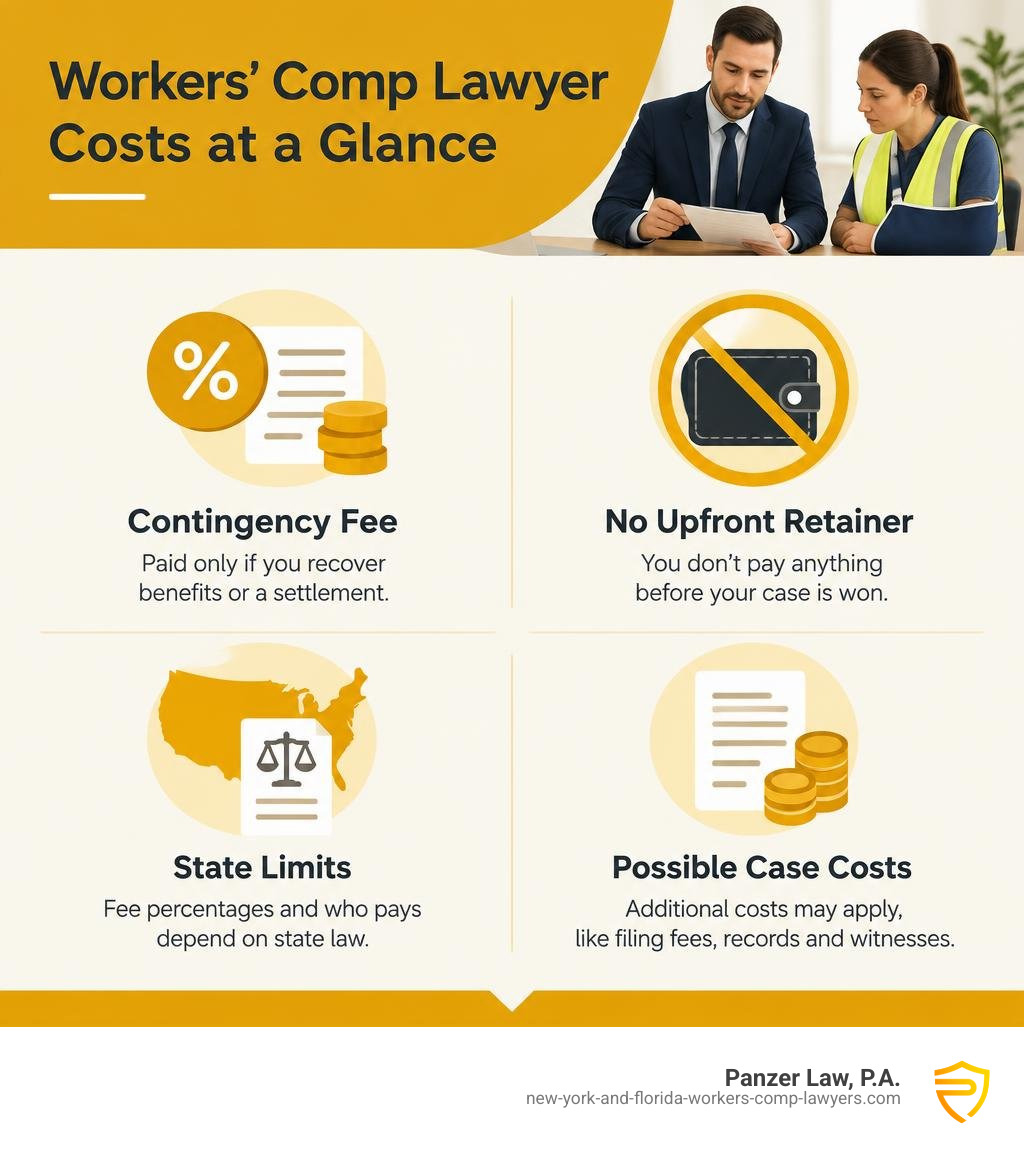
Most workers’ compensation lawyers work on a contingency fee: they are paid if they recover benefits or a settlement for you, rather than charging an upfront retainer. Fees are often a percentage of the recovery, but the limit and who pays depend on state law and the type of dispute. Ask for a written fee agreement that explains both the attorney’s fee and any case costs before you sign.
If your benefits have been delayed or denied, understanding how workers compensation attorneys fees are regulated can help you seek legal advice without guessing what it will cost. I’m Gil Panzer, owner and attorney at Panzer Law, P.A. For more than 30 years, I’ve helped injured workers in Florida and New York navigate claims, medical care, and settlements.
How Workers’ Compensation Attorneys Are Paid

When dealing with a workplace injury, the last thing anyone needs is a confusing bill from a lawyer. Fortunately, workers’ compensation billing is structured to protect injured workers from financial hardship while seeking justice. Following a practical guide to filing workers comp claims helps ensure benefits are protected early in the process.
Instead of traditional hourly billing—where every phone call or email generates an immediate invoice—workers’ comp representation relies on established statutory guidelines and contingency arrangements. This structure aligns the attorney’s incentives directly with your success: your lawyer only gets paid when you receive compensation or secure disputed benefits.
Contingency Fee Model and No Upfront Costs
Under a contingency fee agreement, you pay zero upfront retainers out of pocket. You do not write a check when you hire an attorney, nor do you pay an hourly rate while the case is ongoing. Instead, legal fees represent an agreed-upon percentage deducted from the monetary benefits or settlement recovered on your behalf.
This model provides vital financial protection for workers who are already facing lost wages and mounting medical bills. If you are looking to find local workmans comp lawyers near you, choosing a firm that operates on a strict no-recovery, no-fee model ensures you take on zero financial risk to pursue the benefits you rightfully deserve.
Out-of-Compensation vs. Carrier-Paid Fees
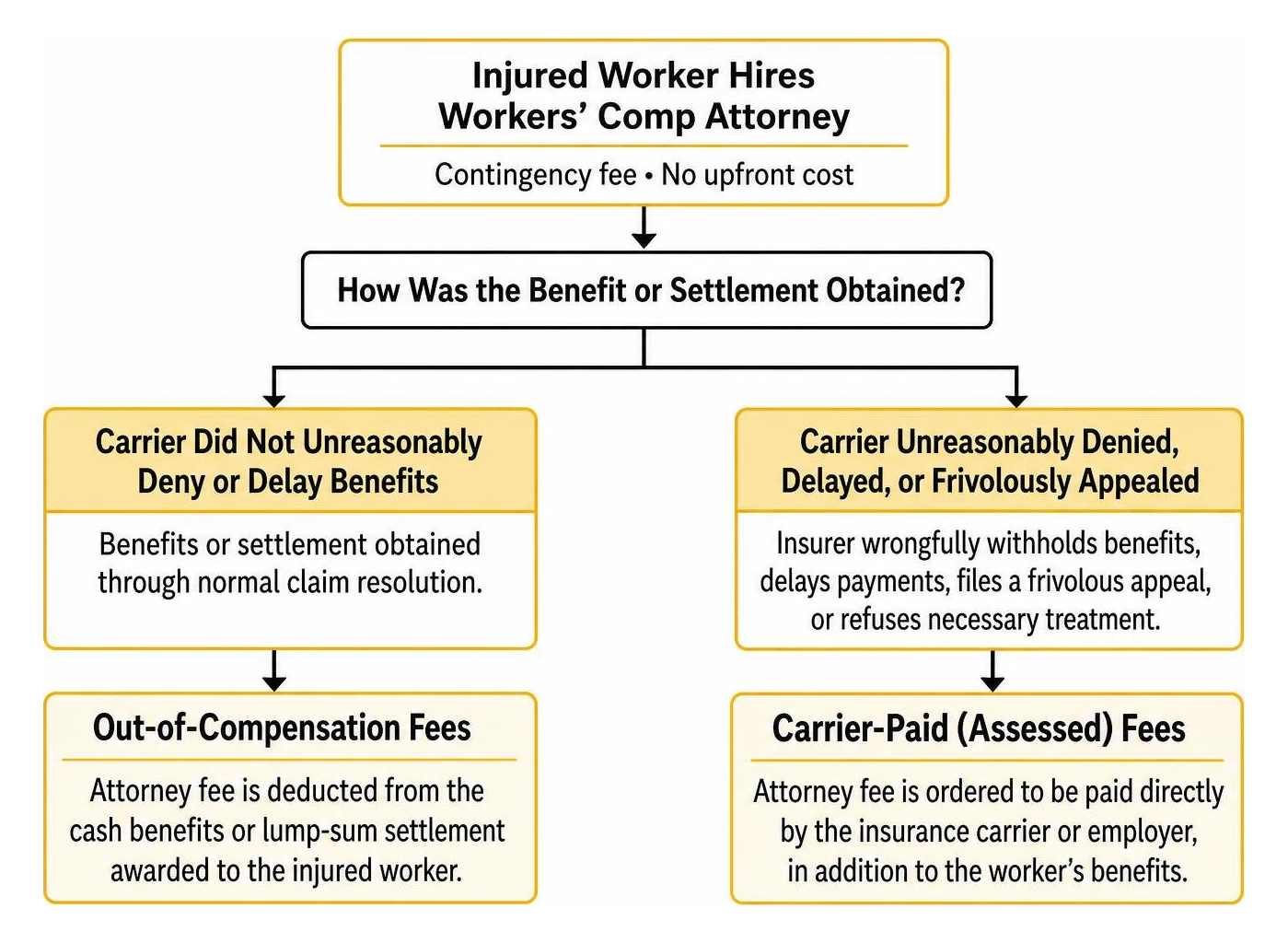
Legal fees in workers’ compensation generally fall into two distinct categories:
- Out-of-Compensation Fees: These are deducted directly from the cash benefits or lump-sum settlement awarded to the injured worker.
- Carrier-Paid (Assessed) Fees: Under specific statutory rules, the insurance carrier or employer is ordered to pay your attorney fees directly, in addition to your benefits. This typically happens when an insurer unreasonably denies or delays benefits, files a frivolous appeal, or refuses to authorize medically necessary treatment.
For example, when insurance companies wrongfully withhold payments, statutory protections in Florida and New York allow administrative bodies to award reasonable attorney fees incurred while enforcing delayed compensation orders, holding insurers accountable without diminishing the worker’s net recovery.
How State Laws Regulate Workers Compensation Attorneys Fees
Every state heavily regulates workers compensation attorneys fees to prevent excessive charges and protect claimants. The fee cannot simply be whatever a lawyer decides to charge; it must comply with state statutory schedules and receive formal judicial approval. Reviewing a practical guide to top rated workers comp lawyers can help clarify how legal standards are maintained across claims.
| Jurisdiction / Rule | Standard Percentage Cap | Key Statutory Limit or Dollar Cap |
|---|---|---|
| Florida | Sliding scale (20% / 15% / 10% / 5%) | Based on benefits secured; carrier-paid for bad faith or medical disputes |
| New York | Discretionary, typically 10%–15% | Approved by Workers’ Compensation Law Judge based on services rendered |
Statutory Caps on Workers Compensation Attorneys Fees in Florida and New York
Statutory fee structures in Florida and New York show how legislatures balance legal access with worker protection:
- Florida: Under Florida Statutes § 440.34, attorney fees are limited to a sliding scale based on the amount of benefits secured: 20% of the first $5,000, 15% of the next $5,000, 10% of the remaining amount of benefits secured up to $50,000, and 5% of benefits secured above $50,000. Fees must be approved by a judge of compensation claims.
- New York: Under New York Workers’ Compensation Law § 24, attorney fees are not set by a fixed percentage but are determined by the Workers’ Compensation Board or a Workers’ Compensation Law Judge based on the services rendered, the complexity of the case, and the results achieved. Fees are typically in the range of 10% to 15% of the award, but may vary.
In Florida and New York, our practice focuses heavily on statutory compliance, ensuring clients never pay more than permitted by the respective workers’ compensation boards and judges.
Specialized Fee Classifications in Florida and New York
In Florida and New York, distinct fee mechanisms exist to address situations where monetary indemnity benefits are not the primary issue:
- Carrier-Paid Medical Benefit Fees: When an attorney successfully recovers disputed medical benefits for an employee, the fee may be assessed directly against the insurer. Because medical benefits go to healthcare providers, these fees are paid by the carrier so the worker does not have to pay out of pocket.
- Vocational Rehabilitation Fees: Similar to medical benefit fees, these are carrier-paid fees awarded when an attorney successfully defends or secures vocational rehabilitation services.
- Insurer Penalty Assessments: When an insurance company acts in bad faith, delays payments without justification, or forces unnecessary hearings, judges can assess penalty fees directly against the insurer.
Fee Calculations in Settlements and Medical Benefit Disputes

Understanding how attorney fees apply to different parts of your claim ensures you know exactly what to expect when evaluating settlement offers. To calculate what you might take home, you can estimate your workers comp settlement amount based on your average wage and disability rating.
Lump-Sum Settlements and Liability Determinations
When negotiating a lump-sum settlement (often referred to as a Compromise and Release or Section 32 Agreement), the attorney fee is calculated as an approved percentage of the total gross settlement:
- With-Liability Settlements: When the insurer accepts liability for the injury, statutory caps typically allow fees between 15% and 20% of the settlement amount.
- Without-Liability Settlements: If liability is disputed and the parties agree to settle without the carrier admitting fault, fee caps in some jurisdictions are adjusted (for instance, dropping to 15% in certain regional models).
- Permanent Partial Disability (PPD) & Permanent Total Disability (PTD): Fees from ongoing disability awards are deducted from periodic payouts or structured settlements according to statutory schedules, ensuring the injured worker maintains steady financial support.
Medical-Only Claims and Disputed Treatment Disputes
Disputes frequently arise not over lost wages, but over necessary medical care—such as surgery approvals, physical therapy, prescription authorizations, or independent medical examinations (IMEs). To safeguard your recovery, understanding your hurt at work compensation and medical coverage is essential.
When an attorney represents a worker solely to secure medical care, fee-shifting rules often apply. Instead of taking a cut of the medical bills (which must be paid directly to doctors and hospitals), the attorney petitions the workers’ compensation judge to assess reasonable hourly fees against the insurance carrier for wrongfully withholding authorized treatment.
Approval Process, Case Costs, and Ethical Standards
A key safeguard in workers’ compensation law is that an attorney cannot unilaterally deduct fees from your settlement check. Every dollar charged in legal fees must be submitted to and approved by an Administrative Law Judge (ALJ) or workers’ compensation referee.
How Workers Compensation Attorneys Fees Are Approved by Judges
The judicial fee approval process follows structured steps:
- Submission of Fee Application: Following a favorable decision or settlement, counsel submits a formal Statement of Attorney Fees or fee petition itemizing all work performed, hours spent, and results achieved.
- Review for Reasonability: The judge evaluates the petition against statutory percentages, the complexity of the case, the skill required, and the benefit obtained for the worker.
- Excess Fee Petitions: If an exceptionally complex case required extraordinary effort exceeding standard statutory caps, an attorney may file an excess fee petition, which requires detailed justification and judicial review.
- Objection Window: Claimants and insurers are provided notice and a statutory objection window (often 10 to 15 days) to raise concerns before the judge issues a binding Fee Approval Order.
Staying informed about administrative updates by reviewing practical workers comp application tips for 2026 helps ensure your documentation meets all filing standards seamlessly.
Litigation Expenses, Attorney Splitting, and Unconscionable Billing
Beyond attorney fees, workers’ compensation cases incur litigation expenses. These costs are separate from legal fees and typically include:
- Medical record copying and retrieval fees
- Independent medical expert witness testimony and narrative reports
- Deposition transcripts and court reporter charges
- Formal subpoena and filing expenses
Reputable firms advance these expenses during litigation and seek reimbursement only from the final settlement.
Unconscionable and Excessive Billing Standards
State ethics boards and judicial bodies strictly prohibit unconscionable fees. In the landmark disciplinary case Eureste v. Commission for Lawyer Discipline, the court sanctioned an attorney for systematically overbilling clients through blanket “file review” charges and billing non-attorney work at attorney rates. Ethical workers’ compensation lawyers maintain precise, itemized accounting to ensure every dollar billed reflects genuine, necessary advocacy.
Frequently Asked Questions About Workers’ Comp Legal Costs
For additional answers to common concerns, visit our comprehensive frequently asked questions resource.
Do I have to pay attorney fees if I lose my workers’ comp case?
No. Under a standard contingency fee agreement, if you do not recover benefits or secure a settlement, you do not owe your attorney any legal fees. We operate on a strict no-recovery, no-fee guarantee, ensuring injured workers can seek quality representation without financial risk.
What should I check in a retainer agreement before signing?
Before signing a retainer agreement, make sure it clearly outlines:
- The exact contingency percentage and how it complies with state statutory caps
- How case-related costs and litigation expenses are handled and reimbursed
- What happens if your claim is resolved without a cash settlement (such as securing medical care alone)
- Clear language confirming no fees are owed if no recovery is obtained
Can I change lawyers during my claim without paying double fees?
Yes, you have the right to change attorneys at any time. If you substitute counsel, you do not pay two separate legal fees. Instead, the single approved statutory fee is divided between your prior and current attorneys based on quantum meruit (the reasonable value of the work each lawyer performed). The dispute is resolved between the lawyers through attorney lien procedures and approved by the judge, ensuring your net settlement payout remains untouched.
Conclusion: Protecting Your Rights and Maximizing Recovery
Navigating a workplace injury is challenging enough without worrying about complex fee structures and legal costs. Workers’ compensation fee regulations exist to level the playing field, ensuring you receive dedicated, experienced legal representation without any upfront out-of-pocket expenses.
At Panzer Law, P.A., we believe in complete financial transparency, aggressive advocacy, and protecting the rights of injured workers across Florida and New York. If you have questions about your benefits or want to understand your legal options, contact our workers comp law firm Panzer Law today for a free, confidential consultation.
