

Understanding Your Rights and Benefits After a Workplace Injury
Finding qualified hurt on the job lawyers starts with identifying attorneys who concentrate specifically on workers’ compensation, offer free consultations, and work on a contingency basis with no upfront legal fees. The right legal advocate immediately evaluates claim denials, coordinates with authorized physicians, and negotiates fair settlements to secure your medical coverage and wage replacement.
When you suffer an injury while performing your daily duties, state laws establish specific protections designed to keep you financially afloat and provide necessary medical care. Workers’ compensation is fundamentally a no-fault system. This means you do not have to prove that your employer did something wrong to receive benefits, but it also establishes strict procedures that every worker must follow.
Navigating this system requires an understanding of how accident reporting, medical evaluations, temporary total disability, and permanent impairment ratings interact. Following an accident, you are entitled to diagnostic testing, necessary surgeries, prescription medications, and physical therapy provided by an authorized doctor. If your doctor places you on work restrictions that your employer cannot accommodate, or removes you from work entirely, wage replacement benefits kick in to offset your lost income.
Immediate Steps to Take After Being Hurt at Work
The moments immediately following an on-the-job injury set the foundation for your entire claim. Taking the correct actions protects both your physical recovery and your legal rights:
- Report the incident immediately: Notify your supervisor or human resources department in writing. In Florida, you generally have a strict 30-day deadline to report an accident, but waiting even a few days gives insurance adjusters room to question whether the injury actually happened at work.
- Request an authorized medical provider: Unlike seeing your personal family doctor, workers’ compensation requires treatment through an authorized network physician. Ask your employer or their carrier for an immediate medical referral.
- Document every detail: Write down exactly what occurred, including the machinery involved, weather conditions, lighting, and any witnesses present. Take photographs of the accident scene, your visible injuries, and any safety hazards.
- Preserve physical and digital evidence: Keep copies of emails, text messages to management, incident reports, and your work schedule.
For a detailed walkthrough of this initial phase, reviewing a practical guide to filing workers comp claims can help prevent administrative missteps that jeopardize your recovery.
Types of Compensation Available for Workplace Injuries
Workplace benefits cover far more than immediate emergency room visits. Depending on the nature and severity of your condition, your claim may encompass several statutory categories:
- Medical Care and Rehabilitation: All reasonable, necessary medical care related to the injury is covered at 100%, with no copays or deductibles when using authorized providers. This includes assistive devices, physical therapy, and hospitalizations.
- Temporary Disability Benefits: When an authorized physician determines you cannot work, or places you on restrictions your employer cannot meet, you receive temporary wage replacement. Temporary Total Disability (TTD) generally pays 66 2/3% of your average weekly wage (AWW), subject to statutory state maximums.
- Impairment and Permanent Disability Benefits: Once you reach Maximum Medical Improvement (MMI)—meaning your condition has stabilized and is not expected to improve further—a physician evaluates you for a permanent impairment rating (PIR), which determines additional monetary compensation.
- Vocational Rehabilitation: If your permanent physical limitations prevent you from returning to your prior occupation, vocational training benefits help you learn new skills for suitable employment.
- Death Benefits: In tragic cases involving fatal workplace injuries, surviving dependents can receive funeral expenses and ongoing financial support up to statutory limits.
To explore how these figures are calculated, refer to our comprehensive overview on understanding your true hurt at work compensation and medical coverage.
Workers’ Compensation Benefits and Claim Limits
While workers’ compensation provides rapid access to medical care and partial wage replacement, it comes with statutory trade-offs known as the “exclusive remedy” doctrine. Under this rule, employees generally surrender the right to sue their direct employer in civil court for negligence in exchange for guaranteed no-fault benefits.
Because workers’ compensation is not a civil lawsuit, it does not provide compensation for non-economic damages such as pain and suffering or emotional distress. However, distinct exceptions exist. If an independent third party—such as an equipment manufacturer, a negligent subcontractor, or a reckless driver—caused your injury, you may pursue a third-party personal injury claim alongside your workers’ compensation case, unlocking compensation for pain, suffering, and full wage loss.
How Hurt on the Job Lawyers Protect Your Claim and Maximize Benefits
Insurance carriers are commercial enterprises focused on managing loss ratios. From the moment an injury is reported, their adjusters, claims managers, and defense attorneys examine medical charts and employment records for ways to limit exposure. Having dedicated legal representation levels the playing field against these institutional defense teams.

A seasoned attorney steps in to handle direct communications with the insurance carrier, gather supporting diagnostic reports, depose defense medical experts, and enforce your statutory right to proper medical care. To secure your benefits effectively, you can protect your benefits with the top rated Florida workers comp attorneys who understand the specific procedural tactics insurers use to underpay claims.
When to Hire Hurt on the Job Lawyers for Complex Workplace Claims
Not every workplace bump or scrape requires formal legal representation. If you cut your finger, receive three stitches, and return to work the next day with the insurer paying the clinic bill directly, you likely do not need an attorney. However, specific complications demand professional legal intervention:
- The insurance carrier denies your claim entirely or disputes that the injury occurred on duty.
- Your employer denies that you reported the accident in a timely manner.
- The insurer delays authorization for critical diagnostic tests (MRIs, CT scans) or surgical procedures recommended by your doctor.
- You had a pre-existing medical issue in the same body part, and the carrier attempts to blame your current limitations on your past history.
- Your employer reduces your hours, harasses you, or terminates your employment after you file a claim.
- You are assigned a 0% permanent impairment rating despite ongoing chronic pain or limited mobility.
If you find yourself facing any of these roadblocks, it is time to find a Florida workers comp lawyer for your claim to ensure your medical and financial interests remain safeguarded.
Proving Causation for Physical, Stress-Related, and Repetitive Trauma Claims
Securing workers’ compensation benefits requires proving legal and medical causation. In straightforward slip-and-fall or machinery accidents, establishing the connection is relatively simple. However, repetitive stress conditions (such as carpal tunnel syndrome, degenerative disc disease from heavy lifting, or chronic joint wear) and occupational illnesses present distinct evidential hurdles.
Under Florida law, the workplace accident or repetitive exposure must be the “major contributing cause” (MCC)—meaning it accounts for more than 50% of the resulting injury and need for treatment when compared to all other combined factors.
Psychological or stress-related claims carry even stricter statutory burdens. Pure mental stress without an underlying physical trauma is generally not compensable under standard state workers’ comp rules. For a mental or nervous injury to qualify, it must be directly precipitated by an accompanying physical injury that required medical treatment, and the physical trauma must remain the major contributing cause of the psychological impairment. Proving these claims requires comprehensive medical records, expert physician depositions, and detailed occupational history logs.
Navigating the Claims, Appeals, and Settlement Process
When an insurance carrier refuses to provide authorized care or wage compensation, your recourse lies within a structured administrative adjudication system.
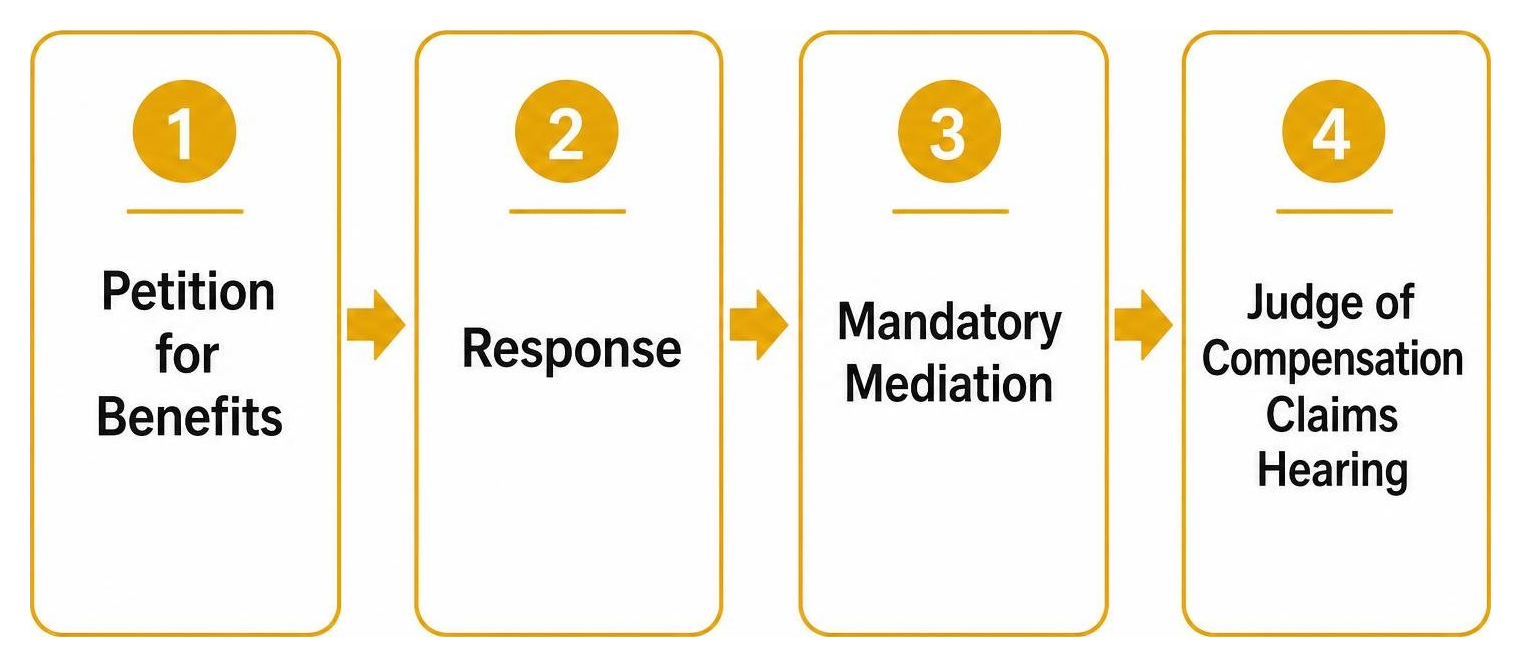
This administrative process is designed to move faster than traditional civil court litigation, but it enforces rigid procedural deadlines and evidentiary rules that require experienced management. You can review the full procedural framework in our comprehensive Florida workers comp lawyer claim representation guide.
Step-by-Step Guide to Filing and Avoiding Common Application Errors
A successful claim relies on meticulous documentation and strict adherence to statutory deadlines. To give your claim the best chance of success:
- Submit a Timely Written Report: Never rely on a casual verbal conversation with a floor supervisor. Submit a written incident report describing the exact time, location, and nature of the accident.
- Adhere to Medical Advice: Attend every scheduled appointment with your authorized treating physician. Missing physical therapy or specialist visits gives the carrier ammunition to argue that your condition has resolved.
- Maintain Work Restriction Slips: Every time you see your authorized doctor, obtain a clear, written physical capacity form detailing your specific physical limitations (e.g., maximum lifting weight, standing limits). Provide copies immediately to your employer and keep one for your records.
- Avoid Inaccurate Histories: Be completely honest and thorough with your treating doctors. If you leave out prior injuries or misstate how the accident happened, insurance lawyers will use those discrepancies to attack your credibility.
For more detailed technical guidance on streamlining your claim submission, check out our workers comp application tips 2026.
What to Do If Your Workers’ Compensation Claim Is Denied
Receiving a formal Denial Notice or Notice of Contest does not mean your case is over. In fact, many legitimate claims are initially contested by insurance adjusters who hope the injured worker will simply walk away.
When a denial occurs, the formal legal response is to file a Petition for Benefits (PFB) with the Office of the Judges of Compensation Claims (OJCC). The petition must detail the specific benefits owed, such as particular medical treatments or retroactive temporary indemnity checks. The insurance carrier is mandated to respond within 14 days, either by authorizing the requested benefits or articulating their legal defense.
If the dispute remains unresolved, the parties attend a state-ordered mediation conference where an independent mediator works to resolve the conflict. If mediation fails, the matter proceeds to a formal final hearing before a Judge of Compensation Claims (JCC), who evaluates the evidence and issues a binding legal ruling. Securing top rated workers comp lawyer a practical guide can help ensure your petition meets all statutory requirements and that your medical testimony is properly presented.
How Workers’ Compensation Settlements and Lump-Sum Payouts Work
Most contested or long-term workers’ compensation claims ultimately resolve through a negotiated settlement rather than a continuous stream of weekly checks. A settlement is an agreement in which the insurance company pays a lump sum of money in exchange for closing out some or all of their future financial and medical obligations under the claim.
Settlements are generally negotiated after you reach Maximum Medical Improvement (MMI), because only then can physicians accurately forecast your future medical expenses and permanent impairment. Settlements take various structures:
- Washout / Full and Final Release: The injured worker receives a single lump-sum cash payout, permanently releasing the employer and insurance carrier from all future wage replacement and medical treatment obligations. You assume full personal responsibility for your future medical care.
- Indemnity-Only Settlement: The carrier pays a lump sum to settle all past and future lost wages, but leaves medical benefits open for authorized treatments related to the workplace injury.
- Structured Settlements: Instead of a single payment, the funds are distributed through an annuity, providing scheduled payments over months or years, which can be useful for catastrophic injuries requiring lifelong care.
For insights into how attorneys evaluate value and project future medical exposure, see our guide on how much is a workers comp settlement estimate your amount.
Evaluating Costs and Selecting the Right Legal Representation
A major hesitation for many injured workers is the fear of legal bills. When you are already missing work and facing mounting household expenses, the thought of paying hourly attorney fees is daunting. Fortunately, workers’ compensation representation is designed to be accessible to everyone, regardless of financial standing.

When selecting representation, you should look for established local experience, direct attorney accessibility, and transparent fee structures. To explore your options near home, look to find local workmans comp lawyers near you.
How Contingency Fees and No Win, No Fee Agreements Work
Hurt-on-the-job attorneys represent clients on a contingency fee basis. This means you pay no upfront retainers, no hourly charges, and no out-of-pocket legal fees. The attorney’s fee is contingent upon successfully securing benefits, winning an administrative hearing, or negotiating a lump-sum settlement on your behalf.
In Florida, attorney fees in workers’ compensation cases are strictly regulated by state statute under Florida Statute § 440.34. The statutory sliding scale for contingency fees on secured benefits is typically structured as follows:
- 20% of the first $5,000 in benefits secured
- 15% of the next $5,000 in benefits secured
- 10% of the remaining benefits secured between $10,000 and $100,000
- A reasonable percentage (typically 5–10%) for benefits recovered over $100,000
In addition, if an attorney successfully prosecutes a Petition for Benefits and proves that the carrier wrongfully withheld medical care or indemnity checks, the Judge of Compensation Claims may order the insurance carrier to pay the attorney’s fees directly, leaving your recovered benefits untouched.
Key Factors When Selecting Hurt on the Job Lawyers
Choosing the right advocate can significantly impact your recovery timeline and final settlement. When vetting law firms, keep these critical criteria in mind:
- Exclusive Focus and Decades of Experience: Workers’ compensation law contains unique procedural codes and administrative judges. Choose a firm with deep, specialized experience in the workers’ compensation system rather than a general practice attorney.
- Trial Readiness: While most cases settle, insurance carriers know which lawyers are willing to take a case to a final merits hearing and which will accept lowball offers to avoid a trial.
- Direct Communication and Bilingual Staff: You should have direct access to your legal team to get prompt answers about doctor authorizations and check schedules. For non-English speakers, having bilingual capability ensures nothing is lost in translation.
- Client Reputation: Look for demonstrated reviews, professional standing, and a history of prioritizing the client’s physical health alongside financial compensation.
Frequently Asked Questions About Workplace Injury Claims
For additional answers to common concerns regarding your legal options, visit our dedicated frequently asked questions hub.
Can I be fired for filing a workers’ compensation claim?
Under Florida Statute § 440.205, it is strictly unlawful for an employer to discharge, threaten to discharge, intimidate, or coerce any employee because they claimed or attempted to claim compensation under the Workers’ Compensation Law.
If your employer terminates your employment in direct retaliation for asserting your statutory rights, you have the right to pursue a separate civil lawsuit for wrongful retaliatory termination. In such a suit, you may recover lost wages, future financial damages, and compensation for emotional distress.
What is the statute of limitations for filing a work injury claim?
There are two critical time limits you must meet under Florida workers’ compensation law:
- The 30-Day Notice Rule: You must report your injury to your employer within 30 days of the date of the accident, or within 30 days of when a doctor first informs you that your medical condition is work-related.
- The Two-Year Statute of Limitations: A formal Petition for Benefits must generally be filed within two years of the date of the workplace accident.
Important Note on Tolling: Each time the workers’ compensation insurance carrier pays a wage replacement check or authorizes and pays for medical treatment with an approved provider, the statute of limitations is extended (tolled) for one year from the date of that payment or authorized visit.
Can I receive both workers’ comp and Social Security Disability benefits?
Yes, you can receive both Florida workers’ compensation and Social Security Disability Insurance (SSDI) benefits simultaneously, but the total amount of combined benefits is subject to a statutory cap.
Federal law mandates that your combined workers’ compensation indemnity checks and SSDI payments cannot exceed 80% of your average pre-disability earnings. If the combined total exceeds 80%, the Social Security Administration will reduce (offset) your monthly SSDI payments to bring the total beneath the threshold.
When negotiating a final workers’ compensation lump-sum settlement, a knowledgeable attorney can include specific “amortization” or “Hartman language” that spreads the settlement over your remaining life expectancy. This legal structuring minimizes or eliminates the SSDI offset, allowing you to maximize both benefit streams.
Conclusion
A serious workplace accident brings physical pain, emotional stress, and financial uncertainty. You do not have to confront corporate insurance adjusters, confusing administrative deadlines, and complex medical evaluations on your own.
At Panzer Law, P.A., our team has dedicated decades to protecting the rights of injured workers throughout South Florida, including Miami, Boca Raton, West Palm Beach, Palm Beach County, and Miami-Dade County. We operate on a pure contingency fee model: no recovery, no fee. We advance all litigation costs, and you pay nothing out of pocket unless we successfully secure benefits or a settlement for your case.
If you or a loved one has suffered an on-the-job injury, reach out to us today for a free, confidential consultation by consulting a dedicated Florida workers’ compensation lawyer. Let us handle the legal complexities so you can focus entirely on your health and recovery.
