

Finding Help With a West Palm Beach Workers’ Comp Claim
If your work injury claim was denied, medical care is delayed, or wage payments have stopped, it may be time to call a workers comp lawyer west palm beach workers trust. Report the injury to your employer as soon as possible, ask how to see an authorized doctor, and keep copies of your medical records and any letters from the insurer. You can also review the Florida Division of Workers’ Compensation for official guidance on the claims process. A lawyer can review the dispute, explain your options, and tell you what representation would cost.
I’m Gil Panzer, owner and attorney at Panzer Law, P.A. As an experienced workers comp lawyer West Palm Beach employees trust, I’ve spent more than 30 years helping injured workers in Florida and New York with claims, medical care, and settlements.
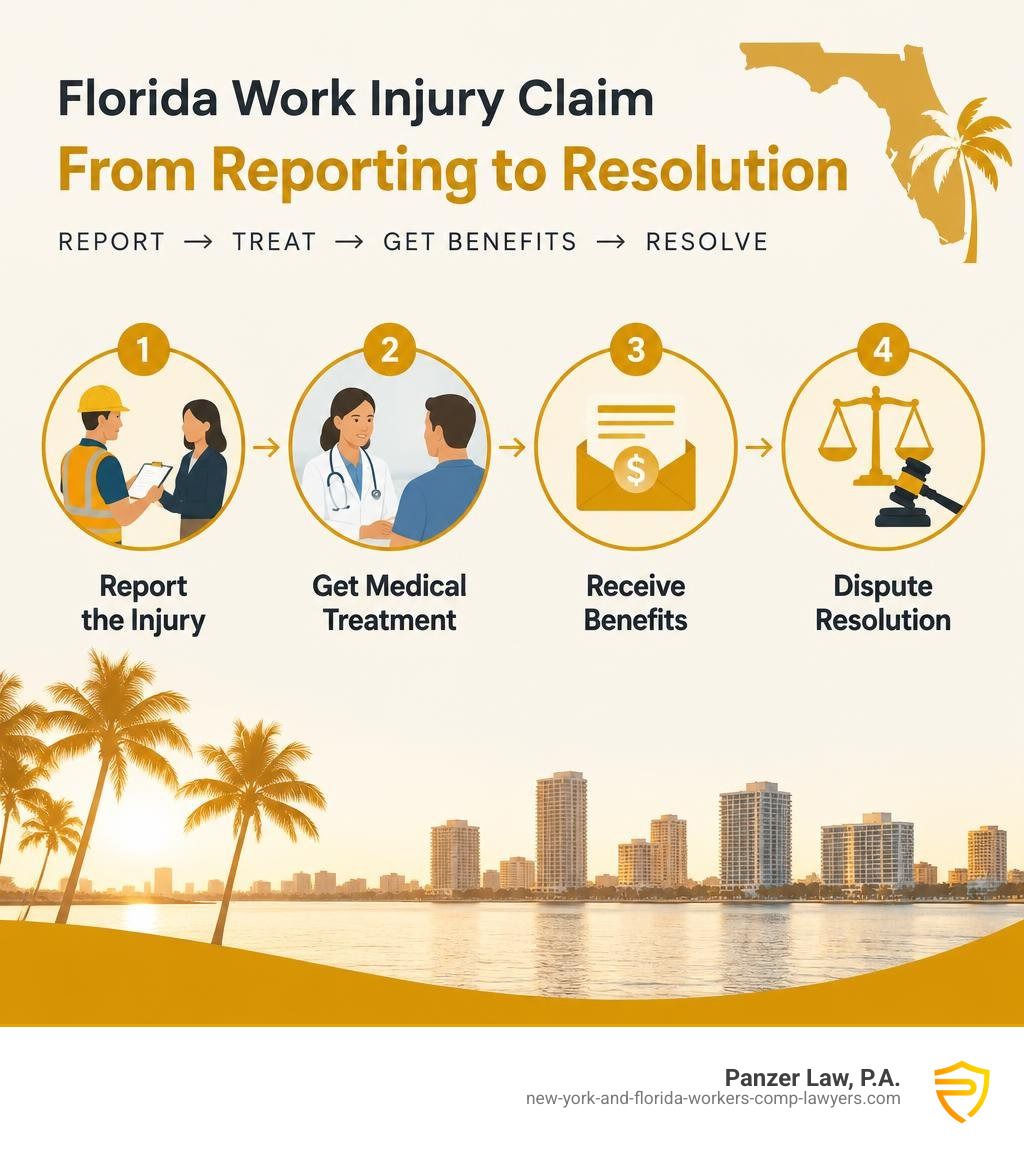
Explore more about workers’ compensation in Florida:
- best workers comp lawyers in florida
- Florida workers’ compensation lawyer
- workers compensation lawyer in florida
When to Hire a Workers Comp Lawyer West Palm Beach
Suffering an injury on the job brings an immediate wave of stress. Between severe physical pain, mounting diagnostic bills, and missing daily shifts, the administrative burden of filing paperwork is often the last thing you want to handle. While straightforward claims with minor cuts or bruises might proceed smoothly, serious injuries almost always trigger friction with the employer’s insurance carrier.

Knowing when to consult a dedicated West Palm Beach Workers Compensation Lawyer makes the difference between having your medical care covered or being left with thousands of dollars in out-of-pocket expenses. Insurance carriers are profit-driven corporations. When significant money is on the line, adjusters are trained to protect the bottom line by minimizing or denying claims. Working with a dedicated workers comp lawyer West Palm Beach workers can rely on ensures that insurance companies take your case seriously from day one.
Key Signs You Need a Workers Comp Lawyer West Palm Beach
Navigating the workers’ compensation system alone is risky, especially when certain red flags appear. You should seek legal counsel immediately if you encounter any of the following situations:
- Your Claim Is Outright Denied: The insurance carrier claims your accident did not happen at work, that you missed a deadline, or that your condition is unrelated to your job duties.
- Critical Medical Care Is Delayed or Refused: The adjuster refuses to authorize necessary MRIs, specialist referrals, physical therapy, or recommended surgical procedures.
- Pre-Existing Conditions Are Blamed: Insurers frequently argue that your back, neck, or joint pain stems from an old injury or natural aging rather than your recent workplace accident.
- Disputes Over Wage Benefits (Indemnity Payments): Your weekly check is miscalculated, delayed, or stopped prematurely while you are still medically unable to return to your normal role.
- Premature Return-to-Work Demands: The employer-selected doctor clears you for full-duty work before you have healed, or your employer refuses to accommodate your light-duty restrictions.
- Employer Retaliation: You experience threats, demotion, hour cuts, or wrongful termination simply because you asserted your legal right to file a claim.
How Legal Representation Levels the Playing Field Against Insurers
Insurance carriers employ seasoned claims adjusters, internal investigators, and defense attorneys whose daily goal is to limit the carrier’s financial exposure. When you represent yourself, you are pitted against professionals who know every loophole in Chapter 440 of the Florida Statutes.
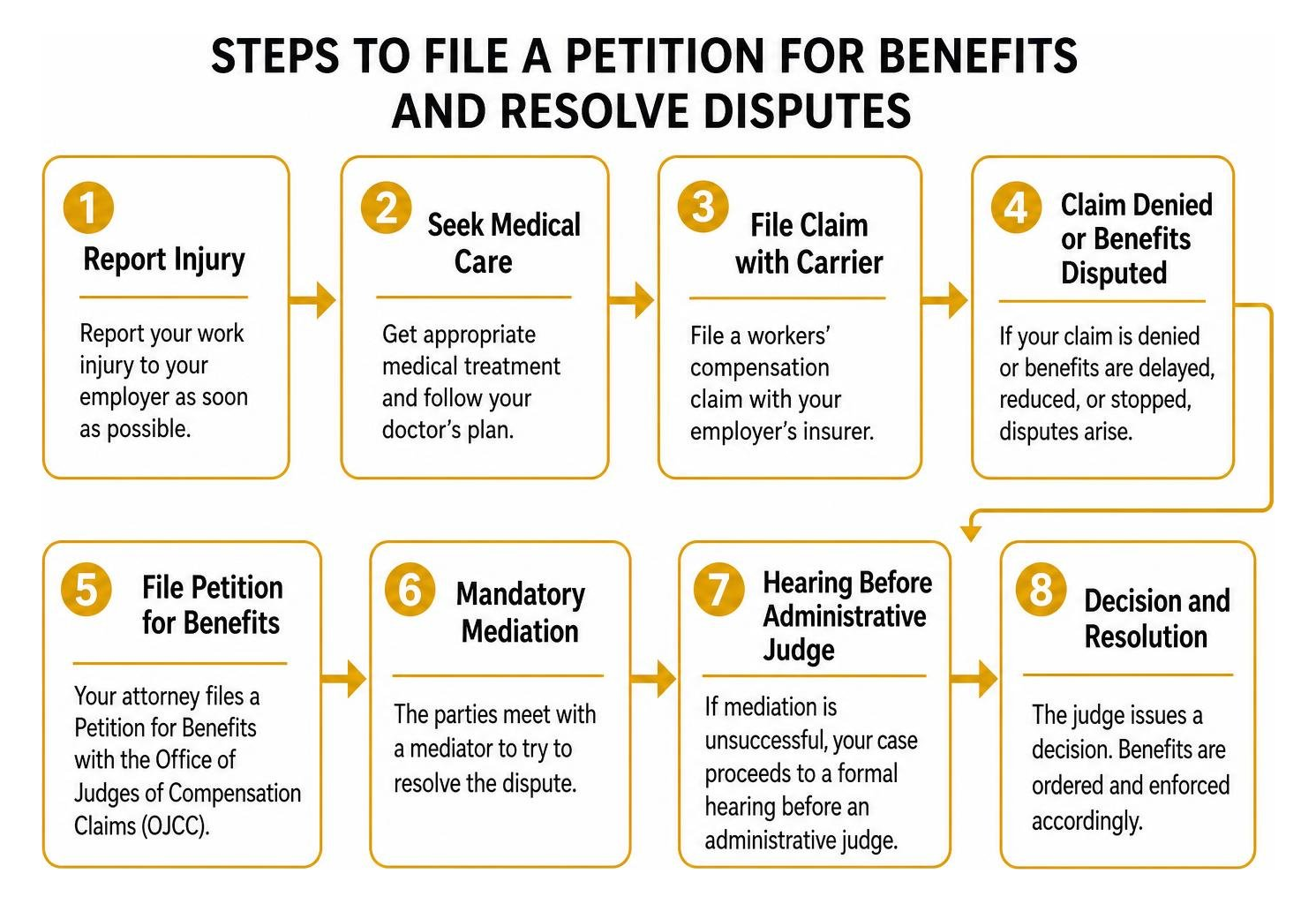
When we step in, we shift the balance of power. We handle every interaction with the insurance company, assemble strong medical evidence from treating physicians, and calculate the true lifetime valuation of your claim. If the insurance adjuster refuses to provide proper medical treatment or wage checks, we file a formal Petition for Benefits and represent your interests through mandatory mediation and formal hearings before an administrative judge.
Understanding Florida Workers’ Compensation Laws and Eligibility
The legal framework governing work injuries in Florida is designed to be self-executing, but the statutory rules can be rigid and unforgiving. If you have been injured on the job, knowing whether you qualify and how the law applies is essential before you find a Florida workers comp lawyer for your claim.
Who Qualifies for Coverage in Palm Beach County
Florida law mandates that most employers carry workers’ compensation coverage, but specific coverage thresholds depend on the industry:
- Non-Construction Businesses: Employers with four (4) or more employees (including corporate officers and LLC members) must provide workers’ compensation coverage.
- Construction Industry: Because of the high risk of catastrophic injuries, construction businesses with one (1) or more employees must secure coverage.
- Agricultural Employers: Coverage is required for agricultural operations with six (6) or more regular employees, or twelve (12) or more seasonal workers performing labor for more than 30 days.
It is also vital to watch out for independent contractor misclassification. Some employers intentionally label workers as “independent contractors” (or 1099 workers) to avoid paying insurance premiums. Under Florida law, your actual job duties and the degree of control your employer exercises over your daily work determine your status—not an arbitrary title on a tax form. Furthermore, undocumented workers are fully protected under Florida workers’ compensation laws and are entitled to medical and disability benefits regardless of legal status.
Critical Deadlines: The 30-Day Notice and Two-Year Statute of Limitations
The Florida workers’ comp system enforces strict statutory deadlines. Missing either of these cutoffs can permanently bar you from recovering financial support:
- The 30-Day Reporting Rule: You must report your injury to your employer within 30 days of the accident date, or within 30 days of when a doctor first informs you that your condition (such as a repetitive stress injury or occupational disease) is related to your job.
- The Two-Year Statute of Limitations: You generally have two years from the date of the accident to file a formal claim for benefits. However, each time the insurance carrier pays for authorized medical care or provides disability benefits, the statute of limitations extends for one additional year from the date of that last authorized treatment or payment.
Workers’ Compensation Benefits and Claim Disputes
When an injury takes you away from your job, Florida law establishes specific benefit categories to replace a portion of your income and cover all necessary medical care. You can protect your benefits with the top rated Florida workers comp attorneys to ensure the insurance adjuster does not shortchange your recovery.
| Benefit Type | What It Covers | Common Insurer Disputes |
|---|---|---|
| Medical Care | 100% of authorized doctor visits, surgeries, hospitalization, prescriptions, and medical equipment. | Refusing to authorize diagnostic tests (MRIs), physical therapy, or necessary surgeries; delaying approvals. |
| Temporary Total Disability (TTD) | 66⅔% of your pre-injury Average Weekly Wage (AWW) if you cannot work at all during recovery (up to 104 weeks). | Miscalculating the Average Weekly Wage (AWW) by excluding overtime, bonuses, or second-job earnings. |
| Temporary Partial Disability (TPD) | Wage replacement (typically up to 64% of AWW) when you can return to light duty but earn less than 80% of your pre-injury earnings. | Claiming the employer offered suitable light duty when the job violates physical medical restrictions. |
| Permanent Impairment (IB) | Impairment benefits paid out after reaching Maximum Medical Improvement (MMI) based on a permanent impairment rating. | Assigning an artificially low impairment rating through an insurer-friendly medical examiner. |
| Permanent Total Disability (PTD) | Ongoing wage benefits paid until age 75 (or life in certain catastrophic cases) for workers who can never return to any employment. | Arguing the worker can perform sedentary work within a 50-mile radius despite severe physical limitations. |
Available Benefits: Medical Care, Wage Replacement, and Disability
- Medical Benefits: The carrier must cover all reasonable and necessary medical treatments related to the industrial accident. This includes travel mileage reimbursement for your trips to and from authorized medical appointments and pharmacies.
- Temporary Disability Benefits: While recovering, benefits are calculated based on your Average Weekly Wage (AWW) for the 13 weeks preceding the accident. TTD pays 66⅔% of this average (or up to 80% for up to six months for severe catastrophic injuries such as limb loss or blindness), subject to the annual statutory maximum.
- Vocational Rehabilitation: If your permanent physical restrictions prevent you from returning to your past occupation, the state provides re-employment services, training programs, and career counseling to help you re-enter the workforce.
No-Fault Workers’ Comp and Employer Immunity
Florida’s workers’ compensation system operates on a no-fault principle. You do not need to prove that your employer, supervisor, or coworker was negligent to qualify for benefits. Even if you made a simple mistake that caused the accident, you are still entitled to medical treatment and wage loss protection.
In exchange for providing no-fault benefits, employers receive workers’ compensation immunity, meaning you cannot sue your employer in civil court for standard negligence or for pain and suffering damages. However, if a negligent third party (such as a reckless driver who hits your delivery vehicle, a negligent subcontractor on a construction site, or a manufacturer of defective industrial machinery) contributed to your injury, you can pursue a separate third-party personal injury lawsuit alongside your workers’ compensation claim.
Navigating Medical Treatment and Common Claim Denials
Securing proper medical care is often the most contentious aspect of a Florida workers’ compensation claim. Adjusters frequently attempt to route injured employees to clinics that prioritize the insurance company’s interests over your physical recovery.

Understanding your rights regarding treating physicians ensures that your injuries are thoroughly evaluated and properly rehabilitated. For a complete look at how we protect injured employees throughout this process, see our Florida Workers Comp Lawyer Claim Representation Guide.
Choosing an Authorized Doctor and Requesting One-Time Changes
Under Florida law, the insurance carrier has the initial right to select your treating physician. You cannot simply visit your personal family doctor and send the bill to workers’ comp; unapproved treatments will not be paid by the carrier.
However, Florida Statute § 440.13(2)(f) gives every injured worker a powerful right: the one-time change of physician.
- If you are dissatisfied with your current authorized doctor, you can submit a written request for a one-time change to a new physician within the same specialty.
- The insurance carrier has exactly 14 calendar days from receiving your written request to authorize a new doctor.
- If the carrier fails to provide a new physician within that 14-day window, you acquire the legal right to select your own doctor, and the insurer must pay for the treatment.
Why Insurers Deny Claims and How to Fight Back
Insurance companies rely on a regular playbook of standard defenses to avoid paying costly claims:
- Major Contributing Cause (MCC): The insurer argues that your workplace accident is not at least 51% responsible for your current medical condition or need for treatment compared to pre-existing conditions or degenerative disc disease.
- Late Notice: The carrier asserts that you failed to report the incident to your supervisor within the mandatory 30-day window.
- Positive Drug or Alcohol Tests: While intoxication can be used to deny a claim, the employer must prove that impairment was the primary cause of the accident, which can be legally challenged.
- Disputes Over Work Restrictions: The employer claims they have a light-duty job available, but the assigned tasks violate your doctor’s orders.
When an insurer issues a formal denial (Notice of Denial), we take the case directly to the Office of the Judges of Compensation Claims (OJCC). We collect detailed medical depositions, secure independent medical examinations (IMEs), and present testimony to overturn bad-faith claim rejections.
Immediate Steps to Take After a Palm Beach County Workplace Accident
The actions you take immediately following a job site incident will shape the outcome of your claim. Follow this essential step-by-step checklist to protect your health and your legal rights:
- Report the Accident Immediately: Inform your supervisor or manager in writing (email or text message) right away. State the exact time, date, location, and nature of the accident. Request a copy of the official First Report of Injury (DWC-1) form.
- Demand Immediate Medical Treatment: Ask your employer or the claims department for the name and address of an authorized urgent care facility or occupational clinic. In a life-threatening emergency, go to the nearest emergency room (such as St. Mary’s Medical Center or Good Samaritan Medical Center in West Palm Beach) and inform the staff that your injury happened at work.
- Document the Scene and Injury: Take clear photographs and videos of the hazard that caused your injury (broken scaffolding, wet floors, malfunctioning machinery). Preserve any damaged clothing, safety gear, or equipment.
- Gather Witness Information: Write down the names, phone numbers, and job titles of any coworkers or third parties who saw the accident occur.
- Follow Doctor’s Orders Carefully: Attend every physical therapy session and follow-up appointment. Do not engage in activities outside of work that could be misconstrued by insurance surveillance investigators as violating your restrictions.
- Keep an Organized File: Save all medical discharge summaries, work status notes (DWC-25 forms), pharmacy receipts, mileage logs, and written correspondence from the insurer.
- Contact an Experienced Attorney: Speak with an experienced Florida Workers Compensation Lawyer before giving recorded statements to the insurance claims adjuster.
Fee Structures for a Workers Comp Lawyer West Palm Beach
A common concern injured workers have is the cost of legal representation when their income is already reduced. At Panzer Law, P.A., we represent injured workers on a contingency fee basis.
- Zero Upfront Costs: You pay nothing out of pocket to hire our firm. We advance all litigation expenses, medical record fees, expert witness costs, and deposition charges.
- No Recovery, No Fee: You only pay legal fees if we successfully recover benefits, win your hearing, or secure an agreeable lump-sum settlement.
- Statutory Fee Caps: In Florida, workers’ compensation attorney fees are governed by state statute (§ 440.34), which sets reasonable sliding-scale percentages based on the benefits secured. In many cases involving wrongful claim denials, we can force the insurance company to pay your attorney fees directly on top of your recovered benefits.
Frequently Asked Questions About Florida Work Injury Claims
For additional answers to common questions about Florida work injury cases, visit our comprehensive Frequently Asked Questions resource.
Can I be fired for filing a workers’ comp claim in Florida?
No. Under Florida Statute § 440.205, it is strictly unlawful for any employer to discharge, threaten to discharge, intimidate, or coerce an employee because of a valid claim for workers’ compensation benefits. While Florida is an “at-will” employment state, filing a workers’ compensation claim creates protected legal status. If your employer retaliates against you, fires you, or cuts your hours because you sought medical care or benefits, you may pursue a separate civil lawsuit for wrongful termination and financial damages.
What if my employer does not carry required workers’ compensation insurance?
If an employer fails to maintain mandatory workers’ comp coverage, the Florida Division of Workers’ Compensation can issue a Stop-Work Order, shutting down business operations and assessing substantial financial penalties. From an injury standpoint, an uninsured employer loses their workers’ compensation immunity. This allows you to sue the employer directly in civil court for full personal injury damages—including 100% of lost income, future lost earning capacity, and pain and suffering.
Are undocumented workers entitled to workers’ compensation benefits?
Yes. Under Florida law, the definition of an “employee” explicitly includes aliens, regardless of their immigration status or work authorization. If you are injured while performing your job in Florida, the employer’s insurance carrier is legally obligated to provide medical treatment and wage replacement benefits. Insurance carriers cannot threaten deportation or use your legal status to escape their statutory duty to pay for your workplace injuries.
Conclusion
A serious workplace injury can alter your financial stability and physical well-being overnight. When dealing with complex claim paperwork, stubborn insurance adjusters, and strict statutory deadlines, you should not have to fight for your rightful benefits alone.
At Panzer Law, P.A., our team has spent over three decades standing up for injured workers across Palm Beach County, Boca Raton, and South Florida. We understand the tactics insurance companies use to minimize payouts, and we know how to secure the full medical care and wage loss compensation you deserve. If your claim has been denied, your benefits are delayed, or you want to discuss a fair lump-sum settlement, reach out to an experienced West Palm Beach Workers Compensation Lawyer today for a free, confidential case review. Consulting a seasoned workers comp lawyer West Palm Beach employees trust is the first step toward getting your life and livelihood back on track.
