

How to Find a Work Injury Lawyer Near You
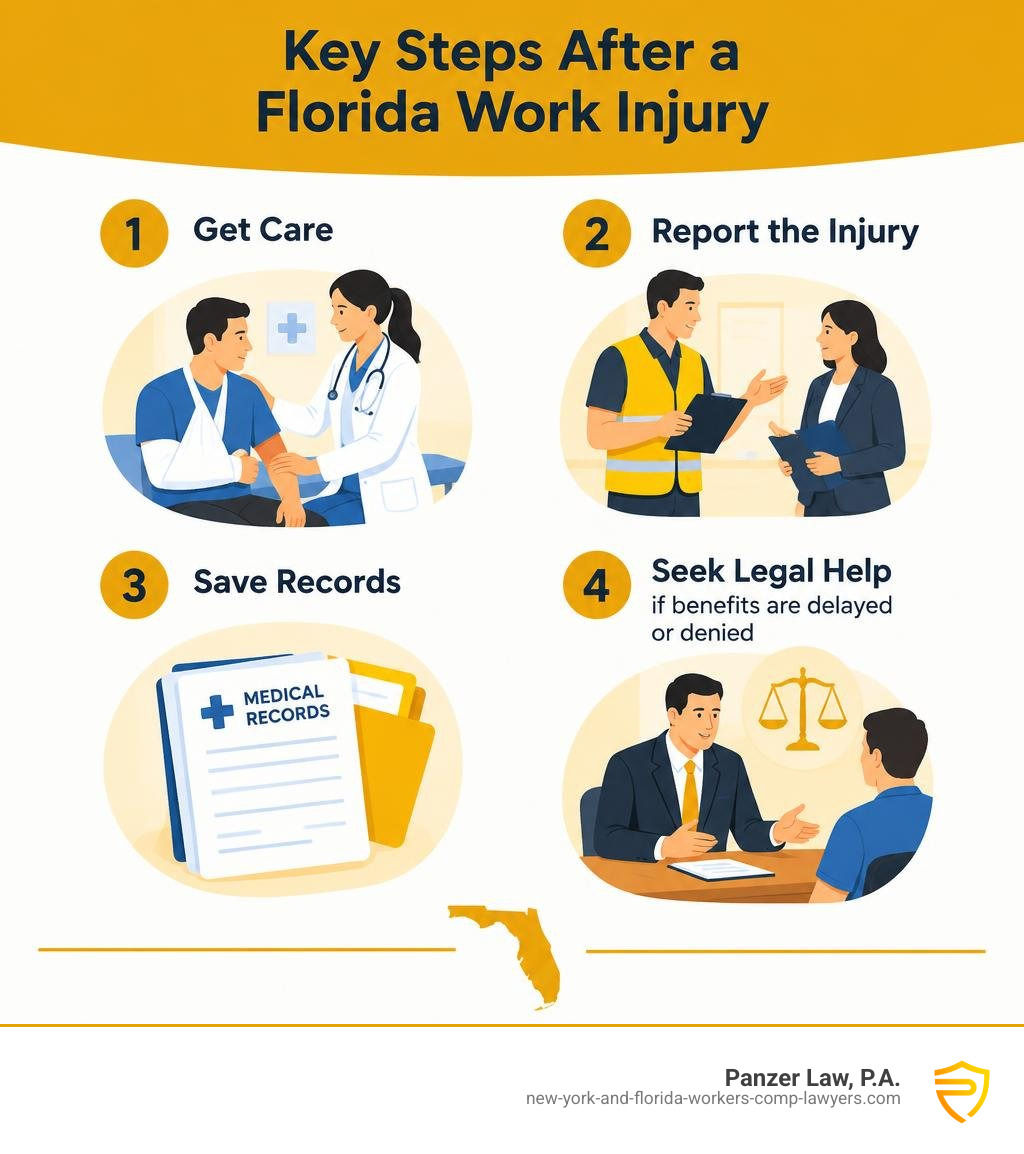
If you were hurt at work in Florida, get medical care, tell your employer as soon as possible, and keep a written record of what happened. If your treatment or wage benefits are delayed or denied, look for a Florida workers’ comp lawyer who handles disputed claims, offers a free consultation, and explains fees before you sign. Florida generally requires you to report an injury within 30 days, but it is safer to report it right away. The Florida Division of Workers’ Compensation publishes employee resources and claim guidance that can help you understand your rights.
I’m Gil Panzer, owner and attorney at Panzer Law, P.A., and I’ve spent more than 30 years helping injured workers in Florida and New York with workers’ comp claims, medical care, and settlements. If you’re searching for a work injury lawyer near me, this guide will help you protect your claim and choose whom to call.
Work injury lawyer near me vocab to learn:
- best workers comp lawyers in florida
- Florida workers’ compensation lawyer
- workers compensation lawyer in florida
What to Do Immediately After an On-the-Job Injury

Suffering a workplace accident can turn an ordinary workday upside down in an instant. Whether you slip on a slick floor in a Miami warehouse or suffer a back sprain lifting heavy equipment on a job site in West Palm Beach, knowing what steps to take protects both your physical health and your financial future.
First and foremost, seek immediate medical attention. If your injuries are severe or life-threatening, call 911 or head straight to the nearest emergency room. Inform the attending medical staff immediately that your injury occurred on the job so they can properly document the incident as work-related.
Next, notify your supervisor or employer in writing. While you might mention the injury verbally, a written record establishes a clear timestamp that prevents the insurance carrier from claiming you fabricated or delayed the incident. Following a practical guide to filing workers comp claims ensures you collect witness statements, preserve physical evidence, and take photographs of the accident scene before conditions change.
Reporting Deadlines and Statute of Limitations
Florida law imposes strict statutory deadlines that control when and how you can pursue benefits:
- The 30-Day Notice Rule: You must formally report your workplace injury to your employer within 30 days of the incident, or within 30 days of discovering that a repetitive stress condition or occupational illness is work-related. Missing this deadline gives insurance adjusters valid legal grounds to deny your claim entirely.
- The Two-Year Statute of Limitations: Generally, you have two years from the initial date of injury (or from the date of your last authorized medical visit or wage indemnity payment) to file a formal Petition for Benefits with the state.
Failing to meet either timeframe can permanently extinguish your right to medical coverage and wage replacement benefits under Florida law.
Critical Mistakes That Jeopardize Your Benefits
Insurance carriers are for-profit corporations whose primary goal is minimizing payouts. Even an honest, hardworking employee can accidentally make missteps that derail an otherwise valid claim. Common errors include:
- Delaying the Initial Report: Waiting weeks to notify your boss signals to the insurance company that your injury was either minor or occurred outside of work.
- Seeking Unauthorized Non-Emergency Treatment: Except in emergency situations, you must treat with a physician authorized by the workers’ compensation carrier. Seeing your personal family doctor without authorization will leave you stuck with the medical bills.
- Giving Recorded Statements Without Counsel: Adjusters often ask leading questions designed to get you to downplay your symptoms or admit fault.
- Accepting Inaccurate Wage Calculations: Your Average Weekly Wage (AWW) determines your weekly check. Leaving out overtime, bonuses, or second-job earnings silently costs you thousands of dollars over time.
- Missing Appeal Windows: If an insurer issues a formal denial or cuts off physical therapy, you must respond quickly before administrative deadlines expire.
Types of Workers’ Compensation Benefits and Financial Recovery
Under Florida law, most non-construction employers with four or more employees—and construction companies with one or more workers—must carry workers’ compensation coverage. Navigating these rights and protecting your workers’ compensation benefits allows you to access several essential categories of financial and medical support:
- Authorized Medical Care: Coverage for all reasonable, necessary doctor visits, surgeries, physical therapy, diagnostic tests (like MRIs and X-rays), and prescription medications.
- Temporary Total Disability (TTD): Paid when your authorized physician states you cannot work at all while recovering.
- Temporary Partial Disability (TPD): Paid when you can return to light-duty work but earn less than 80% of your pre-injury wages.
- Permanent Impairment Benefits (PIB): Compensation paid out based on a statutory percentage rating assigned once your physical healing plateau has been reached.
- Vocational Rehabilitation: Training and job placement assistance if physical restrictions permanently prevent you from returning to your prior occupation.
Medical Care and Wage Replacement Under Florida Law
Florida’s wage replacement benefits generally provide two-thirds (66.67%) of your pre-injury Average Weekly Wage. As of January 1, 2026, Florida’s statutory maximum weekly compensation rate is $1,358 per week. These indemnity benefits are free from state and federal income taxes, providing essential financial stability while you heal.
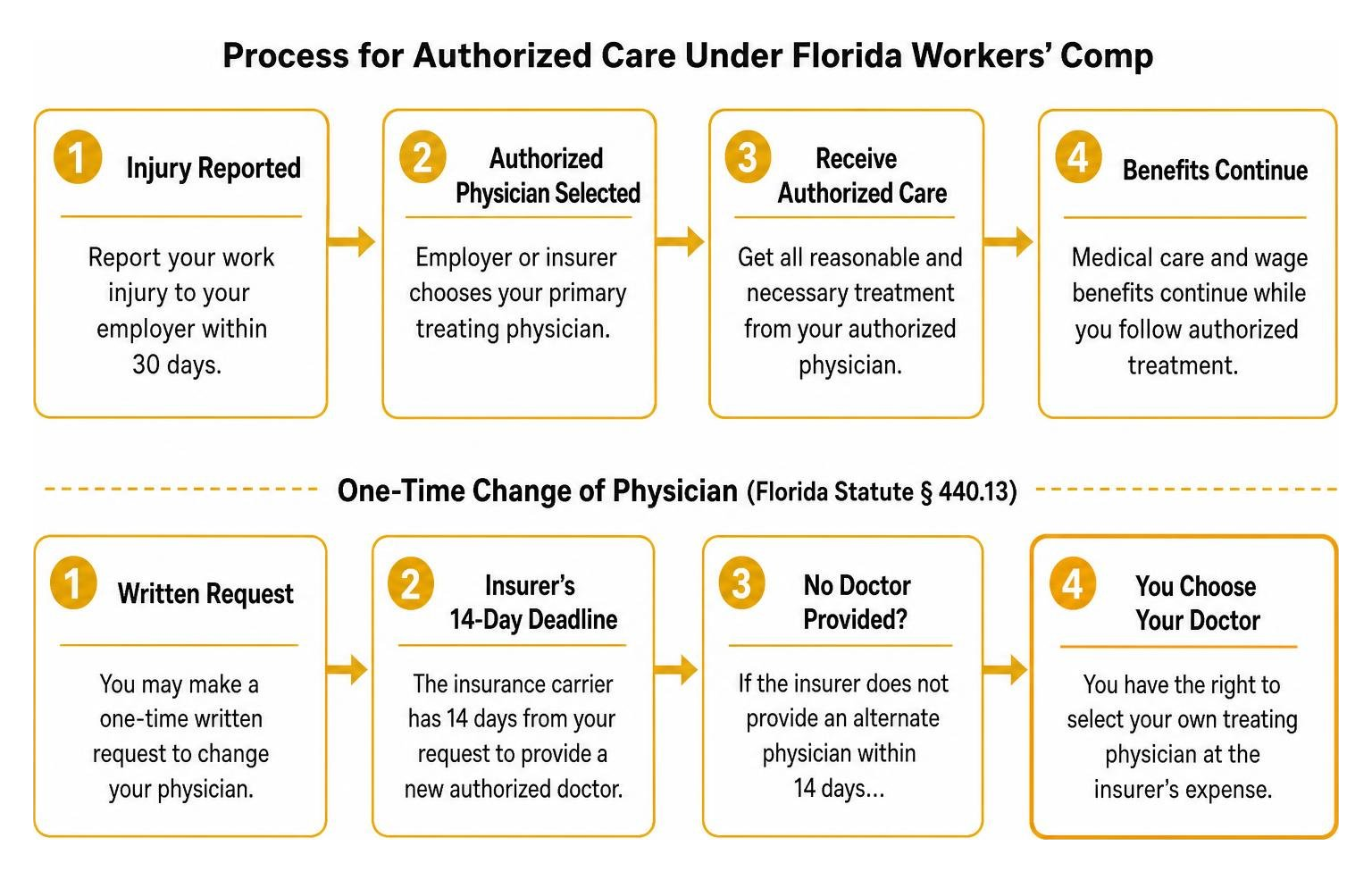
When it comes to medical treatment, your employer or their insurer chooses your primary treating physician. However, Florida Statute § 440.13 provides injured employees the right to request a one-time change of physician during the life of the claim. Once you make this written request, the insurance carrier has 14 days to provide a new authorized doctor. If they fail to provide an alternate physician within those 14 days, you earn the right to select your own treating specialist at their expense.
Workers’ Comp vs. Third-Party Personal Injury Lawsuits
Under Florida’s “exclusive remedy” doctrine, you generally cannot sue your direct employer for negligence in exchange for receiving no-fault workers’ compensation benefits. However, if a negligent third party contributed to your accident, you can pursue a third-party personal injury lawsuit alongside your workers’ comp claim.
| Factor | Workers’ Compensation Claim | Third-Party Personal Injury Lawsuit |
|---|---|---|
| Fault Required? | No-fault system (benefits apply regardless of negligence) | Must prove negligence by a third party |
| Eligible Defendants | Direct employer and their insurance carrier | General contractors, property owners, equipment manufacturers, drivers |
| Medical Expenses | 100% of authorized, reasonable medical care covered | Full recovery of past and projected future medical expenses |
| Lost Wages | Capped at 66.67% of AWW up to statutory limit ($1,358/wk in 2026) | Full 100% recovery of past and future lost earning capacity |
| Pain and Suffering | Not available under Florida Statute Chapter 440 | Fully compensable for non-economic damages and emotional distress |
For example, if you are injured at a construction site due to a defective trenching box or hit by an erratic delivery truck driver while running work errands in Boca Raton, you can claim workers’ comp benefits while simultaneously pursuing full damages through a civil claim.
When to Search for a Work Injury Lawyer Near Me
If your employer immediately reports the claim, the insurance company promptly authorizes your doctor, and your weekly checks arrive on time, you may not need legal representation right away. Unfortunately, claims rarely proceed without friction.
You should promptly consult local work injury legal counsel if you experience any of the following warning signs:
- Your claim is denied outright or disputed by the employer.
- The insurance adjuster refuses to authorize specialist appointments, MRIs, or recommended surgeries.
- Your weekly wage replacement checks are delayed, miscalculated, or stopped without explanation.
- The company doctor prematurely pushes you back to full duty while you are still in severe pain.
- You are ordered to attend an Independent Medical Examination (IME) with an insurance-selected doctor.
- The insurer offers a quick, lowball lump-sum settlement before you have completed treatment.
Navigating Denied Claims and Retaliatory Termination

When an insurance carrier issues a formal Notice of Denial, you must file a Petition for Benefits with the Florida Office of the Judges of Compensation Claims (OJCC). This begins a formal legal dispute involving structured discovery, medical depositions, state-mandated mediation, and potential trial proceedings before a Judge of Compensation Claims.
Additionally, many workers fear that asserting their rights will cost them their job. Florida Statute § 440.205 explicitly makes it unlawful for any employer to discharge, threaten to discharge, intimidate, or coerce an employee because of a valid workers’ compensation claim. If your employer retaliates against you, an experienced attorney providing Florida workers’ comp lawyer claim representation can hold them accountable through a separate civil retaliation claim.
Evaluating Qualifications When Hiring a Work Injury Lawyer Near Me
Choosing the right legal advocate makes a substantial difference in the value of your case. When comparing law firms across South Florida, keep these core qualifications in mind:
- Exclusive Focus on Injury Law: Workers’ compensation is a complex, statute-heavy field. Hiring a general practitioner who handles real estate or divorce cases is like seeing a family practitioner for complex orthopedic surgery.
- Insider Insurance Knowledge: Attorneys who understand the tactics, claim-evaluation software, and settlement guidelines used by insurance carriers can anticipate their moves and negotiate from a position of strength.
- Trial Readiness: Insurance companies track which lawyers settle quickly for pennies on the dollar and which law firms consistently prepare cases for formal adjudication before the OJCC.
- Clear Client Communication: Look for firms that provide direct attorney access and responsive service throughout the life of your claim, rather than handing your file off to a call center.
- Fee Transparency: Review guides on choosing top-rated workers’ compensation representation to confirm the firm operates on a true contingency structure approved by state regulators.
How Legal Representation Works: Costs, Fees, and Case Timelines
Understanding the financial and procedural structure of a workers’ compensation case eliminates stress and lets you focus on physical recovery.
Contingency Fees and Statutory Attorney Rates
At Panzer Law, P.A., we represent injured workers on a strict contingency fee basis. This means:
- Zero Upfront Costs: You do not pay any retainers, hourly rates, or out-of-pocket expenses to start your case.
- No Recovery, No Fee: If we do not successfully secure benefits or a financial settlement on your behalf, you owe us nothing in attorney fees.
- Statutorily Regulated Fees: In Florida, workers’ compensation attorney fees are strictly regulated by Florida Statute § 440.34 and must be reviewed and approved by a Judge of Compensation Claims to ensure fairness.
What to Expect During the Legal Process with a Work Injury Lawyer Near Me
Once you hire our team, we immediately take over communications with the insurance carrier, handle your paperwork, and conduct a comprehensive audit of your benefits to ensure your Average Weekly Wage is accurate.
The typical legal progression follows these key stages:
- Claim Audit & Medical Review: We gather all medical records, wage histories, and accident reports to identify any unpaid indemnity checks or delayed treatments.
- Filing a Petition for Benefits: If benefits remain denied or delayed, we file formal Petitions for Benefits detailing the specific medical care and wage loss owed to you.
- Medical Depositions & Discovery: We depose authorized physicians, cross-examine insurance experts, and build comprehensive medical evidence.
- State Mediation: Most Florida workers’ comp disputes are sent to a formal mediation conference where both parties work with a neutral mediator to negotiate a fair resolution.
- Final Hearing (Trial): If the insurance carrier refuses to offer a reasonable settlement or provide required care, we present your case before a Judge of Compensation Claims for a binding ruling.
While simple medical disputes may be resolved within a few months, complex cases involving catastrophic injuries or disputed liability can take 12 to 18 months to reach a full and final lump-sum settlement.
Frequently Asked Questions About Workplace Injuries
Can I choose my own doctor for an on-the-job injury?
Under Florida workers’ compensation laws, your employer or their insurance carrier selects your authorized treating physician for non-emergency care. However, you are legally entitled to request a one-time change of physician at any point during your claim. If the insurance carrier fails to provide a new authorized doctor within 14 calendar days of your written request, you gain the legal right to select your own treating physician.
What is Maximum Medical Improvement (MMI)?
Maximum Medical Improvement (MMI) is the point in your recovery where your treating physician determines your physical condition has stabilized and is not expected to improve with further medical intervention. Reaching MMI does not mean you are 100% healed or that your benefits vanish. Instead, your physician will evaluate you for a Permanent Impairment Rating (PIR), which determines whether you are entitled to ongoing permanent impairment wage benefits or continuing supportive medical care.
Are undocumented workers eligible for workers’ compensation benefits?
Yes. Florida Statute § 440.02 explicitly defines an employee to include any person carrying out employment under an appointment or contract of hire, including foreign nationals and undocumented workers. If you are injured on the job in Florida, you have the legal right to medical treatment and indemnity wage loss benefits regardless of your immigration status.
Conclusion
A serious workplace accident can threaten your health, your livelihood, and your family’s financial stability. You do not have to confront multi-million-dollar insurance carriers and their defense lawyers alone.
At Panzer Law, P.A., we are dedicated to protecting the rights of injured employees throughout Boca Raton, Miami, West Palm Beach, Palm Beach County, and Miami-Dade County. We fight to ensure you receive authorized medical care, accurate wage replacement benefits, and the maximum financial recovery you deserve under Florida law.
Contact us today for a free, confidential case evaluation with an experienced Florida workers’ compensation lawyer. We work on a no-recovery, no-fee model—you pay nothing unless we successfully recover benefits for you.
