

How to Start a Workers’ Comp Claim After a Work Injury
If you’re hurt at work in Florida, tell your employer as soon as possible, preferably in writing. Get emergency care if you need it. For other treatment, ask your employer or its insurer which doctor is authorized to treat you. Tell the doctor your injury is work-related, and keep copies of your injury report, medical records, work restrictions, and wage records. Florida generally requires you to report a work injury within 30 days, so don’t wait to see if it gets better.
I’m Gil Panzer, owner and attorney at Panzer Law, P.A. For more than 30 years, I’ve helped injured workers in Florida and New York with filing a workmans comp claim, getting medical care, and addressing denied benefits.
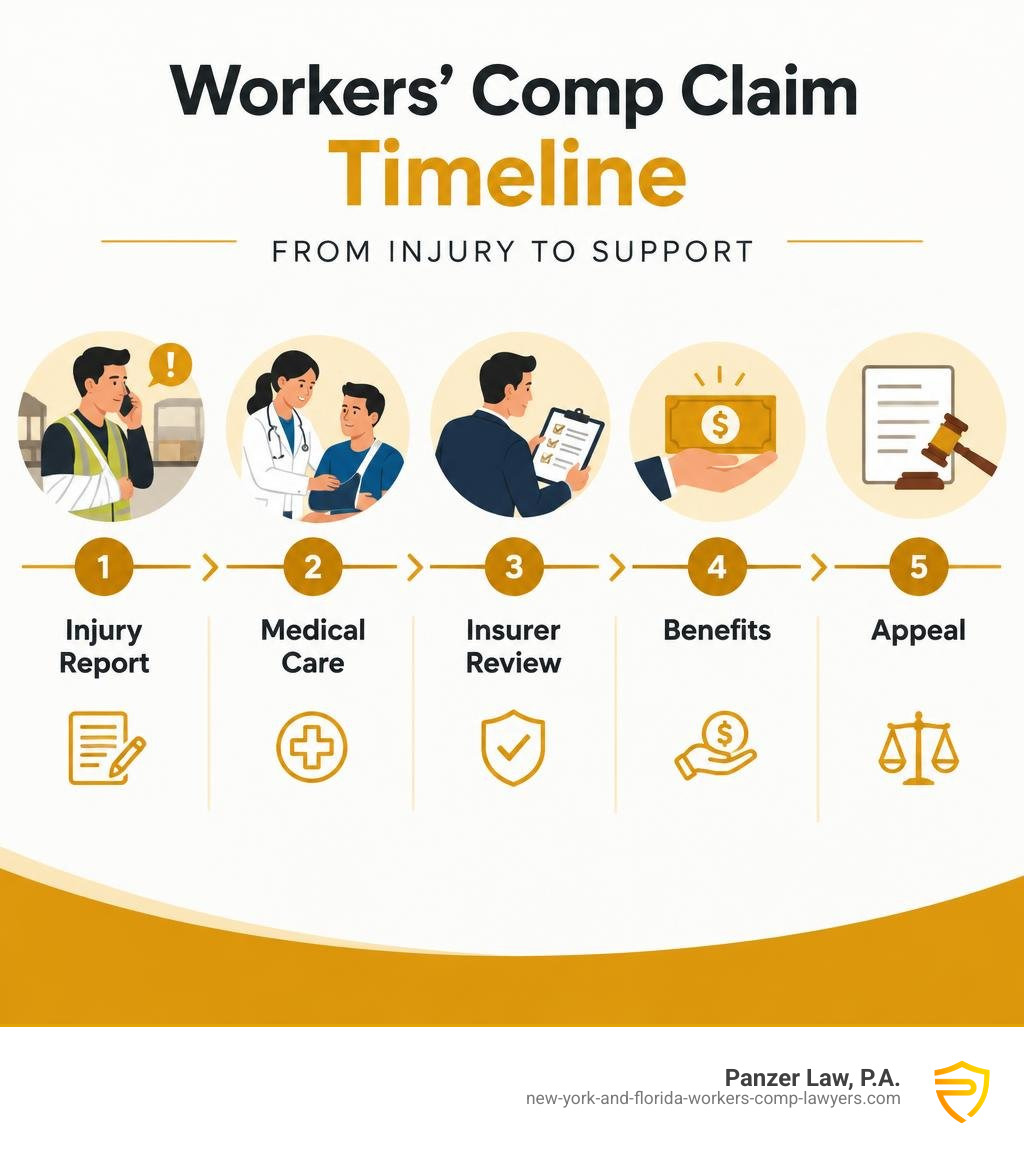
Filing a workmans comp claim terms simplified:
Step-by-Step Guide to Filing a Workmans Comp Claim
When a workplace injury strikes, knowing how to start the claims process quickly can prevent delays in both your medical treatment and your wage replacement checks. Workers’ compensation is a no-fault insurance system designed to protect employees hurt on the job, providing essential medical care and disability payments regardless of who caused the accident.
Navigating this system requires clear, sequential steps:
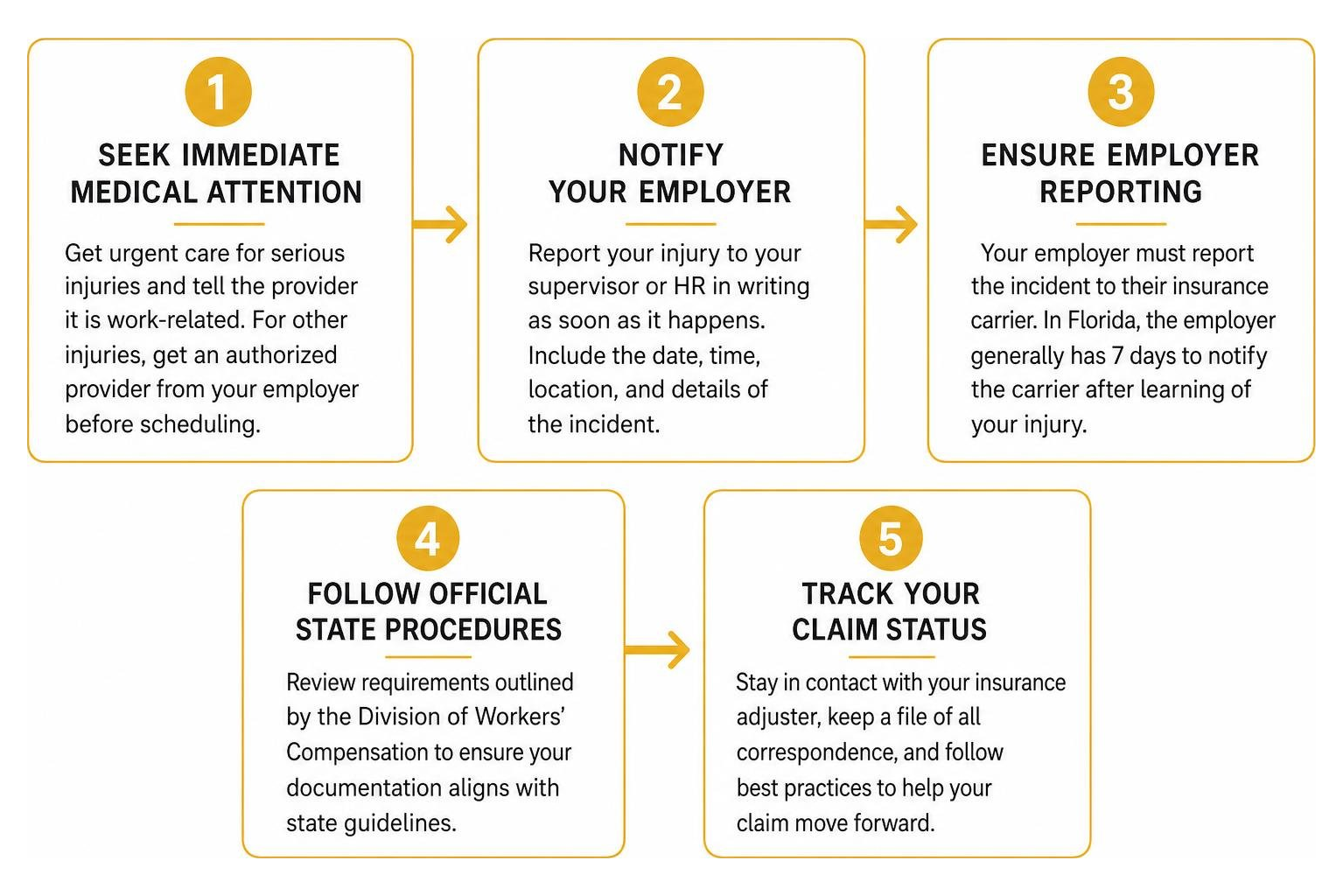
- Seek Immediate Medical Attention: If your injury is an emergency, seek urgent treatment right away and notify the facility that it is work-related. For non-emergencies, ask your employer for an authorized medical provider before scheduling an appointment.
- Notify Your Employer: Formally report your injury to your supervisor or HR department in writing as soon as it happens. Document the date, time, exact location, and details of the incident.
- Ensure Employer Reporting: Your employer must report the incident to their insurance carrier. Under Florida guidelines, the employer generally has 7 days to notify the carrier after learning of your injury.
- Follow Official State Procedures: Review requirements outlined by the Division of Workers’ Compensation to ensure your initial documentation aligns with state guidelines.
- Track Your Claim Status: Maintain open communication with the insurance adjuster assigned to your case, keep a dedicated file of all correspondence, and consult our practical guide to filing workers comp claims for step-by-step best practices.
Critical Deadlines and Time Limits for Filing a Workmans Comp Claim
Missing a statutory deadline is one of the most common reasons legitimate claims get denied. Both Florida and New York enforce strict statutory windows for reporting injuries and initiating formal legal proceedings.
| Requirement / Milestone | Florida Deadline | New York Deadline | Key Consequences of Missing Deadline |
|---|---|---|---|
| Initial Injury Reporting | Within 30 days of the injury | Within 30 days of the incident | Forfeiture of right to claim benefits |
| Employer Carrier Notification | Within 7 days of notice | Within 10 days of notice | Administrative penalties for employer |
| Formal Claim Filing Limit | Within 2 years of accident date | Within 2 years of incident | Complete bar on receiving compensation |
| Post-Care Claim Window | 1 year from last authorized medical payment | Ongoing based on claim schedule | Inability to reopen medical claims |
| Insurer Review / Response | Accepts or pays under reservation within 14 days | Must respond within statutory timeframe | Automatic dispute escalation options |
In Florida, if an insurer disputes compensability, they must generally make their determination or provide notice within 14 to 60 days depending on the initial filing status.
Essential Forms and Required Documentation for Filing a Workmans Comp Claim
To build a solid claim, you need strong documentation from day one. Insurance companies look for any discrepancy between your accident report and your initial medical evaluations.
Make sure you compile and keep copies of the following items:
- First Report of Injury Form: Completed by your employer and sent to the carrier.
- Detailed Incident Report: Your written statement specifying how, when, and where the injury happened, including any equipment involved.
- Witness Statements: Contact information and signed statements from coworkers who observed the accident.
- Medical Documentation: Initial emergency room discharge notes, diagnostic scans (X-rays, MRIs), and physician work status slips.
- Wage Records: Recent paystubs, W-2 forms, or 13-week pre-injury earnings statements used to calculate your average weekly wage.
Review our latest workers comp application tips for 2026 to avoid simple paperwork oversights that could delay your benefits.
Selecting an Authorized Medical Provider
Under Florida workers’ compensation laws, you cannot simply visit your own personal family physician and expect the insurer to pay the bills. The insurance carrier has the legal right to select and authorize your treating medical provider.

If you require non-emergency care, your employer or insurance adjuster must provide you with a list of authorized doctors or managed care network clinics. All authorized treatment, prescriptions, physical therapy, and diagnostic tests are fully covered with zero copays or deductibles.
If you are dissatisfied with your authorized doctor, Florida law allows you a one-time change of physician during your claim. You must make this request in writing to the insurance carrier. The carrier then has 14 days to provide a new authorized physician; if they fail to do so within that window, you gain the legal right to select the doctor of your choice.
Understanding Your Benefits, Wage Replacement, and Return to Work
Workers’ compensation provides several core benefits: full coverage for reasonable and necessary medical care, partial wage replacement while you recover, and permanent disability benefits if you suffer lasting physical impairment.

To learn more about your statutory rights to treatment and wage recovery, read our overview on understanding your hurt at work compensation and medical coverage.
Medical Expense Coverage and Wage Replacement Calculations
Wage replacement benefits are designed to offset the income you lose while recuperating. In Florida, wage replacement is based on your Average Weekly Wage (AWW), calculated using the gross earnings from the 13 weeks immediately preceding your injury:
- Temporary Total Disability (TTD): If your doctor states you cannot work at all, you receive 66 2/3% (roughly two-thirds) of your AWW, subject to the state maximum cap. For severe injuries (such as loss of a limb or severe spinal damage), this rate can increase to 80% for up to six months.
- Temporary Partial Disability (TPD): If you can perform light-duty work but earn less than 80% of your pre-injury wage, TPD benefits pay roughly 64% of the difference between your current earnings and your pre-injury AWW.
- Waiting Period: Wage loss compensation starts on the 8th day of missed work. If your disability lasts more than 21 days, the initial 7 days of lost wages are paid retroactively.
- Mileage Reimbursement: You are entitled to reimbursement for travel expenses to and from authorized medical appointments and pharmacies.
For an in-depth breakdown of how ongoing indemnity benefits and impairment ratings translate into final claim values, see our guide to estimating your workers comp settlement amount.
Returning to Work and Vocational Rehabilitation
As you recover, your authorized physician will evaluate your progress until you reach Maximum Medical Improvement (MMI). MMI is the stage where your condition has stabilized and no further significant recovery is anticipated, even with continuing medical treatment.
When your physician clears you for modified or light-duty work:
- Your employer may offer a transitional light-duty assignment within your physical restrictions (e.g., no heavy lifting, limited standing).
- If your employer offers a legitimate light-duty job within your capabilities and you refuse it, you risk losing your wage replacement benefits.
- If your permanent restrictions prevent you from returning to your prior career, state-sponsored vocational rehabilitation services can help with job retraining, resume preparation, and placement assistance.
What to Do If Your Claim Is Denied or Your Employer Is Uninsured
An insurance denial is not the end of the road. Insurers regularly deny claims for questionable reasons—such as asserting your injury happened outside of work, claiming a pre-existing condition caused your symptoms, or alleging late notification.
When faced with an unfair dispute, reviewing our Florida workers comp claim representation guide helps you understand your immediate legal recourse.
Appealing a Workers’ Comp Denial and Requesting Hearings
If the insurance carrier denies your claim or refuses to authorize critical medical procedures, you receive a formal Notice of Denial. The dispute resolution process involves several key phases:
- Petition for Benefits (PFB): We file a formal Petition for Benefits with the Office of the Judges of Compensation Claims (OJCC), outlining the exact benefits (medical treatment, indemnity checks) that were improperly denied.
- Response from Carrier: The carrier must either agree to provide the requested benefits or file a response explaining their legal defenses within 14 days.
- State Mediation: In Florida, claims with an active PFB proceed to mandatory state mediation. An independent mediator attempts to help both sides reach a voluntary resolution without a courtroom battle. Over 70% of disputed issues resolve at this stage.
- Final Evidentiary Hearing: If mediation does not resolve the dispute, your case proceeds to an Administrative Law Judge for a formal hearing, where medical records, doctor depositions, and witness testimonies are evaluated.
If your claim has hit a roadblock, you can find local workmans comp lawyers near you who know how to challenge insurance adjusters effectively.
Filing Claims Against Uninsured Employers
In Florida, non-construction employers with four or more employees (and construction businesses with one or more workers) are legally required to carry workers’ compensation insurance.
If your employer unlawfully fails to maintain coverage:
- The state Division of Workers’ Compensation can issue an immediate Stop-Work Order and assess heavy daily fines against the company.
- You can pursue direct legal action against your employer in civil court. Because they broke the law by not carrying insurance, they are stripped of key common-law defenses (such as claiming you were contributorily negligent).
- Personal injury lawsuits against uninsured employers can recover full damages, including lost earning capacity and pain and suffering.
Frequently Asked Questions About Workers’ Compensation
How long does an employer have to report a work injury to their insurance carrier?
In Florida, an employer is required by law to report a workplace injury to their workers’ compensation insurance carrier within 7 days of receiving notice from the injured employee. If the employer fails to meet this deadline, they may face administrative fines and state compliance penalties.
Can undocumented or part-time employees receive workers’ compensation?
Yes. Under Florida workers’ compensation laws, coverage applies to all employees regardless of whether they work part-time, full-time, or seasonal schedules. Furthermore, immigration status does not bar an injured worker from receiving medical benefits and wage loss compensation for on-the-job injuries.
What is Maximum Medical Improvement (MMI)?
Maximum Medical Improvement (MMI) is the point at which an authorized doctor determines that your work-related injury has healed as much as it ever will. Once you reach MMI, your temporary disability benefits end (capped at a maximum of 104 weeks in Florida). If you still have lasting limitations, the doctor assigns a Permanent Impairment Rating (PIR), which determines the amount of permanent impairment benefits you receive.
Conclusion: Protecting Your Rights and Securing Full Benefits
Filing a workers’ compensation claim should be straightforward, but dealing with insurance carriers, strict statutory deadlines, and authorized medical networks can quickly become overwhelming. Ensuring every form is filed accurately and on time protects your physical health and your financial stability.
At Panzer Law, P.A., we represent injured workers across Boca Raton, Miami, West Palm Beach, Palm Beach County, and Miami-Dade County. We handle every detail of your case on a strict contingency-fee basis—meaning there are never any upfront costs or attorney fees unless we successfully recover benefits or secure a settlement for you.
If you or a family member was hurt on the job, contact the dedicated Panzer Law workers compensation attorneys today for a free, no-obligation consultation.
