

What Does a Lawyer for Injury at Work Do?
A lawyer for injury at work is a legal professional who represents employees injured on the job, helping them navigate workers’ compensation claims, gather evidence, negotiate with insurers, and advocate for their rights in hearings or trials. When you suffer a work-related accident, your primary focus should always be physical recovery. Unfortunately, the paperwork, administrative hurdles, and insurance disputes can quickly feel overwhelming. That is where we step in. A dedicated attorney guides you through every phase of the legal process, from initial case intake to final resolution.
Navigating these claims requires a clear strategy. To understand the foundational administrative steps, review our practical guide to filing workers comp claims.
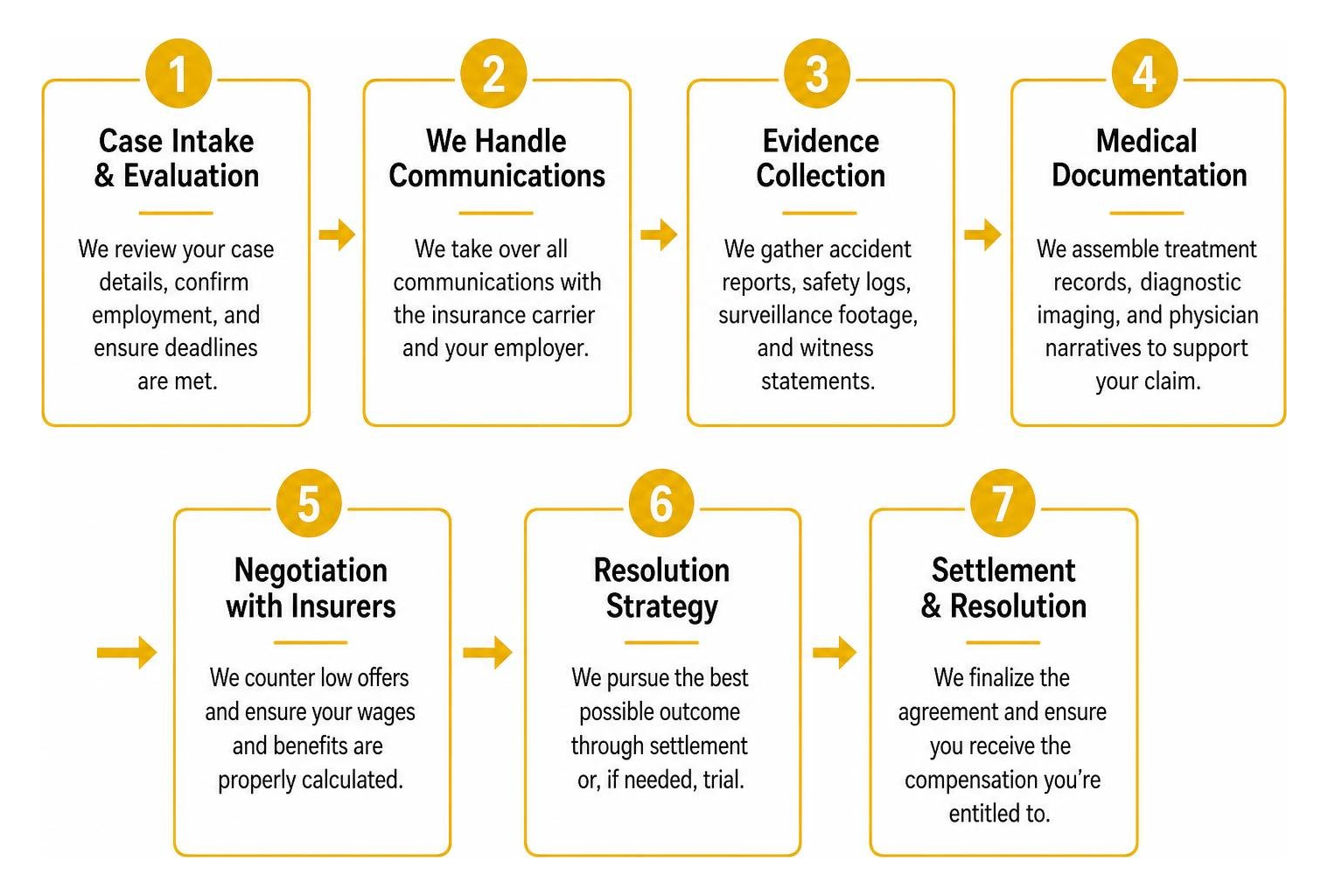
During the initial phase, we evaluate your case details, confirm employment status, and ensure you meet strict statutory deadlines. We take over all direct communications with the insurance carrier and your employer, eliminating the risk of accidental statements that could harm your claim. Our day-to-day responsibilities include:
- Evidence Collection: Gathering accident reports, safety logs, surveillance footage, and witness statements from coworkers.
- Medical Documentation: Assembling treatment records, diagnostic imaging, and physician narratives that substantiate your diagnosis and treatment plan.
- Negotiating with Insurers: Countering low settlement offers and ensuring that calculated average weekly wages reflect your true earnings.
- Administrative and Courtroom Representation: Presenting evidence, cross-examining witnesses, and advocating on your behalf during hearings and formal trials.
Core Duties and Case Management Responsibilities
A workplace injury claim involves much more than standard form submission. It requires detailed statutory interpretation and legal research. Insurance companies employ defense counsel whose sole mission is to minimize payout obligations. We provide a rigorous counterweight by analyzing state statutes, administrative rulings, and procedural rules to establish medical causation and secure indemnity benefits.
Beyond statutory research, we coordinate with independent medical examiners to evaluate permanent impairments and determine the long-term impact on your earning capacity. We prepare you thoroughly for depositions, defend you against intrusive questioning, and manage every stage of the appeals process if an administrative judge rules unfavorably. If you are uncertain about what your benefits should cover, we recommend understanding your true hurt at work compensation and medical coverage to protect your financial stability.
Legal Qualifications, Industry Outlook, and Compensation Benchmarks
The legal profession requires rigorous academic training, professional licensing, and continuous ethical accountability. When you retain legal representation, you are working with an advocate who has spent years mastering civil procedure, evidence rules, and administrative law.
Education, Licensing, and Essential Skills
To practice law, an attorney must complete a four-year undergraduate degree followed by three years of graduate study at an accredited law school to earn a Juris Doctor (J.D.) degree. Law school curricula focus on torts, civil procedure, contracts, and constitutional law. After graduation, candidates must pass a comprehensive state bar examination, undergo an extensive character and fitness evaluation, and complete the Multistate Professional Responsibility Examination (MPRE).
Lawyers must also complete mandatory Continuing Legal Education (CLE) credits annually to maintain active licensing. This ensures counsel remains current on statutory revisions, case precedents, and procedural updates.
Practicing injury law demands specific technical and personal competencies:
- Analytical and Investigative Skills: The ability to distill complex medical records, forensic reports, and technical safety standards into persuasive arguments.
- Oral Advocacy and Negotiation Tactics: Crafting compelling arguments before administrative law judges and knowing when to push back during contentious settlement conferences.
- Digital Case Management: Leveraging advanced case management platforms and electronic discovery tools to track deadlines, manage filings, and preserve crucial evidence.
- Resilience Under Pressure: Managing high-stress caseloads and tight filing deadlines while maintaining clear, empathetic communication with injured clients.
For practical advice on optimizing your documentation early, review these workers comp application tips 2026.
Attorney Salary Trends and Career Growth Projections
The legal sector remains a vital, competitive industry. In 2025, lawyers held approximately 863,700 jobs across the nation. According to the U.S. Bureau of Labor Statistics, the median annual wage for lawyers was $159,670 as of May 2025 (translating to a median hourly wage of $76.76). Earnings vary across industries:
- Federal Government: $178,380 median annual wage
- Legal Services (Private Practice and Law Firms): $157,870 median annual wage
- Local Government: $131,390 median annual wage
- State Government: $115,330 median annual wage
The lowest 10 percent of practitioners earned less than $78,360, while the top 10 percent earned more than $351,600.
Employment of lawyers is projected to grow 5 percent from 2025 to 2035, faster than the average for all occupations. This growth translates to roughly 28,700 projected job openings each year over the decade. Career advancement within the private sector generally follows a structured trajectory: new attorneys begin as junior associates, advance to senior associate roles handling complex trial litigation, and ultimately achieve law firm partnership or establish independent boutique firms.
How to Hire and Work with Legal Counsel for Job Injuries

Hiring the right legal counsel is one of the most critical decisions you will make after an on-the-job accident. The process should begin with verified research rather than selecting the first billboard or television advertisement you see.
Understanding Contingency Fees and Representation Costs
Injured workers often worry that hiring a high-caliber attorney will create an overwhelming financial burden. In workers’ compensation and personal injury law, representation operates on a contingency fee model. This payment framework aligns your attorney’s goals directly with your own recovery, ensuring quality advocacy regardless of your current financial situation.
Under a contingency fee structure:
- You pay zero upfront fees or retainers.
- We only get paid if we recover compensation for you through a settlement or court award.
- Attorney fees are subject to statutory regulation and must be approved by an administrative workers’ compensation judge.
- Litigation expenses (such as expert witness fees, medical record copies, and deposition transcripts) are deducted from the final recovery rather than billed to you out of pocket.
If you want to understand how potential settlements are calculated before speaking with counsel, take time to estimate your workers comp settlement amount.
How to Choose the Right Lawyer for Injury at Work
When evaluating legal representation, focus on local jurisdictional experience, trial readiness, and transparent communication. Workplace injury laws are location-specific; choosing counsel familiar with local administrative judges and hearing offices is essential to building an effective legal strategy.
When interviewing prospective attorneys during your initial consultation, ask these vital questions:
- What percentage of your legal practice is dedicated specifically to workers’ compensation and workplace injuries?
- How often do you take claims to formal trial hearings versus accepting an insurer’s settlement offer?
- Who will be my primary point of contact, and how frequently will I receive updates regarding my case?
- Are you familiar with the specific procedural rules of the local administrative hearing offices in our area?
- How do you handle out-of-pocket litigation costs if the claim becomes heavily contested?
To find experienced legal representation, you can find local workmans comp lawyers near you, connect directly with a workers compensation lawyer in New York, or consult an experienced workers compensation lawyer in Florida.
Frequently Asked Questions About Hiring Workplace Accident Attorneys
For detailed answers to common procedural and benefit questions, visit our comprehensive frequently asked questions hub.
When Do You Need a Lawyer for Injury at Work?
You should retain an attorney if:
- Your employer or their insurance carrier denies your claim entirely.
- Your wage-replacement checks are consistently delayed, miscalculated, or stopped without explanation.
- The insurance company refuses to authorize necessary diagnostic tests (such as MRIs) or recommended surgical procedures.
- The insurer argues that your current disability stems entirely from a pre-existing medical condition.
- Your authorized treating doctor pushes you to return to work before you are physically capable of performing your duties.
- You experience workplace retaliation, demotion, or termination after reporting an injury.
- Your employer improperly classifies you as an independent contractor to avoid providing statutory coverage.
- A negligent third party (such as an equipment manufacturer or subcontractor) contributed to your job-site accident.
How Much Does Legal Representation Cost for On-the-Job Injuries?
Legal representation costs you nothing upfront. Under the contingency fee framework, your attorney receives a regulated percentage of the benefits or settlement obtained on your behalf. All fee agreements are transparent, reviewed in detail during your initial consultation, and submitted for formal administrative approval upon claim resolution. If no compensation is secured, you owe no attorney fees.
Conclusion
An on-the-job injury can disrupt your livelihood, your health, and your family’s financial security. Insurance carriers have teams of claims adjusters and defense lawyers working to protect their bottom line; you deserve dedicated legal advocates fighting for yours. By reporting your claim immediately, preserving thorough medical documentation, and working with experienced counsel, you can protect your rights and recover the full benefits you are owed.
If you have been injured on the job in Florida or New York, contact our team at Workers Compensation Law Firm Panzer Law today for a free, confidential case evaluation.
