

Why Hiring an Injury Lawyer at Work Makes a Critical Difference
Hiring an injury lawyer at work can make the difference between a denied claim and the full medical and wage benefits you deserve. An experienced workers’ compensation attorney protects your rights from day one, handles insurance adjusters, gathers evidence, and fights for maximum recovery while you focus on healing. You can begin by finding local workmans comp lawyers near you who understand the complex rules governing your claim.
When an on-the-job incident turns your routine upside down, dealing with adjusters while managing severe physical pain can quickly feel overwhelming. Many injured employees assume the system is designed to seamlessly take care of them. Unfortunately, workers’ compensation is administered through private insurance carriers whose primary goal is often minimizing claim payouts.
Every year across the United States, roughly 5,000 workplace fatalities occur, and approximately 2.8 million nonfatal workplace injuries and illnesses are reported in private industry. In dangerous environments like building sites, OSHA identifies the “Fatal Four” hazards—falls, struck-by incidents, electrocutions, and caught-in/between accidents—which account for roughly 60% of all construction deaths. In fact, falls alone cause about 42% of construction fatalities. Shockingly, studies show that 54% of workers killed in falls had no access to a personal fall arrest system, and 20% of construction fall deaths occurred within the worker’s first two months on the job.
Beyond construction, back injuries represent the single most common workplace ailment, making up approximately 20% of all work-related injuries across all sectors. With the average lost-time workers’ comp claim costing roughly $42,000 in combined medical expenses and wage replacement, insurance carriers scrutinize every single detail to reduce their financial exposure. Having a dedicated advocate protects your legal rights from day one.
High-Risk Industries and Common Workplace Hazards
Workplace accidents happen in every environment—from corporate offices to busy shipping warehouses—but certain industries carry disproportionately high risks:
- Construction and Demolition: Involving scaffolding collapses, roof falls, trench cave-ins, and heavy machinery mishaps. Around 1,000 construction workers die annually and nearly 200,000 suffer serious injuries.
- Warehousing, Freight, and Logistics: Forklift rollovers, falling pallet racks, loading dock accidents, and crush injuries.
- Manufacturing and Industrial Plants: Inadequately guarded machinery, lack of lockout/tagout protocols, industrial chemical spills, and toxic exposure.
- Healthcare and Nursing Facilities: Repetitive lifting strain, patient transfer back injuries, and slip-and-fall hazards on wet hospital floors.
- Transportation and Field Services: Motor vehicle crashes during deliveries, highway work-zone impacts, and loading equipment failures.
When severe accidents occur due to regulatory lapses, public OSHA citation records and safety logs serve as vital evidence of safety neglect.
The Role of Legal Representation in Insurance Disputes
Insurance adjusters often employ subtle tactics to reduce benefits. They may argue that your herniated disc is a “pre-existing condition,” push you to return to work before your doctor agrees, or delay authorization for crucial surgeries and diagnostic MRIs.
Our legal team steps in to:
- Conduct an independent investigation of the job site and preserve crucial video footage or maintenance records.
- Ensure you follow our practical guide to filing workers comp claims to avoid administrative traps.
- Handle all communications with adjusters so you avoid making recorded statements that could harm your claim.
- Calculate your average weekly wage accurately, including overtime, bonuses, and second jobs.
- Identify potential third-party personal injury liability to pursue damages that workers’ comp cannot provide, such as pain and suffering.
Workers’ Compensation Benefits and Coverage
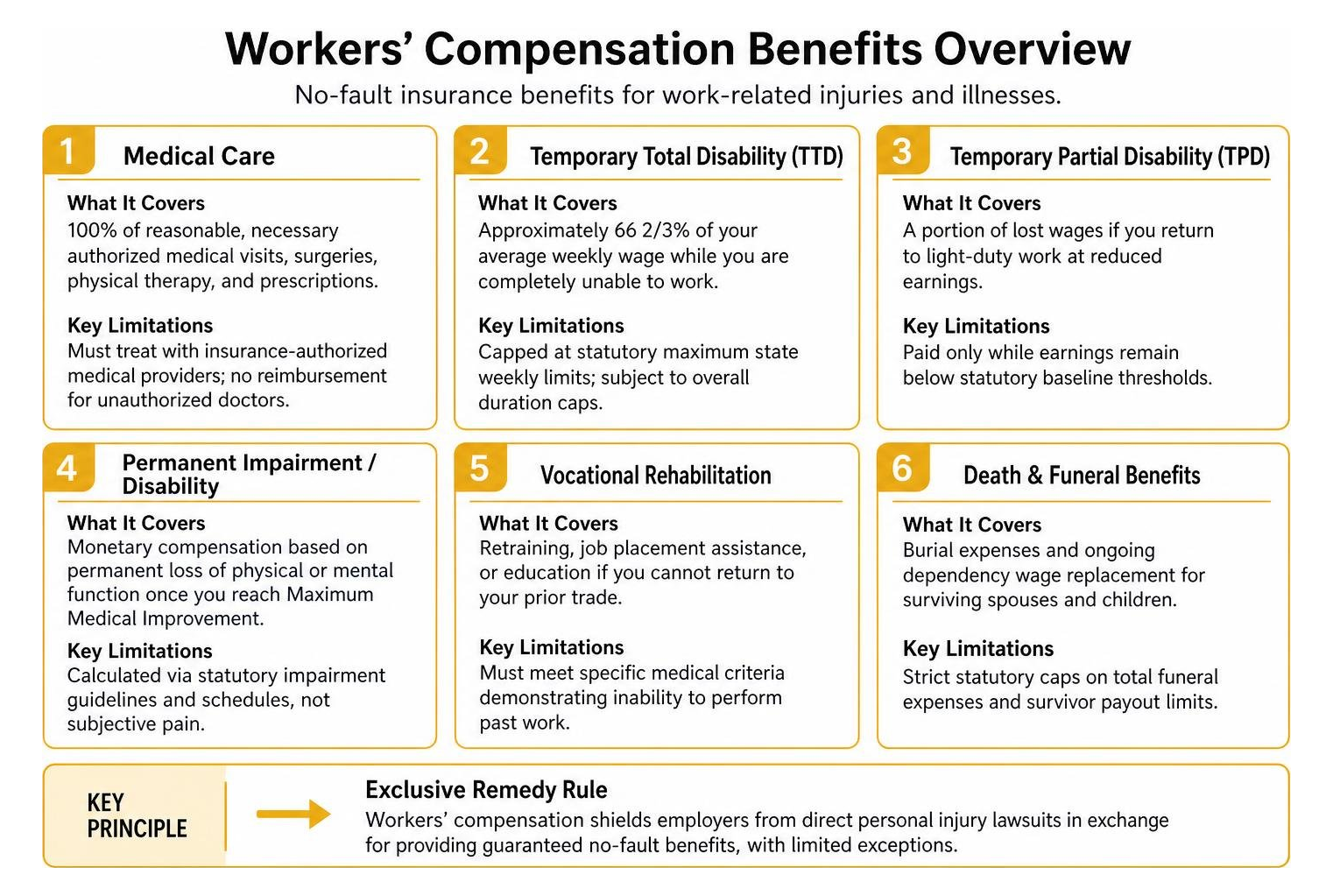
Workers’ compensation is fundamentally a no-fault insurance system. This means that in the vast majority of situations, you do not have to prove your employer was careless or negligent to receive benefits. Even if a momentary lapse in judgment contributed to your slip or fall, you remain entitled to statutory relief.
| Benefit Type | What It Covers | Key Limitations |
|---|---|---|
| Medical Care | 100% of reasonable, necessary authorized medical visits, surgeries, physical therapy, and prescriptions. | Must treat with insurance-authorized medical providers; no reimbursement for unauthorized doctors. |
| Temporary Total Disability (TTD) | Approximately 66 2/3% of your average weekly wage while you are completely unable to work. | Capped at statutory maximum state weekly limits; subject to overall duration caps. |
| Temporary Partial Disability (TPD) | A portion of lost wages if you return to light-duty work at reduced earnings. | Paid only while earnings remain below statutory baseline thresholds. |
| Permanent Impairment / Disability | Monetary compensation based on permanent loss of physical or mental function once you reach Maximum Medical Improvement. | Calculated via statutory impairment guidelines and schedules, not subjective pain. |
| Vocational Rehabilitation | Retraining, job placement assistance, or education if you cannot return to your prior trade. | Must meet specific medical criteria demonstrating inability to perform past work. |
| Death & Funeral Benefits | Burial expenses and ongoing dependency wage replacement for surviving spouses and children. | Strict statutory caps on total funeral expenses and survivor payout limits. |
To understand the full scope of your financial recovery, review our detailed guide on understanding your true hurt at work compensation and medical coverage.
Exclusive Remedy Rule and When You Can Sue Your Employer
Under the “exclusive remedy” rule, workers’ compensation shields employers from direct personal injury lawsuits in exchange for providing guaranteed no-fault benefits. However, critical exceptions exist where an employer or a related entity can be sued outside the workers’ comp system:
- Intentional Torts and Egregious Misconduct: If an employer deliberately engaged in conduct virtually certain to cause injury or death.
- Uninsured / Non-Subscriber Employers: If an employer failed to carry mandatory workers’ compensation insurance, the exclusive remedy shield is stripped away, allowing you to sue them directly in civil court for full damages, including pain and suffering.
- Third-Party Liability Claims: While you generally cannot sue your direct employer, you can file personal injury lawsuits against negligent third parties on the same job site. These third parties include:
- Subcontractors or general contractors who created hazardous conditions.
- Manufacturers of defective power tools, faulty scaffolding, or malfunctioning heavy equipment.
- Negligent third-party drivers who cause a crash while you are driving for work.
- Commercial property owners who fail to maintain safe premises.
How an Injury Lawyer at Work Evaluates Permanent Disability Ratings
Once your medical condition stabilizes and your authorized doctor determines that further treatment will not significantly improve your physical state, you reach Maximum Medical Improvement (MMI). At this stage, the physician assigns a Permanent Impairment Rating (PIR).
This rating—expressed as a percentage of whole-body impairment—directly dictates the duration and financial value of your permanent disability benefits. For example, a severe spinal fusion or an amputated limb yields a substantially higher rating than a minor soft-tissue strain.
Insurance company doctors frequently assign low impairment ratings to minimize their financial liability. When we step in, we review the diagnostic records, cross-examine medical findings, and petition for independent medical examinations when your rating fails to reflect your actual functional limitations and loss of wage-earning capacity.
Immediate Steps to Take After an On-the-Job Accident
The actions you take immediately following a work accident directly impact both your health and your financial recovery.

- Seek Prompt Medical Treatment: If it is an emergency, go straight to the nearest emergency room. Inform the healthcare staff that your injury occurred on the job.
- Notify Your Employer in Writing: Verbally telling a coworker or foreman is not enough. Submit a formal written notice describing the date, time, location, and nature of the accident. Keep a date-stamped copy for your personal records.
- Document the Scene and Injury: Take clear photographs of the hazard that caused the incident (e.g., broken ladders, missing machine guards, oil spills), your visible injuries, and any damaged equipment.
- Collect Witness Information: Write down the names, job titles, and phone numbers of any coworkers or third-party contractors who saw the accident occur.
- Review Practical Application Tips: Ensure you follow essential filing protocols by referencing our workers comp application tips 2026 to avoid unnecessary procedural delays.
Reporting Deadlines and Statutory Filing Requirements
Work injury claims are strictly governed by statutory deadlines. Missing a deadline can result in a complete loss of your right to benefits:
- Notice of Injury to Employer: In states like Florida, you must report your injury to your employer within 30 days of the accident (or within 30 days of when a doctor first diagnoses an occupational disease). In New York, written notice must generally be provided within 30 days.
- Formal Petition / Claim Filing: In Florida, the statute of limitations to file a formal Petition for Benefits is typically 2 years from the date of injury (or one year from the last payment of compensation or authorized medical treatment). In New York, an injured employee must file a formal Employee Claim (Form C-3) within 2 years of the accident date.
- Third-Party Personal Injury Lawsuits: If pursuing a third-party civil claim against an equipment manufacturer or negligent driver, civil statutes of limitations apply (typically 2 to 4 years depending on the jurisdiction and cause of action).
Medical Documentation and Dealing with Insurance Adjusters
The workers’ compensation insurer selects and authorizes your treating medical providers. Receiving care from an unauthorized private physician without prior approval can lead to unpaid medical bills that the insurer refuses to cover.
When speaking with insurance adjusters:
- Do not agree to a recorded statement without consulting an attorney. Adjusters frequently ask misleading questions designed to make you downplay your symptoms.
- Never sign blanket medical authorization releases that give insurers access to your entire lifetime medical history.
- Be aware of your anti-retaliation protections: It is strictly illegal under state laws for an employer to fire, demote, harass, or threaten an employee simply for reporting an injury or filing a valid claim.
You can protect your benefits with the top rated Florida workers comp attorneys who understand how to deal directly with insurance adjusters on your behalf.
When to Consult an Injury Lawyer at Work for Denied Claims
If your claim has been denied, or if the insurer refuses to authorize specialized care, physical therapy, or lost-time wage checks, you must act quickly. Resolving these disputes requires filing formal legal petitions, engaging in structured mediation conferences, and presenting medical evidence before an administrative Judge of Compensation Claims.
For a comprehensive breakdown of how experienced legal counsel manages these disputes, review our top rated workers comp lawyer a practical guide.
Frequently Asked Questions About Workplace Injury Claims
Can undocumented workers receive workers’ compensation benefits?
Yes. Workers’ compensation laws protect injured workers regardless of their immigration status. If you are injured while performing your job duties, you are legally entitled to authorized medical treatment and wage replacement benefits. Employers and insurance carriers cannot avoid paying benefits by citing a worker’s immigration status, nor can they legally threaten deportation or retaliation for reporting a work accident.
How much does it cost to hire legal representation for a job injury?
Reputable workers’ compensation lawyers work on a contingency fee basis. This means you pay no upfront costs, no retainers, and no hourly fees. Attorney fees are only paid if your lawyer successfully secures benefits or recovers a settlement on your behalf. If there is no recovery, you owe nothing. Furthermore, attorney fee percentages in workers’ compensation cases are regulated and capped by state law to protect injured workers.
What benefits may be available beyond standard medical bills and lost wages?
Beyond standard medical coverage and temporary wage replacement, you may qualify for:
- Permanent Impairment or Disability Benefits: Lump-sum or ongoing compensation for lasting physical damage.
- Vocational Rehabilitation Services: State-sponsored retraining, job coaching, and educational assistance if your physical limitations prevent you from returning to your past occupation.
- Third-Party Personal Injury Settlements: Full damages for pain, suffering, emotional distress, and loss of future earning capacity obtained through lawsuits against negligent contractors or equipment manufacturers.
- Death Benefits: Burial expense reimbursement and long-term dependency wage replacement for surviving family members if a workplace accident proves fatal.
Conclusion
A serious workplace accident can disrupt your health, career, and household finances in an instant. Navigating administrative paperwork, statutory deadlines, and aggressive insurance tactics should never stand between you and the comprehensive medical care and wage replacement you deserve.
At Panzer Law, P.A., our legal team brings decades of dedicated advocacy to injured workers across Florida (including Boca Raton, Miami, West Palm Beach, Palm Beach County, and Miami-Dade County) and New York. We operate entirely on a no-recovery, no-fee model, ensuring you have experienced legal representation without any out-of-pocket expenses.
If you or a family member was hurt on the job, contact our dedicated workers’ compensation law firm today for a free, confidential case evaluation to protect your rights and maximize your recovery.
