

How to Start a Workers’ Compensation Claim
Get medical help first if you need it. Then tell your supervisor about the work-related injury or illness as soon as possible. In Florida, you generally have 30 days to report it, but waiting can make it harder to document what happened. Ask your employer how to start the workers’ compensation claim, follow its instructions for authorized medical care, and keep copies of every report, medical note, and message.
If your employer does not report the injury, your care is delayed, or benefits are denied, you can ask the Florida Division of Workers’ Compensation for help or speak with a workers’ compensation attorney. Filing workman’s compensation claim paperwork correctly from the start helps protect your right to medical care and wage-loss benefits.
I’m Gil Panzer, owner and attorney at Panzer Law, P.A., with more than 30 years of legal experience helping injured workers in Florida and New York. My work includes guiding clients through filing workman’s compensation claim forms, getting medical care, and resolving benefit disputes.

Understanding the proper strategies for applying for workers compensation and managing workmans comp claims ensures you do not miss out on vital benefits.
Crucial First Actions After an On-the-Job Injury
When an accident happens on the job, your immediate reactions shape the rest of your case. Taking the proper actions right away protects your physical well-being and preserves your legal right to receive financial recovery.
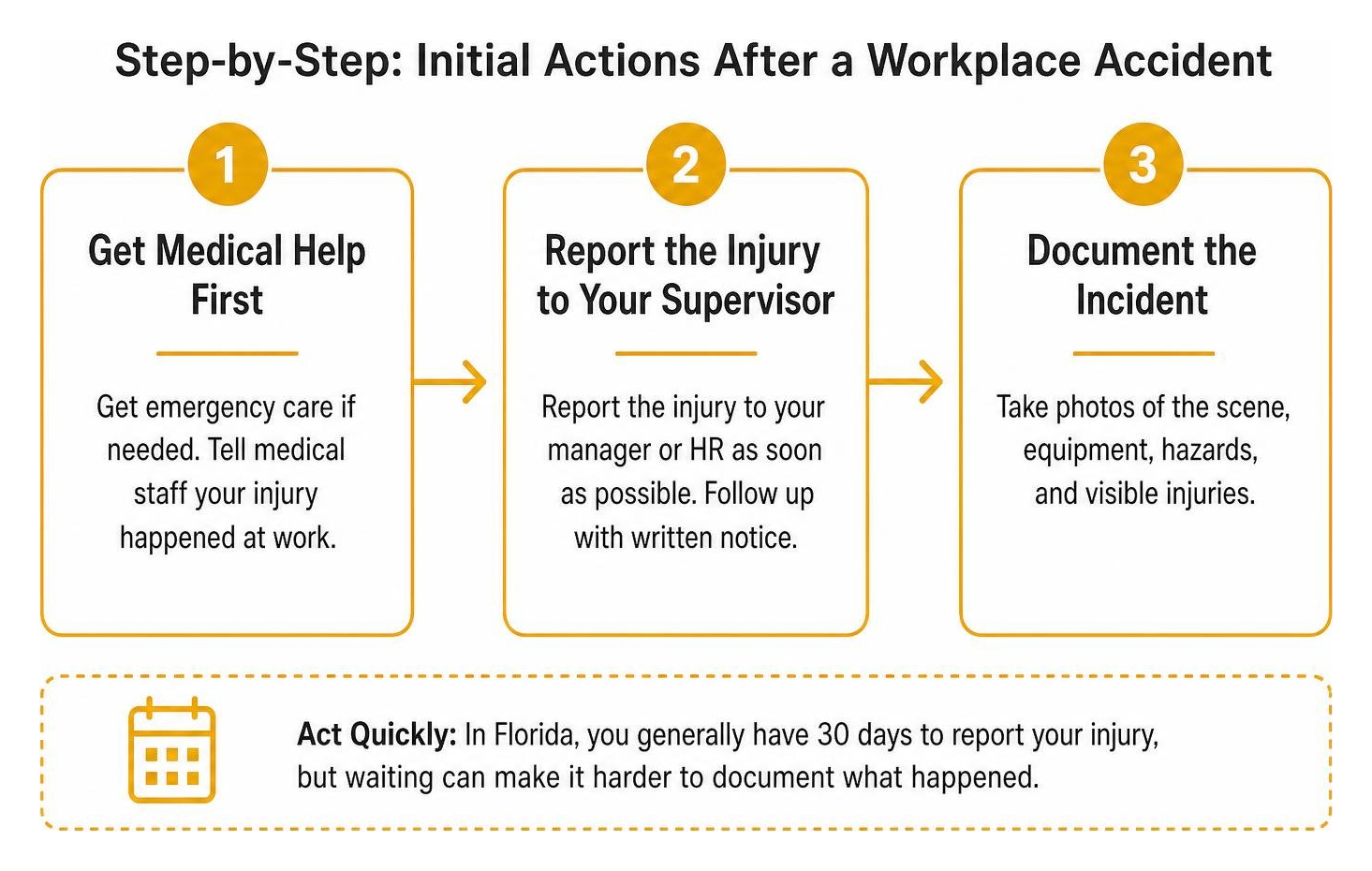
Immediate Steps Before Filing Workman’s Compensation Claim Documents
- Obtain Emergency Medical Care: Your health comes first. If your condition is severe, call 911 or head straight to the nearest emergency room. Make sure to tell the hospital staff that your injury happened at work so they log it accurately.
- Give Formal Notice to Your Supervisor: Tell your manager or human resources representative about the accident as soon as you are stable. While oral notice is common, following up with written notice creates an undeniable record.
- Preserve Physical Evidence and Scene Details: Take photographs of the accident site, faulty equipment, tripping hazards, and your visible injuries.
- Collect Witness Statements: If coworkers or bystanders saw the incident, ask for their contact details and written notes of what they saw before memories fade.
- Log Everything: Maintain a personal notebook tracking every conversation, doctor visit, work restriction, and out-of-pocket expense. For detailed assistance during this phase, check out our guide to filing workers comp claims.
Understanding Statutory Deadlines and Reporting Windows
Deadlines can make or break your claim. In Florida, state law requires you to notify your employer within 30 days of the date of the accident or within 30 days of when a doctor first tells you that your medical condition is job-related. In New York, workers must give written notice to their employer within 30 days of the accident.
Failing to meet these initial notification windows gives insurance adjusters an easy excuse to deny your benefits entirely. After initial reporting, statutory limits govern how long you have to file a formal claim petition if disputes arise.
| State Jurisdiction | Injury Notification Window | Claim Petition Filing Limit | Wage Loss Waiting Period |
|---|---|---|---|
| Florida | 30 Days | 2 Years from Date of Injury | 7 Days (retroactive after 21 days) |
| New York | 30 Days | 2 Years from Date of Accident | 7 Days (retroactive after 14 days) |
Official guidance from regulatory agencies like the Florida Division of Workers’ Compensation outlines how quickly each stage must proceed. Adhering strictly to these timelines keeps your claim viable.
Step-by-Step Protocol for Filing Workman’s Compensation Claim Forms
Once you notify your employer, the administrative paperwork begins. Navigating these forms with precision prevents unnecessary delays in medical care and wage-replacement checks.

Completing Required State and Federal Forms Accurately
The specific paperwork depends on your jurisdiction and employer type:
- Florida State Claims: Your employer or their insurance carrier files the Form DFS-F2-DWC-1 (First Report of Injury or Illness). When you review or complete employee sections of state claim documents, detail every single affected body part. If you injured your lower back and your right knee during a fall, list both. Leaving a body part off the initial paperwork makes it difficult to get insurance coverage for that injury later.
- New York State Claims: Employees injured in New York file Form C-3 (Employee’s Claim for Compensation) with the state board to formally establish their case.
- Federal Employees: Federal personnel operating in regional offices must report injuries through the ECOMP portal, filing Form CA-1 for traumatic, single-shift injuries or Form CA-2 for occupational diseases that develop over multiple shifts.
When submitting forms by mail, send them via certified mail with return receipt requested or deliver them in person and request a signed, dated copy. Having tangible proof of submission eliminates disputes over whether paperwork was received on time. For practical strategies on submitting clean applications, review our workers comp application tips.
Common Mistakes When Filing Workman’s Compensation Claim Petitions
Small filing errors can trigger major administrative headaches. Avoid these frequent pitfalls:
- Vague Descriptions: Writing “hurt back” is far less effective than writing “sharp lower back pain and right leg numbness caused by lifting a 50-pound crate on October 14, 2026.”
- Missing Secondary Symptoms: Failing to report radiating pain, head trauma, or joint stiffness that appears days after the initial impact.
- Failing to Keep Document Copies: Always retain identical photocopies or scanned digital files of every document you submit.
- Seeking Non-Authorized Care: Except in an emergency, seeing your personal family doctor without insurance authorization can leave you responsible for medical bills.
Employer and Insurer Responsibilities After Submission
Once your employer receives notice of your workplace injury, legal obligations shift to them and their insurance carrier.
Medical Authorization and Healthcare Provider Network Rules
In Florida, your employer’s insurance carrier has the legal right to select your treating physician. You must treat with an authorized provider within their network for bills to be covered.
If your employer or insurer delays approving your care, Florida law requires timely provision of necessary treatment. To learn more about treatment guidelines and financial safeguards, explore our resource on medical coverage and hurt at work compensation.
Response Timelines and Claim Status Notifications
After your employer submits the first report of injury to their insurer:
- Carrier Status Acknowledgment: The claims administrator must open a file, review the accident details, and issue an initial status determination or explanatory letter.
- Acceptance or Investigation: The insurer typically has an initial window to accept the claim, pay benefits under a reservation of rights, or issue a formal denial.
- Written Justification for Denials: If the insurance company decides to contest your claim, it must provide a written notice explaining the factual and legal reasons for the denial.
Securing Medical Care and Wage Replacement Benefits
Workers’ compensation benefits are designed to address two primary concerns: paying for your medical recovery and replacing a portion of lost income.
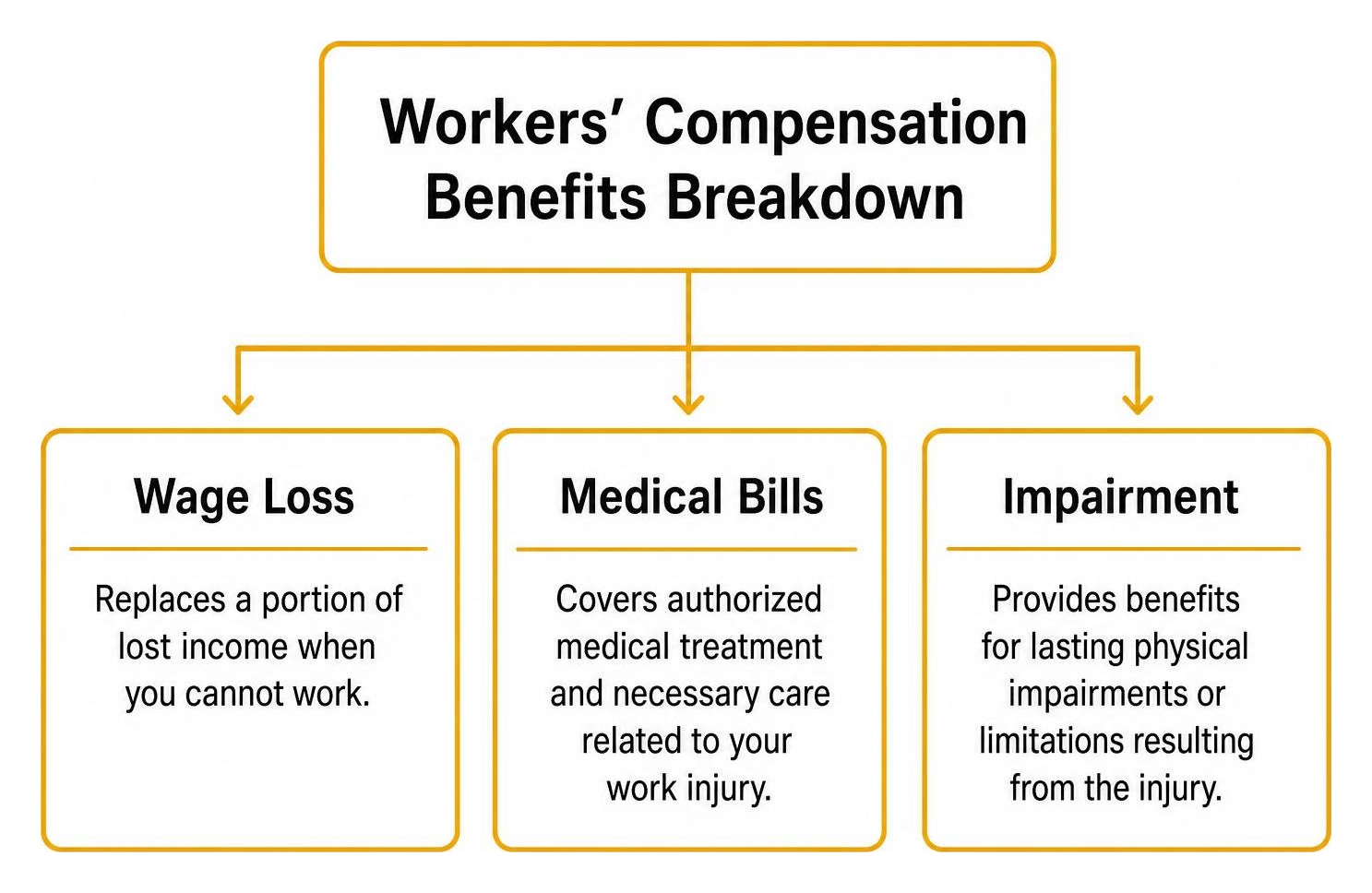
Types of Disability Payments and Wage Loss Compensation
Wage-replacement benefits are calculated based on your Average Weekly Wage (AWW), which considers your earnings across the 13 weeks preceding the accident:
- Temporary Total Disability (TTD): If your authorized doctor states you cannot work at all, you receive 66 2/3% (two-thirds) of your average weekly wage, subject to state statutory maximums. Certain severe injuries may qualify for up to 80% of your AWW for an initial period.
- Temporary Partial Disability (TPD): If you can return to work on light duty but earn less than 80% of your pre-injury wage, TPD benefits make up a percentage of the difference.
- Permanent Impairment Benefits (IB): Once you reach Maximum Medical Improvement (MMI)—the point where your condition is not expected to improve further—an authorized physician assigns a permanent impairment rating, which determines the duration and amount of additional financial compensation.
If your injury causes lasting physical limitations, you may eventually consider resolving your case through a lump-sum agreement. You can learn more about how value is calculated by reviewing our guide on estimating a workers comp settlement.
Navigating Claim Denials and Dispute Resolution
If your claim is denied, you do not have to accept the insurance company’s decision as final. The dispute resolution process involves several key legal steps:
- Notice of Denial: Review the insurance carrier’s formal denial letter to see why they refused the claim (e.g., alleging the injury did not occur during the course of employment, or asserting late reporting).
- Petition for Benefits (PFB): In Florida, your attorney files a formal Petition for Benefits with the Office of the Judges of Compensation Claims (OJCC) to demand unpaid medical care or indemnity checks.
- State-Mandated Mediation: Most disputes proceed to an informal mediation conference where both parties attempt to resolve disagreements before a neutral mediator.
- Final Hearing: If mediation does not resolve the dispute, a Judge of Compensation Claims hears testimony, reviews medical records, and issues a binding legal ruling.
Working with a top-rated workers comp lawyer levels the playing field against insurance carriers and their defense teams.
Frequently Asked Questions About Filing Workman’s Comp Claims
How long does an insurer have to accept or deny my claim?
In Florida, once an employer reports an injury, the insurance carrier must promptly investigate. Insurers often elect to pay benefits under a “pay and investigate” provision for up to 120 days while deciding whether to formally accept or deny compensability.
Can I choose my own doctor for workers’ compensation treatment?
Under Florida workers’ compensation laws, the employer’s insurance carrier selects and authorizes your treating medical providers. If you treat with an unauthorized doctor, the insurer will generally refuse to pay those medical bills. However, Florida law allows you a one-time change of physician during the life of your claim.
What should I do if my employer refuses to report my injury?
If your employer refuses to submit your injury report to their insurer, contact the state division or an experienced attorney immediately. You can file a formal claim independently and provide written notice to prevent your employer from blocking your access to benefits.
Conclusion: Protecting Your Rights Throughout the Process
Filing a workers’ compensation claim should be straightforward, but insurance adjusters and complex paperwork often stand in the way of injured workers getting the care they need.
At Panzer Law, P.A., we represent injured workers across South Florida—including Boca Raton, Miami, West Palm Beach, Palm Beach County, and Miami-Dade County—as well as clients in New York. We operate on a strict contingency fee model: you pay no attorney fees or legal costs unless we recover money for you.
If you were hurt on the job and need help securing medical treatment or lost wages, connect with our dedicated Florida workers’ compensation lawyers today for a free, confidential consultation.
